
The Quantum Internet Already Has Infrastructure. The Race Is Now About Who Controls the Stack.
A live quantum network is running beneath New York City. The question now is who owns each layer.
By Rabbt | May 15, 2026
Most of the coverage around quantum networking focuses on the wrong question. People keep asking when the quantum internet will arrive. The more useful question is who already controls the infrastructure layer that will carry it.
In February 2026, Cisco, Qunnect, and NYU demonstrated entanglement swapping across 17.6 kilometers of existing telecom fiber beneath New York City, achieving swapping rates of more than 5,400 entangled pairs per hour at greater than 99% polarization fidelity. That number is nearly 10,000 times better than prior benchmarks on similar platforms. The physics worked in the real world. The structural question is who owns the stack once it scales.
| Want more Frontier Economy intelligence? Follow the research as it develops. Subscribe to Rabbt on Substack at rabbt.substack.com. |
The Frontier Economy Context
Quantum networking is not a single product. It is a stack, and different companies control different layers of it. At the physical layer, you need hardware that can generate, stabilize, and route entangled photons across real-world fiber, fiber that vibrates, shifts temperature, and degrades signal quality in ways a controlled lab never will. At the coordination layer, you need software that can synchronize geographically separated nodes with picosecond timing accuracy. At the compute layer, the longer-term vision involves connecting quantum computers across cities, enabling distributed quantum computing that no single machine could achieve alone.
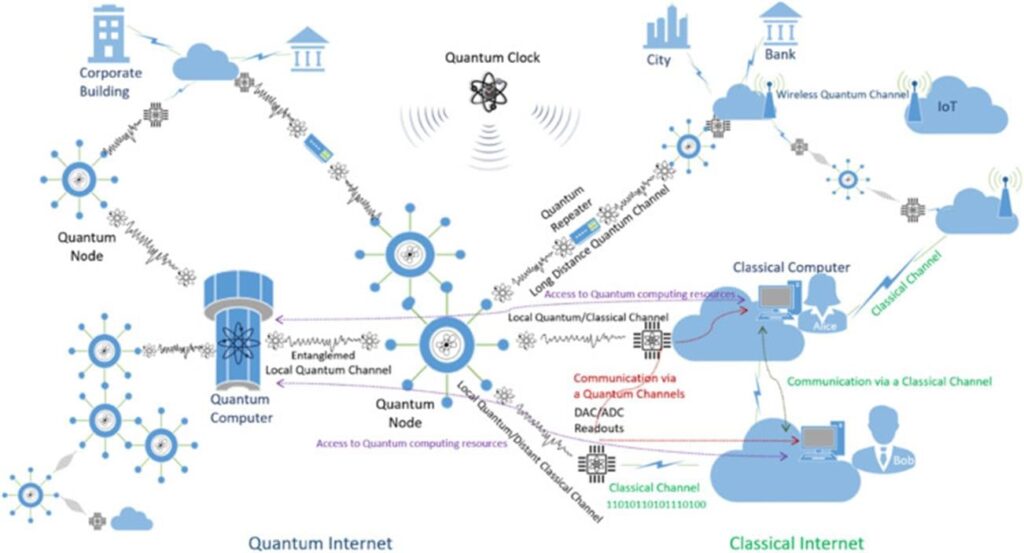
The New York demonstration validated all three layers working together in a live metropolitan environment. The hub-and-spoke architecture used a commercial data center at 60 Hudson Street in Manhattan as the central node, with two outlying nodes at Qunnect’s Brooklyn Navy Yard facility. Because the system used standard telecom fiber already in the ground, rather than purpose-built quantum infrastructure, the deployment math changes entirely. The path to commercial quantum networking does not require replacing existing fiber. It requires layering quantum hardware and software on top of what already exists.
Governments are not waiting. China operates a 2,000-kilometer quantum communication network connecting Beijing and Shanghai. The European Union is building EuroQCI, a continent-wide quantum communications infrastructure. The U.S. Department of Energy is funding quantum internet prototypes. The race is not theoretical. The infrastructure investments are already being made.
Company Intelligence
Cisco Systems (Ticker: CSCO)
Ticker: CSCO Market Cap: ~$381B Role: Orchestration software, coordination layer
Cisco contributed the orchestration software that synchronized all three nodes in the New York demonstration. The company describes its role as a digital air traffic controller for the network, coordinating Qunnect’s hardware across geographically separated nodes using the White Rabbit timing protocol for picosecond-level synchronization. Cisco does not manufacture quantum hardware. It controls the coordination layer, which is the part of the stack that determines whether a quantum network functions as an integrated system or remains a collection of isolated experiments.
Cisco’s quantum networking position currently depends on hardware partners, primarily Qunnect, to supply the physical layer. If the hardware landscape consolidates around a different photonics standard or if a competitor builds an integrated hardware-software solution, Cisco’s coordination layer advantage narrows. Cisco Investments participated in Qunnect’s oversubscribed $10M Series A extension in June 2025, creating a financial stake in ensuring Qunnect’s hardware layer succeeds.
What to Watch: Whether Cisco announces a standalone quantum networking product line targeting enterprise or government customers. That would signal a shift from infrastructure partner to direct market participant.
Qunnect (Private)
Stage: Series A Total Funding: ~$24.7M Investors: Airbus Ventures, Cisco Investments, Quantonation
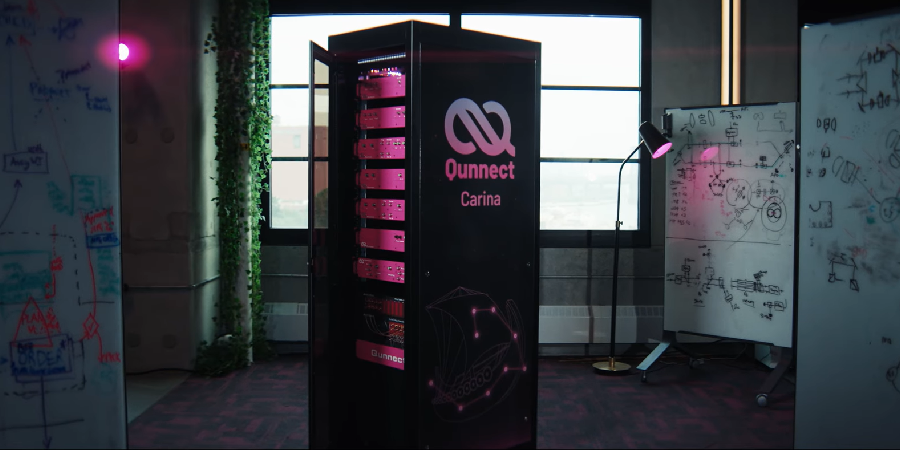
Qunnect controls the physical layer. Its Carina product suite generates entangled photon pairs, stabilizes polarization across real-world fiber using Automatic Polarization Controllers, and operates at room temperature at the outlying spoke nodes. That is a critical cost advantage because cryogenic cooling is only required at the central hub node, not at every endpoint. That architectural decision directly affects deployment economics and the speed at which a hub-and-spoke quantum network can expand to new endpoints.
The GothamQ demonstration was not a controlled experiment. It ran on what Qunnect’s co-founder and chief scientist described as some of the noisiest, most chaotic fiber on Earth. The system maintained greater than 99% polarization fidelity throughout. Qunnect has also deployed a quantum network in Berlin in partnership with Deutsche Telekom’s T-Labs, giving it a second live metropolitan testbed outside the United States.
What to Watch: Whether Qunnect closes commercial contracts with financial institutions or government agencies. Manhattan was chosen specifically because of the density of financial infrastructure within a five-mile radius. The first signed commercial customer in that sector would be a meaningful signal.
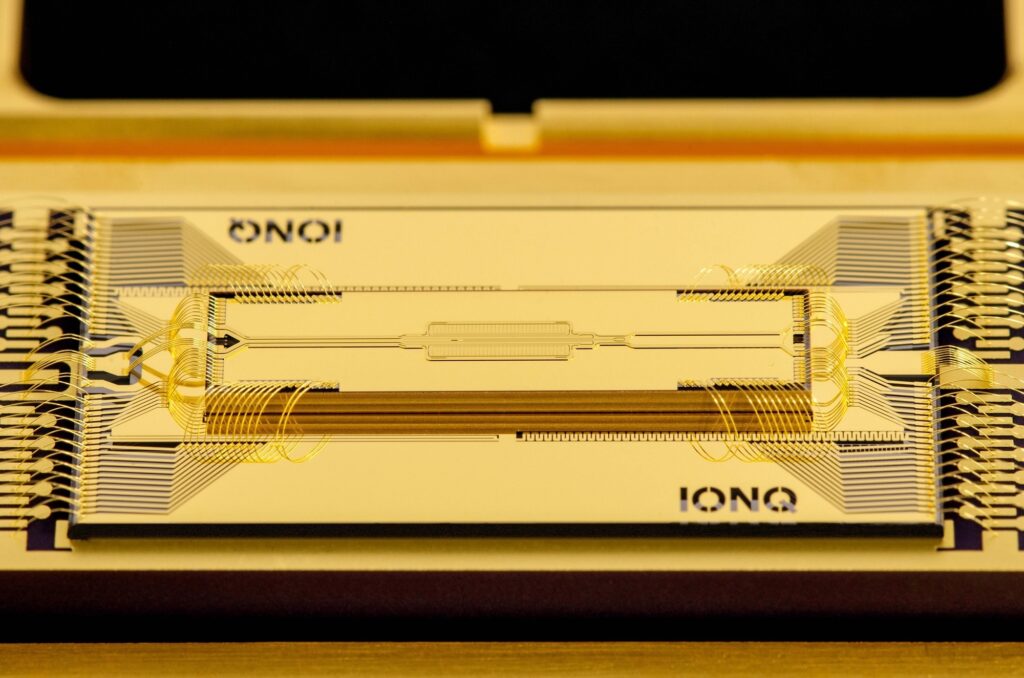
IonQ announced its plan to use barium ions as qubits in its systems, bringing about a wave of advantages it believes will enable advanced quantum computing architectures.
IonQ (Ticker: IONQ)
Ticker: IONQ Price: ~$56.81 (May 11, 2026) Market Cap: ~$21.2B 52-Week Range: $25.89 to $84.64 Q1 2026 Revenue: $64.7M (+755% YoY)
IonQ is building toward the compute layer of the quantum internet, not the communication layer. The company’s $22M partnership with EPB in Chattanooga, Tennessee, to establish the first U.S. quantum computing and networking hub positions IonQ as the anchor tenant of distributed quantum infrastructure. The SkyWater Technology acquisition, approved by shareholders in May 2026, is aimed at bringing chip fabrication in-house, which matters for supply chain security and for government customers who require domestic manufacturing provenance.
IonQ reported record Q1 2026 revenue of $64.7M, up 755% year over year, and raised its full-year outlook to $260M to $270M. The company also acquired Lightsynq, which develops long-distance quantum repeaters, and Capella Space, which adds satellite-based capabilities. Each acquisition adds strategic optionality but also integration complexity. Additionally, DARPA contracts around quantum interconnects and diamond-based memories are directionally aligned with IonQ’s modular networking roadmap.
What to Watch: Whether the EPB Chattanooga hub generates a second commercial quantum networking partnership. The first U.S. quantum hub designation means little if it remains a single installation. Replication is the structural test.
Comparison: Quantum Networking Stack Positions
| Company | Role in Stack | Structural Position | Key Dependency | What to Watch |
|---|---|---|---|---|
| Cisco (CSCO) | Orchestration software | Controls the coordination layer that ties quantum nodes together as an integrated system | Reliant on hardware partners like Qunnect for signal generation; a competing integrated solution narrows this advantage | Whether Cisco builds a standalone quantum networking product line or remains a picks-and-shovels partner |
| Qunnect (Private) | Quantum hardware, signal stabilization | Controls the physical layer: entanglement sources and polarization management in real urban fiber at commercial scale | Dependent on commercial fiber infrastructure and data center partners; limited funding runway at ~$24.7M total raised | First signed commercial contract in financial services or government; Series A runway vs deployment timeline |
| IonQ (IONQ) | Quantum computing, networking integration | Positioned at the compute layer; moving toward distributed quantum computing across networked nodes via EPB hub and acquisitions | Dependent on SkyWater acquisition integration and EPB Chattanooga hub operationalizing as a proof point | Whether EPB hub generates a second commercial quantum networking partnership; SkyWater integration execution |
The Honest Tension
The New York demonstration was a three-node proof of concept. The swapping rate of 5,400 entangled pairs per hour over deployed fiber is a record, but it is also a rate that needs to improve significantly before quantum key distribution becomes practical at commercial throughput. Quantum repeaters, the technology required to extend quantum networks beyond metropolitan distances, are still in development.
There is also a timing risk that is difficult to quantify. Post-quantum cryptography, the classical approach to making existing encryption quantum-resistant, is advancing in parallel. NIST finalized its first post-quantum cryptographic standards in 2024. If post-quantum cryptography proves good enough to protect most data most of the time, the urgency of quantum networking infrastructure could plateau before it reaches mass deployment. The companies building the physical quantum internet are betting that entanglement-based security becomes the required standard for the most sensitive communications. That is plausible. It is not guaranteed.
Additionally, the hub-and-spoke architecture solves the city-scale problem but does not solve the intercontinental problem. The gap between a metropolitan demonstration and a global quantum communication network involves technology, economics, and geopolitical cooperation that does not yet exist.
| Rabbt Intelligence NoteA structured Research File on Qunnect would map its polarization stabilization technology against the evidence of sustained 99% fidelity in a live metropolitan environment, and flag the first signed commercial contract in financial services or government as the change trigger most likely to shift this picture from demonstration to deployment. The Relationship Graph would show that Cisco Investments sitting inside Qunnect’s cap table creates a structural dependency that most coverage on either company misses entirely: Cisco has an economic incentive to ensure Qunnect’s hardware layer succeeds, because Qunnect’s failure removes the primary validation of Cisco’s quantum orchestration software in deployed environments. The open question: does the hub-and-spoke architecture scale to twenty metropolitan nodes before a better-funded competitor with integrated hardware and software emerges from stealth? |
0 Comments