
The quantum computing story has been told as a future event for twenty years. That framing is now wrong. It was not wrong because the technology suddenly arrived fully formed. It was wrong because the market stopped waiting for a single transformational moment and started paying for specific things quantum hardware can do today. Ford’s manufacturing subsidiary in Turkey is scheduling vehicle production runs. Japan’s largest mobile operator is optimizing network congestion. A Fortune 100 company signed a six-figure enterprise license in early 2026. These are not proofs of concept. They are production deployments. The question for analysts covering the frontier economy is not whether quantum computing will commercialize. It is which structural positions survive the transition from government-funded research to enterprise revenue.
Three structural shifts defined the quantum computing landscape heading into 2026. First, the U.S. government converted from passive funder to active procurement partner. DARPA’s Quantum Benchmarking Initiative, DARPA’s HARQ program for networked quantum systems, the Missile Defense Agency’s SHIELD IDIQ contract, and the Air Force Research Laboratory’s superconducting networking contract all landed in 2025 and early 2026. Government money is no longer purely R&D funding. It is tied to deliverables.
Second, the hardware gap between the leading players widened. IonQ’s trapped-ion approach produced a 202% revenue increase in 2025, with Q4 revenue of 1.9 million beating consensus by 53%. D-Wave’s annealing architecture generated 179% revenue growth on the back of real enterprise deployments. Rigetti, using superconducting qubits, posted .1 million in full-year 2025 revenue. All three are public, all three are burning cash, and all three are betting on different technical approaches reaching commercial scale first.
Third, enterprise procurement patterns shifted. The early customer profile was research institution and government lab. The 2025 and 2026 customer profile includes Forbes Global 2000 manufacturers, logistics operators, pharmaceutical companies, and financial institutions. That shift changes the revenue durability picture. Government contracts end. Enterprise software and services relationships compound. How quickly each company converts its technical approach into enterprise-grade product is the structural question that matters most right now.
IonQ (NYSE: IONQ) | ~$47 | Market Cap: ~$17B
Structural Position
IonQ controls the most commercially developed trapped-ion quantum computing platform in the public market. Trapped-ion systems use individual atoms as qubits, which produces higher native gate fidelity than superconducting approaches at current qubit counts. Fidelity determines whether computation results are useful or noise. IonQ has converted that technical position into the broadest enterprise deployment footprint among pure-play quantum companies: systems installed in South Korea, Europe, and the United States, revenue across more than 30 countries, and international markets representing over 30% of total revenue. Additionally, it operates on AWS Braket, Microsoft Azure, and Google Cloud, which means enterprise procurement does not require a capital hardware decision.
Key Dependencies
IonQ’s 2026 revenue guidance of 25 to 45 million rests on a 70 million remaining performance obligation backlog. That backlog needs to convert to recognized revenue through contract execution. The two government contracts that matter most structurally are the DARPA HARQ program, which focuses on linking different types of quantum computers into networked systems, and the Missile Defense Agency’s SHIELD IDIQ. IonQ Federal is the vehicle designed to convert that government access into task order revenue. A separate dependency is the QuantumBasel Switzerland partnership, worth over 0 million and extended through 2029, which is the clearest example of what a multi-year enterprise anchor looks like. If that structure replicates across other geographies, backlog converts predictably. If contract execution slips, the 2026 guidance number becomes unreachable.
Recent Signal
In April 2026, IonQ won the DARPA HARQ contract, focused on building networked quantum systems. That followed a February win on the Missile Defense Agency’s SHIELD IDIQ. Both contracts position IonQ Federal as the primary vehicle for government quantum procurement. On the commercial side, IonQ reported that more than 60% of revenue now comes from commercial customers. The company also launched InSAR capabilities in May 2026, enabling automated millimeter-scale Earth monitoring applications for geospatial and defense customers. That is a product launch into a specific, identifiable market, not a general-purpose capability announcement.
What to Watch
Two milestones carry structural weight. First, the Q1 2026 earnings report, released May 6, will test whether IonQ’s 25 to 45 million full-year guidance holds after one quarter of actual commercial execution. Second, whether IonQ Federal converts SHIELD and HARQ program wins into task order revenue by Q3. Government program wins do not automatically produce revenue. Task order execution does.
D-Wave Quantum (NYSE: QBTS) | ~$21 | Market Cap: ~$7.75B
Structural Position
D-Wave controls the most commercially proven position in quantum computing, measured by production deployments with enterprise customers. Its annealing architecture is purpose-built for optimization problems: scheduling, logistics, network management, molecular simulation. That is not a limitation. It is a positioning decision. Annealing quantum computers do not do everything. However, what they do, they do better than classical alternatives at scale, and D-Wave has the customer evidence to prove it. Ford’s Turkey manufacturing subsidiary reduced vehicle scheduling time from 30 minutes to under 5 minutes per 1,000-vehicle run. Japan’s largest mobile operator, NTT DOCOMO, deployed D-Wave’s solver across 250,000 base stations with a 15% improvement in network performance. The Port of Los Angeles used D-Wave technology to handle 60% more cargo per crane per day.
Key Dependencies
D-Wave’s January 2026 acquisition of Quantum Circuits, a gate-model quantum computing company, is the key structural move to understand. Annealing is commercially proven but structurally limited to optimization. Gate-model is where general-purpose quantum computation lives. D-Wave is now the only public company building both. That dual-platform strategy expands the total addressable market but also adds integration execution risk. The key dependency is whether the Quantum Circuits gate-model capability can be commercialized at the same pace as the annealing business. A second dependency is bookings momentum: January 2026 alone produced over 0 million in bookings, which exceeded all of 2024’s full-year bookings total. That momentum needs to hold through Q2 for the FY2026 revenue ramp to materialize.
Recent Signal
D-Wave’s Q1 2026 earnings report, scheduled for May 12, will be the first clean look at post-acquisition financial structure. Before that, the company announced a 0 million system sale to Florida Atlantic University and a 0 million two-year enterprise QCaaS agreement with a Fortune 100 company, both closed in early 2026. Revenue from over 135 individual customers in FY2025, including over two dozen Forbes Global 2000 companies, gives D-Wave the broadest real-world deployment evidence in the sector. The company is also planning its first-ever Investor Day at the New York Stock Exchange, a signal about where management believes the company sits in its maturity curve.
What to Watch
Two events define the picture. First, whether the May 12 earnings report shows Q1 2026 bookings maintaining the January pace. A slowdown after January’s 0 million surge would raise questions about whether that figure was seasonal or structural. Second, whether D-Wave’s gate-model integration produces a credible commercial roadmap in 2026. Combining annealing and gate-model into a coherent enterprise offering requires more than an acquisition. It requires a product architecture, and that will show up in customer conversations before it shows up in revenue.
Rigetti Computing (Nasdaq: RGTI) | ~$18 | Market Cap: ~$6.1B
Structural Position
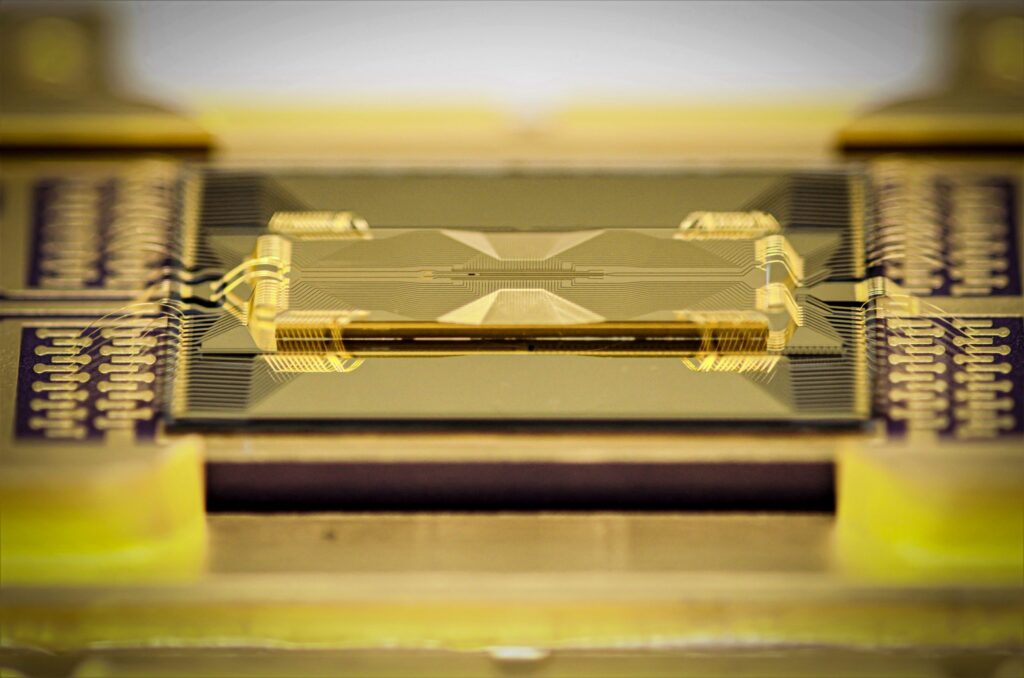
Rigetti controls the most advanced superconducting chiplet architecture in the public quantum market. Its Fab-1 facility in Berkeley is the only dedicated, integrated quantum device manufacturing facility operated by a public company. That vertical integration matters because manufacturing yield is a primary constraint on scaling superconducting systems. Rigetti’s chiplet approach addresses the scaling problem differently than competitors: instead of building larger monolithic chips, it links smaller modules together. The 108-qubit Cepheus system, launched in April 2026, is now available via Rigetti Quantum Cloud Services and Amazon Braket. A 336-qubit Lyra system is targeted for late 2026, and a 1,000-plus qubit system is targeted for 2027.
Key Dependencies
Rigetti’s revenue is structurally dependent on government and research institution contracts. Full-year 2025 revenue was .1 million, down 56% from 2024, because revenue recognition is tied to system delivery timing rather than recurring subscriptions. The .4 million contract from India’s Centre for Development of Advanced Computing for a 108-qubit on-premises system is the largest single commercial contract Rigetti has announced relative to its revenue base. That deal alone exceeds full-year 2025 revenue. A second structural dependency is the Quanta Computer partnership, which includes a 00 million, five-year manufacturing commitment alongside a 5 million Quanta investment. That relationship de-risks the manufacturing scale problem but adds a dependency on Quanta’s execution.
Recent Signal
In April 2026, Rigetti expanded its R&D footprint at Berkeley Lab by signing a new sublease, a quiet operational signal that the company is investing in capacity ahead of the Lyra 336-qubit launch. The Cepheus-1-108Q general availability launch in April 2026 represents Rigetti’s highest qubit-count commercial offering, now accessible on cloud and via the C-DAC India on-premises order. NVIDIA’s launch of open-source Ising quantum AI models in April 2026 also provided external validation of the optimization approaches that underpin Rigetti’s hardware roadmap.
What to Watch
The Q1 2026 earnings report, scheduled for May 18, will answer whether revenue recovered from the Q4 2025 miss. A quarter at million or above confirms the C-DAC contract and Novera QPU shipments are converting to recognized revenue. Below million raises structural concerns about revenue consistency. The second milestone is Lyra 336-qubit delivery. Rigetti has pushed back hardware milestones before. On-time Lyra delivery in late 2026 would be the first concrete step toward the qubit count where narrow quantum advantage on commercial problems becomes demonstrable.
Company Comparison
| IonQ (IONQ) | D-Wave (QBTS) | Rigetti (RGTI) | |
| Ticker | NYSE: IONQ | NYSE: QBTS | Nasdaq: RGTI |
| Price (May 6, 2026) | ~$47 | ~$21 | ~$18 |
| Market Cap | ~$17B | ~$7.75B | ~$6.1B |
| Hardware Approach | Trapped ion | Annealing + gate-model (post-QCI acquisition) | Superconducting chiplet |
| 2025 Revenue | ~$130M (202% YoY) | ~$24.6M (179% YoY) | ~$7.1M (-56% YoY) |
| 2026 Revenue Guidance | $225-$245M | Not formally guided; bookings $30M+ in Jan alone | ~254% growth expected per analysts |
| Key Structural Position | Largest pure-play by revenue; enterprise + government deployments across 30+ countries | Only dual-platform public quantum company; most production deployments by use case | Only public company with a dedicated quantum chip fab; chiplet architecture for modular scaling |
| Key Dependency | DARPA HARQ + SHIELD task order execution; backlog to revenue conversion | Quantum Circuits gate-model integration; Q1 2026 bookings pace | Lyra 336Q delivery timeline; C-DAC India revenue recognition |
| What to Watch | Q1 2026 earnings May 6; IonQ Federal task order wins | May 12 Q1 earnings; gate-model commercial roadmap | May 18 Q1 earnings; Lyra milestone delivery |
The commercial traction is real, but the gap between current revenue and current valuations is also real. IonQ’s market cap is approximately 130 times trailing revenue. D-Wave trades at over 300 times trailing revenue. Rigetti’s 2025 revenue base is smaller than its single largest announced contract. These are not companies being valued on what they earn today. They are being valued on where quantum computing lands in three to seven years. That creates a structural vulnerability: any delay in the hardware roadmap, any quarter of weaker-than-expected bookings, or any shift in government procurement priority can compress valuations faster than the underlying technology changes. Additionally, the commercial use cases that exist today, optimization, scheduling, logistics, are already partially served by classical and AI-enhanced approaches. The advantage quantum provides in those domains is real but not always decisive. The use cases where quantum provides unambiguous advantage, cryptography, drug discovery at molecular scale, materials simulation, are still several years from production deployment. The frontier economy opportunity is in understanding which structural positions survive that transition before the market prices it in.
Rabbt Intelligence Note
A structured Research File on IonQ would map the $370 million remaining performance obligation backlog against Q1 2026 revenue recognition, and flag IonQ Federal’s SHIELD and HARQ task order conversion rate as the condition most likely to shift the commercial picture in 2026. The Relationship Graph would show the three-way dependency structure between IonQ’s trapped-ion hardware roadmap, its cloud distribution agreements with AWS, Azure, and Google, and its government contract pipeline, three revenue streams with very different durability profiles that most coverage treats as a single commercial story. The open question: if IonQ’s Q1 2026 earnings confirm the commercial customer mix crossing 60% of revenue, does the government contract dependency become a ceiling on growth or an insurance policy against enterprise churn?
0 Comments