
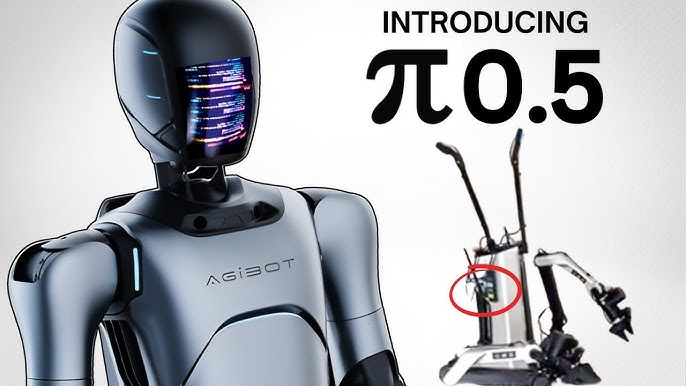
Here’s Who Controls the Physical AI Layer
The race to commercialize autonomous robotics has a hardware problem, a data problem, and a manufacturing problem. The companies solving all three at once are building the stack everyone else will depend on.
By Rabbt | May 22, 2026
The demos are real. That was always going to be the easy part.
What most coverage of the autonomous robotics moment keeps missing is the difference between a robot that performs well in a curated environment and a robot that performs well enough to anchor a commercial contract. Figure AI ran its second-generation robot at BMW’s Spartanburg plant for eleven months. It loaded more than 90,000 parts, contributed to the production of 30,000 vehicles, and ran every single working day. That is not a demo. That is a data acquisition program disguised as a deployment, and it produced the engineering intelligence that went directly into the redesign of Figure 03. The frontier economy does not reward the flashiest robot. It rewards the company that controls the learning loop.
The Infrastructure Behind the Moment
The robotics sector raised roughly $38 billion in 2025. That is not a vote for humanoids in everyone’s living room by next year. It is a structural bet that the physical AI layer underneath the next generation of manufacturing, logistics, and defense operations will be a winner-take-most position, and that whoever controls it will capture disproportionate value for years.
Several structural forces have converged in 2026. First, NVIDIA’s GR00T platform and the Isaac simulation environment have made it significantly cheaper to train robot models at scale, which has compressed the development cycle for foundation model companies. Second, the EgoScale paper published in February demonstrated that robot policy performance scales predictably with training data, the first strong evidence that robotics follows the same data-driven improvement curves that defined large language models. Third, the cost gap between Western and Chinese-manufactured humanoid units has become a genuine commercial variable. Western units currently run between $90,000 and $100,000 per unit according to Bank of America’s 2026 analysis. Chinese units carry a bill of materials cost closer to $35,000. That gap will force every serious Western player to think hard about manufacturing efficiency, not just model performance.
The Frontier Economy companies worth watching are not the ones with the best demos. They are the ones that have figured out which layer of the stack to own.
| Rabbt Research Deep-dive analysis on frontier economy companies. Structural position, dependency mapping, and what to watch, before the narrative forms. Subscribe at rabbt.substack.com |
Figure AI: The Full-Stack Bet
Private. Last valuation: $39B (Series C, September 2025). Total funding: approximately $1.9B. Investors include NVIDIA, Brookfield Asset Management, Parkway VC, Microsoft, OpenAI Startup Fund, Jeff Bezos.
Figure AI is making a different bet than most of its competitors. Rather than licensing a foundation model to run on other companies’ hardware, Figure is building everything: the robot body, the AI model, the manufacturing facility, and the commercial deployment contract. The company ended its OpenAI partnership in early 2025 and replaced it with Helix, a proprietary vision-language-action neural network built entirely in-house. Helix 02, released in March 2026, extended control to full-body locomotion including walking and balance.
The BMW deployment of Figure 02 did more than validate the commercial case. It produced the engineering failure data that informed Figure 03’s redesign. The forearm and wrist electronics were the top failure points, challenged by tight packaging and thermal management constraints. Figure 03’s redesigned wrist electronics eliminate the distribution board entirely, with each motor controller communicating directly with the main computer. That level of iterative learning from real deployment is a structural advantage that no company can replicate from a lab.
Figure 03 is now in commercial deployment at BMW’s Spartanburg plant, an initial fleet of forty units running parts-handling, sub-assembly placement, and quality inspection work at approximately $25 per robot operating hour. The contract includes phased expansion to additional Spartanburg workstations through 2026 and 2027, plus pilot deployments at BMW’s German facilities in Munich, Regensburg, and Leipzig. BotQ, Figure’s in-house manufacturing facility, is targeting 12,000 units per year in production capacity.
The key dependency: NVIDIA. Figure’s Helix model requires substantial GPU infrastructure for training and simulation. NVIDIA is also a Series C investor, which makes this dependency a strategic alignment rather than a pure supply chain risk, but alignment can shift.
What to watch: the pace of BotQ output against the announced 12,000 unit per year target, and whether Figure 03 deployment expands to customers beyond BMW. One anchor customer is a proof point. Two anchor customers is a pattern.
Physical Intelligence: The Brain Without the Body
Private. Last valuation: $5.6B (Series B, November 2025). Total funding: approximately $1.1B. Investors include CapitalG, Lux Capital, Thrive Capital, Amazon, Jeff Bezos, T. Rowe Price, NVIDIA via NVentures. Reported to be in advanced discussions for a Series C near $1B at a valuation exceeding $11B as of March 2026.
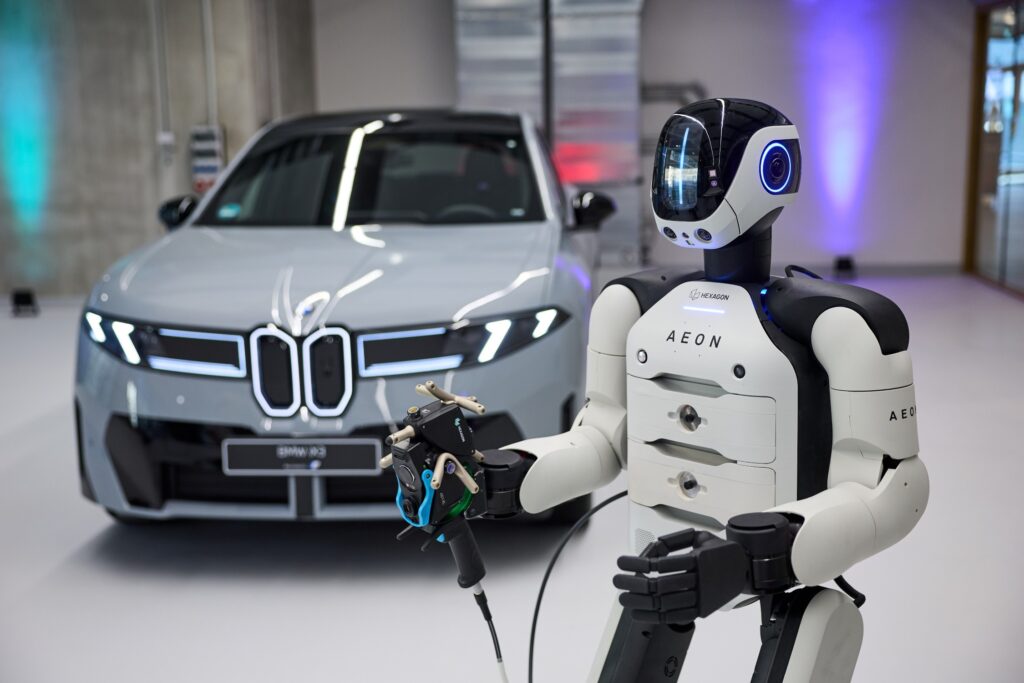
Physical Intelligence does not manufacture robots. That is the point. Founded by a team out of Google DeepMind, Stanford, and UC Berkeley, PI is building what it calls a universal brain for robots, a foundation model that accepts natural language commands and translates them into motor actions across different robot hardware platforms. Its flagship model, pi-zero, works across dozens of tasks including laundry folding, kitchen cleaning, and box assembly, on robots made by multiple different manufacturers.
The commercial logic follows the LLM playbook: OpenAI captured value not by building better chips but by building the model layer that ran on other companies’ chips. PI is betting that whoever builds the best robot brain will extract disproportionate value regardless of who manufactures the hardware. The pi-zero model has been deployed in live commercial environments through hardware partners. Weave uses PI’s models in robots performing laundry folding at customer sites in the San Francisco Bay Area. Ultra deploys PI’s models in warehouse packing operations, with a human-in-the-loop intervention system feeding continuous data back into model improvement.
The structural challenge is the data dependency. PI depends on hardware partners for robot training data. Companies that own both hardware and deployment, like Figure AI or Boston Dynamics, have a direct data advantage that does not require negotiation with a partner. The EgoScale paper showed that policy performance scales with pretraining data size. That law applies equally to PI’s competitors.
The open-source threat is real. OpenVLA and RDT-1B are free and available. If open models reach 90% of PI’s performance, the willingness to pay for a proprietary model contracts significantly. The counterargument is network effects: more deployment generates more data, which trains better models, which attract more partners, compounding the advantage over time.
What to watch: the Series C close and its valuation, which would function as a market signal about institutional conviction in the pure-software-layer thesis; and the first disclosed revenue-generating industrial pilot at a named customer beyond the current partner demonstrations.
Palladyne AI: The Defense Niche Nobody Is Watching
Ticker: PDYN (NASDAQ). Price as of May 22, 2026: approximately $6.34. 52-week range: $4.14 to $13.00. Market cap: approximately $282M to $297M. TTM revenue: $7.07M. Q1 2026 revenue: $3.5M (107% year-over-year growth). FY2026 guidance: $24M to $27M. Backlog: $17M.
Palladyne AI is the company formerly known as Sarcos Technology and Robotics, rebranded in March 2024 after pivoting away from industrial exoskeletons toward a purer software autonomy play. It is small, it is unprofitable, and it is doing something structurally interesting in a part of the robotics stack that the humanoid robot conversation tends to ignore entirely.
Palladyne’s core product is AI software that runs on top of existing third-party robots, industrial cobots, and unmanned aerial vehicles, enabling them to observe, learn, reason, and act in environments that were not specifically programmed. Palladyne IQ is the industrial robotics version. Palladyne Pilot targets UAVs and multi-drone coordinated systems. SwarmOS handles collaborative autonomous operations across multiple platforms simultaneously.
The defense vector is where the structural position gets interesting. In April 2026, Palladyne’s subsidiary GuideTech was selected as one of fourteen companies invited to participate in AFRL’s Relentless Wolfpack Industry Day, focused on networked collaborative autonomous weapon systems. The company is also confirmed to participate in Northern Strike 26-2, a Department of Defense joint exercise. Defense procurement cycles are long, but contracts are sticky and switching costs are high. A DoD contract relationship is a different kind of moat than a commercial partnership agreement.
Palladyne also issued a new patent in 2026 for its Bayesian Program Learning framework, which enables robots to generalize learned behaviors to new contexts without retraining. That IP position matters in a defense context where customers cannot rely on continuous retraining infrastructure in the field.
What to watch: whether the Relentless Wolfpack and Northern Strike participation converts to a contract award, and whether FY2026 revenue guidance of $24M to $27M holds through Q2 and Q3. The company is burning cash against a small revenue base. The execution window is not infinite.
Comparison: The Physical AI Stack
| Company | Role in Stack | Structural Position | Key Dependency | What to Watch |
| Figure AI | Full-stack hardware + AI model | Controls hardware, software, manufacturing, and deployment contract simultaneously. BotQ produces at scale. | NVIDIA chips for Helix training; BMW as anchor commercial customer and proof-of-concept validator | Figure 03 deployment expansion beyond Spartanburg; BotQ output versus announced 12,000 unit/year target |
| Physical Intelligence (PI) | Foundation model layer / robot brain | Software-only; runs on third-party hardware. Controls the AI layer for multiple robot platforms simultaneously. | Hardware partners for training data access; continued compute scale from NVIDIA and cloud providers | Series C close above $11B; first disclosed revenue-generating industrial pilot at named customer |
| Palladyne AI (PDYN) | Autonomy software for defense + industrial robots | Niche position in defense autonomy and industrial cobots. Bayesian learning IP, DoD contract pipeline, $17M backlog. | DoD procurement cycles; AFRL contract expansion; GuideTech integration delivering multi-platform autonomy | FY2026 revenue guidance confirmation of $24M-$27M; Northern Strike 26-2 contract award outcome |
The Honest Tension
The 99.9% reliability threshold is the number that matters, and nobody in this sector has publicly claimed to hit it at production scale. In controlled lab environments, state-of-the-art robot policies achieve around 95% task accuracy. In real-world conditions with variable lighting, material textures, and unpredictable human behavior, that number typically drops closer to 60%. The gap between demo and deployment is not engineering theater. It is a genuine unsolved problem at scale. Figure’s BMW deployment ran 1,250 hours and involved a specific, well-defined task in a structured automotive environment. That is a long way from the generalized deployment that justifies current valuations. Additionally, Chinese manufacturers are producing capable humanoid hardware at a bill-of-materials cost less than half that of Western units. If the cost gap persists, it will compress margins for every Western player trying to price at the commercial level, regardless of how good the AI model is.
| Rabbt Intelligence Note A structured Research File on Figure AI would map the BotQ manufacturing ramp against the customer expansion pipeline, and flag the point at which production output exceeds committed deployments as the condition most likely to signal whether the vertical integration strategy is working or creating inventory risk. The Relationship Graph would show that NVIDIA sits simultaneously as infrastructure dependency, strategic investor, and potential competitor through its own GR00T robotics platform, a structural tension that most coverage of the Figure funding narrative misses entirely. The open question: If PI closes its Series C above $11 billion and Figure completes its BotQ ramp, does the market end up with two dominant physical AI layers or does one of them begin to look redundant? |
0 Comments