
BETA Built an Open Charging Network. Automakers Picked a Different Plug.
The eVTOL company markets its Charge Cube as a bridge between aircraft and cars. The bridge is real. The plug it's built on is the one Ford, GM, Toyota, and six other automakers are moving away from.
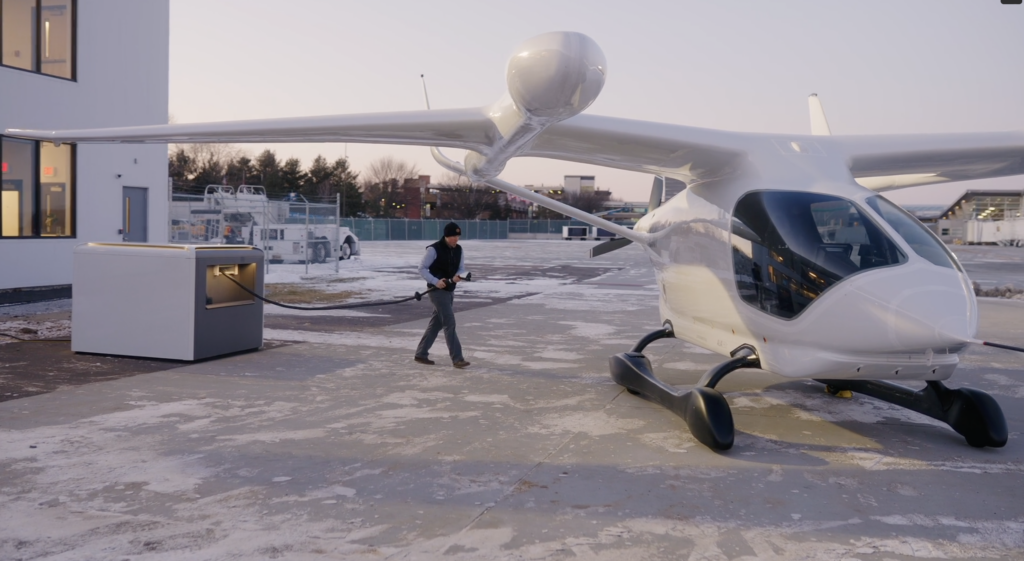
BETA’s ‘Charge Cube’ being plugged into an electric flying vehicle
Most coverage of BETA Technologies treats its charging network as a private aviation amenity, hardware sitting behind an airport fence, built for BETA's own aircraft and its fleet partners. That read has it backwards. BETA has spent years explicitly inviting ordinary EV drivers to plug in alongside its aircraft, and the company frames the result as an open network, a deliberate contrast to the closed, single-brand charging model Tesla built first [1]. The real structural question is not whether BETA lets outside cars in. It does. The question is which plug those cars need, and it's the one American automakers are moving away from.
Why the Charging Standard Fight Matters Now
Every electric vehicle needs a physical plug, and for most of the last decade, American drivers had two real options. The Combined Charging System, or CCS, is an open connector standard that any automaker or charging company can build to without paying a licensing fee, and it became the default plug on most non-Tesla electric cars. The North American Charging Standard, or NACS, is the connector Tesla designed for its own cars and its own Supercharger network. Tesla opened that design to the rest of the industry in 2023, and the Society of Automotive Engineers formalized it as the J3400 standard the same year [2]. Ford, General Motors, Stellantis, Hyundai, Kia, Rivian, BMW, Toyota, and Honda have all committed to building NACS ports into future vehicles, with the rollout staggered across the 2025 and 2026 model years. Most new non-Tesla EVs sold in 2026 still ship with a CCS port, but the industry's direction is set: NACS, not CCS, is the plug automakers are building toward [2]. BETA Technologies, whose chargers already power ground vehicles at dozens of sites, has stayed with CCS. That was an easy call when CCS was simply the industry default. It is a harder one now that the default itself is losing ground with the drivers BETA has spent years trying to reach.
Every Monday at 6 AM Eastern. Subscribe at rabbt.org/frontier-file
BETA Technologies
Public. NYSE: BETA. Price: $26.76 as of August 15, 2026 [3]. Market cap: approximately $6.18 billion [3]. Headquartered in South Burlington, Vermont. Founded 2017. Completed a roughly $1 billion initial public offering on November 4, 2025, after raising more than $1.5 billion in private investment, including a $300 million round from GE Aerospace [4].
BETA Technologies builds the CX300 and A250 electric aircraft for cargo, medical transport, passenger, and defense customers, including UPS, Air New Zealand, United Therapeutics, Bristow, and the U.S. Department of Defense. But its charging business may be the more structurally important asset, because it’s the piece that decides whether electric aviation standardizes on one interoperable plug or fragments the way early EV charging did before Tesla's connector won out.
The Charge Cube, BETA's 320-kilowatt fast charger, runs on CCS by design. BETA chose the standard because the General Aviation Manufacturers Association endorses it, which signals to aircraft buyers that a charging investment will not be orphaned, and because CCS lets the same hardware serve cars, trucks, and airplanes without a redesign. Joby Aviation, BETA's closest rival in air taxi development, took the opposite path and built its own proprietary charging system instead, a decision that risks fragmenting eVTOL charging the same way competing plugs once fragmented consumer EV charging [5]. Which standard wins is not an abstract question for BETA, because it has already built one: dozens of Charge Cubes online at airports across the country, with fifty additional sites in permitting and construction [6]. That is the precise, sourced figure. Rounder counts that circulate elsewhere should be treated as approximations, not confirmed totals.
Multiple installations make clear the network was never meant to be fleet-only. At Marshfield Municipal Airport in Massachusetts, BETA and its airport partner Shoreline Aviation built one charger inside the airport fence for aircraft and a separate charger in the parking lot specifically so drivers of ordinary electric cars could charge theirs too [7]. BETA has installed similar consumer-facing chargers at regional airports in other states, part of a stated strategy to serve rural areas that otherwise lack fast charging [1].
In July 2026, BETA joined Archer Aviation and Macquarie Capital to form America's Consortium for Electric Skyways, a plan to build interoperable, CCS-based charging at more than 250 U.S. airport and metro sites by 2030. Both BETA and Archer are selected participants in the FAA's eVTOL Integration Pilot Program, and the consortium is designed to concentrate that federal program's early markets around shared, standardized hardware [8]. The dependency that actually matters for BETA is not its aircraft certification timeline, which is well covered elsewhere. It’s whether CCS remains the standard the aviation industry actually settles on, and whether the automotive market's drift toward NACS ever pulls aviation charging in the same direction.
What to watch: whether ACES reaches meaningful site counts ahead of its 2030 target, and whether any eVTOL manufacturer beyond Joby breaks from the CCS standard BETA has built its entire network around.
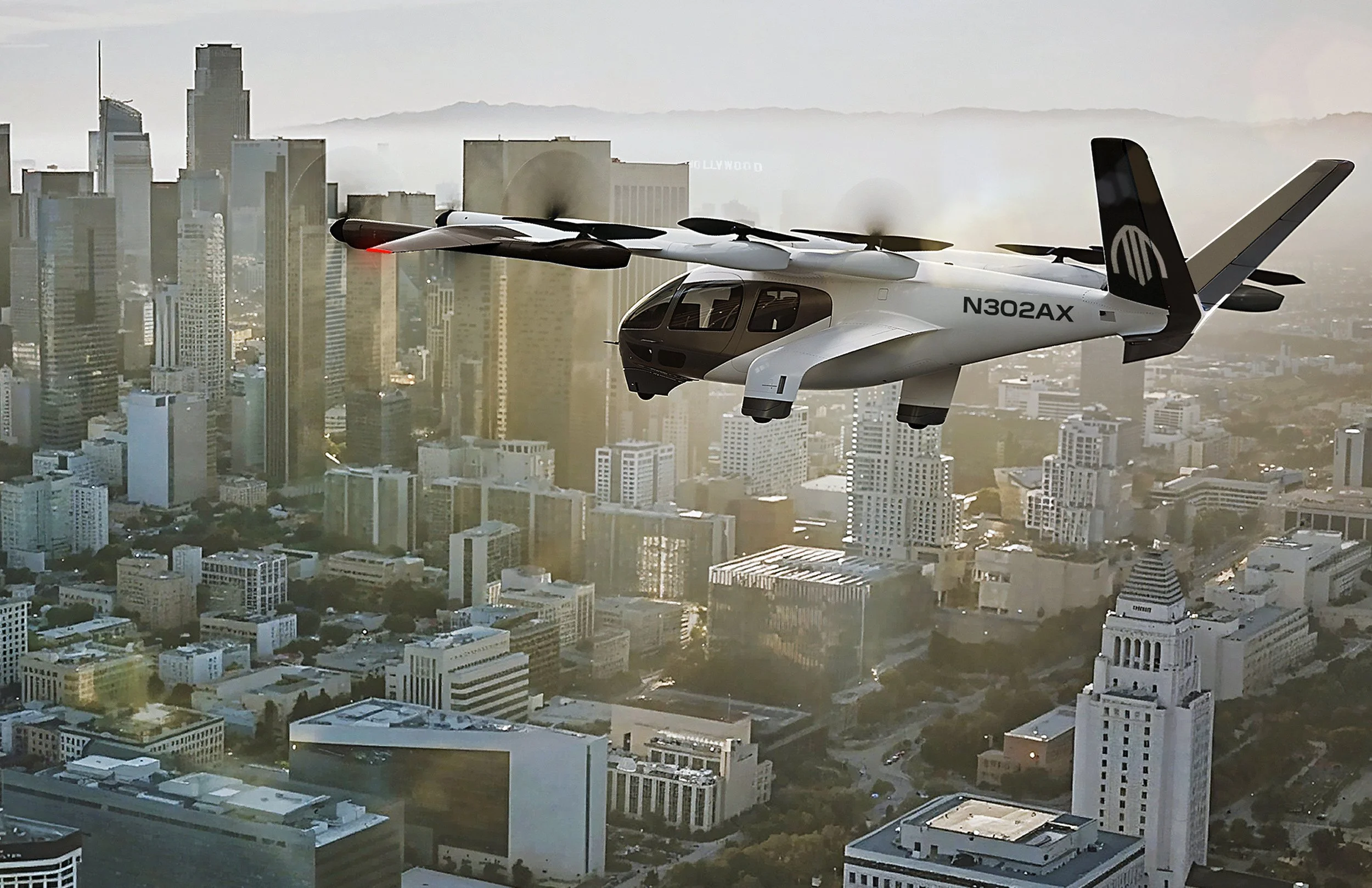
Archer Aviation Air Taxi
Archer Aviation
Public. NYSE: ACHR. Price: approximately $6.39 as of mid-August 2026 [9]. Market cap: approximately $4.9 billion [10]. Headquartered in San Jose, California. Founded 2018 by Brett Adcock and Adam Goldstein.
Archer Aviation is BETA's co-founder in the ACES consortium, and its planned routes in California, Texas, Florida, and New York determine where the consortium's first sites actually get built [8]. The two are not the complements they appear to be. BETA's five-seat ALIA VTOL carries passenger orders inside a backlog of 560 units, with type certification targeted for late 2027 or early 2028, so both companies are building passenger aircraft [11]. What separates them is the business model. BETA sells airframes and charging hardware to operators, while Archer intends to fly its own service [12]. They partner on the infrastructure and compete on the aircraft that will plug into it: Archer supplies the operational reason to build a site, BETA supplies the hardware that goes in it.
Archer's own numbers explain why sharing infrastructure cost across operators matters so much to the consortium model. The company reported a net loss of $263.2 million for the quarter ending June 30, 2026, on revenue of just $5.0 million, though it held $1.56 billion in cash and short-term investments at quarter's end [13][14]. On August 9, 2026, Archer signed a definitive agreement to acquire Wisk Aero, Insitu, and SkyGrid from Boeing, and the two companies announced it the following day [15]. Boeing receives newly issued shares equal to roughly 19.75 percent of Archer's Class A stock outstanding immediately before closing, two warrants covering $200 million in total, and the right to name a director [13]. The deal has not closed. Completion is expected by the end of 2026 and depends on antitrust and other regulatory clearance [13]. The move is unconnected to the charging story, though it matters for Archer's balance sheet and technical roadmap.
What to watch: whether Archer's planned routes in the four ACES launch states begin generating the flight volume needed to justify the consortium's build-out pace.
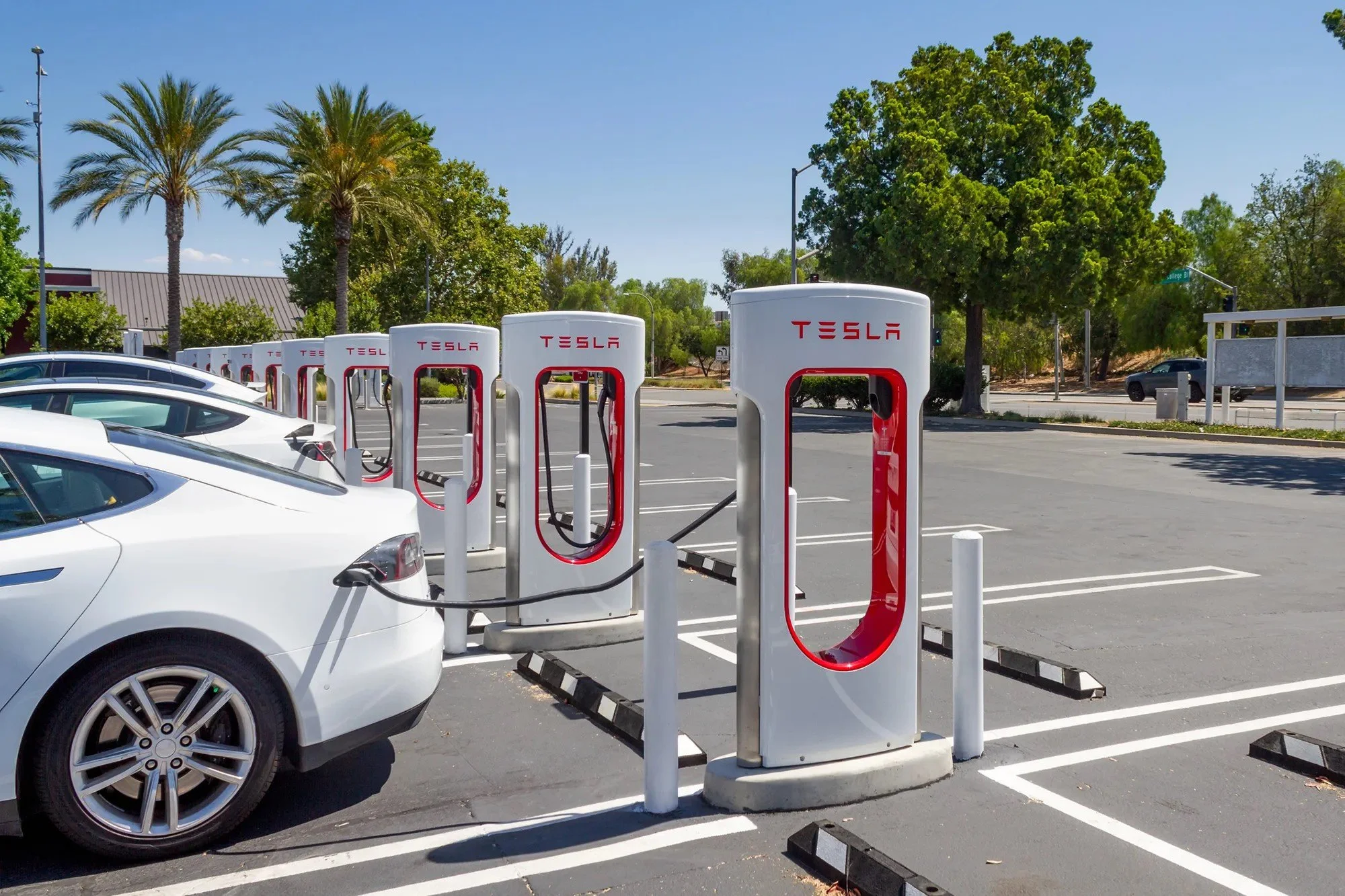
Row of Tesla Supercharging Stations
Tesla
Public. NASDAQ: TSLA. Price: approximately $336.87 as of August 19, 2026 [16]. Market cap: approximately $1.33 trillion [17]. Headquartered in Austin, Texas.
Tesla is the contrast case, not because it competes with BETA in aviation, but because it owns the charging standard the U.S. car market is consolidating around. Tesla designed the connector now called NACS for its own vehicles and its own Supercharger network, then opened the design in 2023 so any manufacturer could use it without paying Tesla a fee [2]. That decision is why Ford, GM, Hyundai, and most other automakers now build NACS ports into new models, and why Stellantis brands including Jeep and Dodge are set to gain Supercharger access during 2026 [18].
The asymmetry that matters for BETA sits in the other direction. As of early 2026, there is still no widely available aftermarket adapter that lets a CCS-only car plug into most Tesla Superchargers. Tesla's Magic Dock adapter, built into select Supercharger stalls, covers only a minority of its roughly 3,032 U.S. sites [19]. The practical effect is not that BETA's network is closed. It is open to consumers today, in a way Tesla's historically was not. The effect is that BETA's version of open runs on the technology losing ground with new car buyers, while Tesla, the network that used to be the closed one, is the one now gradually expanding access to outside vehicles.
What to watch: whether Tesla's Magic Dock coverage expands meaningfully beyond its current minority footprint, which would narrow the practical gap between the two networks' competing claims to openness.
| Company | Role in Stack | Structural Position | Key Dependency | What to Watch |
|---|---|---|---|---|
| BETA Technologies | CCS-based charging hardware supplier for aviation and ground vehicles | Sole hardware provider across its own network and the 250-site ACES consortium; explicitly markets consumer car access, not just fleet use | Continued industry-wide adoption of CCS as aviation's standard, and non-fragmentation from rivals like Joby | Pace of ACES site build-out toward its 2030 target |
| Archer Aviation | ACES co-founder, operator-side anchor | Determines where consortium sites get built based on planned air taxi routes; partners with BETA on charging while competing with it on passenger aircraft | Cash runway and passenger-route ramp funding the pace of site build-out | Whether planned routes in California, Texas, Florida, and New York begin generating real flight volume |
| Tesla | Owner of the NACS/J3400 connector and the dominant U.S. fast-charging network | Contrast case: controls the standard the car industry is consolidating around, while its historically closed network is now opening to outside vehicles | Continued OEM adoption of NACS and the pace of Magic Dock expansion to non-Tesla vehicles | Whether Magic Dock coverage expands meaningfully beyond its current minority of Supercharger sites |
The Honest Tension
BETA's open-network framing holds up today: any CCS-equipped car can charge at a Charge Cube, and BETA has built specific sites to serve exactly those drivers. But CCS is the standard losing share among new vehicles, and no widely available adapter yet lets CCS cars reach Tesla's much larger Supercharger network. If NACS adoption continues at its current pace, BETA's network stays open in principle while becoming compatible with a shrinking share of new cars on the road. That does not break BETA's aviation charging thesis, which does not depend on consumer car traffic. It does complicate the consumer bridge BETA has spent years publicly building.
This is editorial content. Rabbt is not a registered investment advisor and does not provide investment recommendationsThis issue reflects structural analysis and figures verified as of its publish date. The frontier economy moves quickly: funding rounds close, valuations shift, contracts get renegotiated, and timelines change. Details in this issue may no longer be current by the time you are reading it. Treat this as a structural snapshot, not a live feed, and verify anything time-sensitive independently before acting on it.Sources
[1] Seven Days (Kevin McCallum), "Beta Technologies Plans a Web of Charging Stations Across the Eastern U.S. to Power Its Electric Planes," sevendaysvt.com, Oct. 19, 2022, updated Oct. 23, 2024.
[2] U.S. News & World Report, "NACS vs. CCS: What EV Shoppers Need to Know in 2026," cars.usnews.com.
[3] Morningstar, BETA Technologies (NYSE: BETA) stock quote, morningstar.com, pulled Aug. 15, 2026.
[4] Seven Days, "Beta Technologies Hits Stock Market With $1 Billion IPO," sevendaysvt.com, Nov. 5, 2025.
[5] Revolution.aero, "Building the backbone of electric flight," revolution.aero.
[6] BETA Technologies, "Charge — Grow the Network," beta.team/charge-grow-the-network.
[7] FLYING Magazine (Jonathan Welsh), "Beta Technologies, Shoreline Aviation Partner with Massachusetts Agencies to Promote Electric Aviation," flyingmag.com, Oct. 13, 2023.
[8] Archer Aviation and BETA Technologies investor relations, "Archer Aviation, BETA Technologies and Macquarie Capital Launch ACES: America's Consortium for Electric Skyways," press release, July 16, 2026.
[9] CNN Markets, Archer Aviation (NYSE: ACHR) stock quote, cnn.com, pulled Aug. 18, 2026.
[10] TradingView, Archer Aviation (NYSE: ACHR) market capitalization, tradingview.com, pulled mid-Aug. 2026.
[11] BETA Technologies, Inc., Form 424B4 (IPO prospectus), U.S. Securities and Exchange Commission, sec.gov, filed November 2025.
[12] TechCrunch, “Beta Technologies unveils first passenger carrying electric aircraft,” techcrunch.com, Sept. 30, 2024.
[13] Archer Aviation Inc., Form 10-Q for the quarterly period ended June 30, 2026, U.S. Securities and Exchange Commission, sec.gov, filed Aug. 10, 2026.
[14] Archer Aviation Inc., “Archer Announces Second Quarter 2026 Results,” press release, Aug. 10, 2026.
[15] The Boeing Company and Archer Aviation Inc., “Archer to Shape Physical AI Future of Aerospace and Defense with Acquisition of Boeing’s Wisk Aero, Insitu and SkyGrid Subsidiaries; Boeing to Invest in Archer and Collaborate,” press release, Aug. 10, 2026.
[16] Investing.com, Tesla (NASDAQ: TSLA) stock quote, investing.com, pulled Aug. 19, 2026.
[17] Morningstar, Tesla (NASDAQ: TSLA) stock quote, morningstar.com, pulled Aug. 18, 2026.
[18] EVDANCE, "Jeep and Dodge EVs to Gain Tesla Supercharger Access Starting in 2026," evdances.com, Nov. 20, 2025.
[19] usevchargingstations.info, "CCS vs NACS: EV Charging Connectors Compared (2026)."
