
The Company Actually Building 5D Glass Storage Isn't Microsoft
Most coverage of glass data storage, points straight at Microsoft. The company that actually built it is a four-person startup that nobody's covering.
Rabbt | August 31, 2026
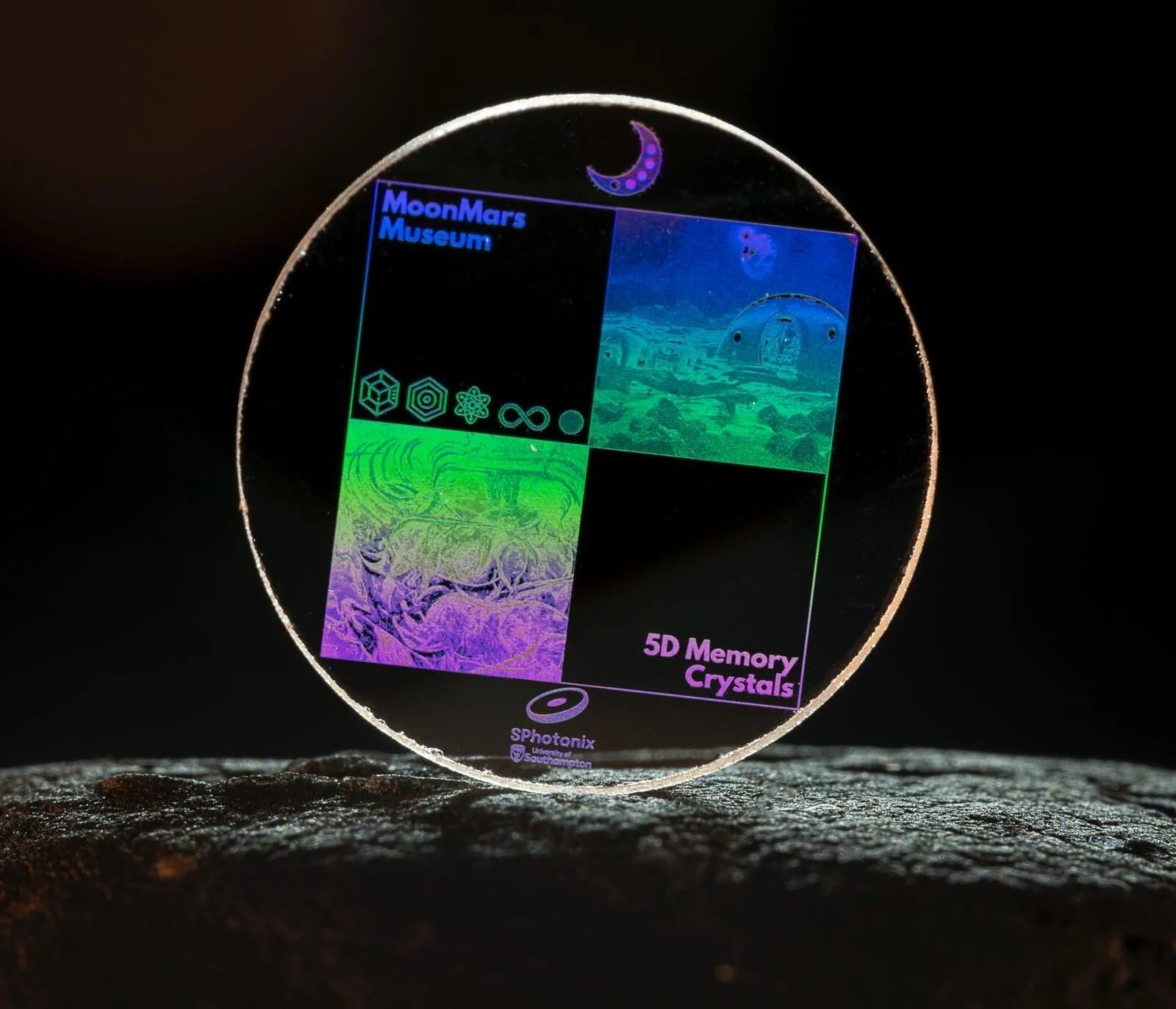
SPhotonix-Moon-Mars-Museum
Ask an investor about glass data storage and most will say Microsoft. That's the wrong answer. The 360-terabyte glass disc making headlines this year wasn't built by Microsoft. It was built by SPhotonix, a four-person startup working out of labs in Delaware and Switzerland that almost nobody covers [1]. Microsoft's own glass storage effort, Project Silica, published new research in February and then said, in its own words, that the research phase is complete [6]. No product date. No pricing. No shipping timeline. SPhotonix is actually in talks with data centers right now [1].
Why Data Center Archival Infrastructure Matters Now
Global data volumes keep climbing, and most of what companies and governments generate is not accessed daily. It's archived: financial records, medical scans, research data, government files that need to survive decades or centuries, not just years. Traditional archival media, magnetic tape and hard drives, degrade within a matter of decades and need periodic migration to new hardware. That migration cost compounds every few years, indefinitely.
That gap is why glass and DNA storage exist as categories at all. Both promise media that can sit untouched for centuries without degrading and without power. Glass stores information as microscopic structures burned into the material with a femtosecond laser, a pulse of light lasting about one-quadrillionth of a second, short enough to modify glass without cracking it. DNA storage takes a different route entirely, encoding data directly into synthetic DNA, or deoxyribonucleic acid, the same molecule that already stores every instruction for every living thing on the planet.
Neither approach is settled science anymore. It's a commercial race now. Biomemory just absorbed a rival to consolidate its DNA storage intellectual property in one place [8][9]. Microsoft published new research on its own glass approach in February, using ordinary borosilicate glass instead of costlier fused silica [5]. Money and attention are both arriving. What's still unresolved is who actually controls the pathway to commercial deployment.
The economics matter as much as the physics here. Neither modality has published a current, verifiable cost-per-terabyte figure for a data-center-scale deployment, and that absence is itself a signal: cost is usually the first thing a company publicizes once it is actually competitive, and the silence from all three companies on this specific number suggests none of them are ready to make that claim yet.
Every Monday at 6 AM Eastern. Subscribe at rabbt.org/frontier-file
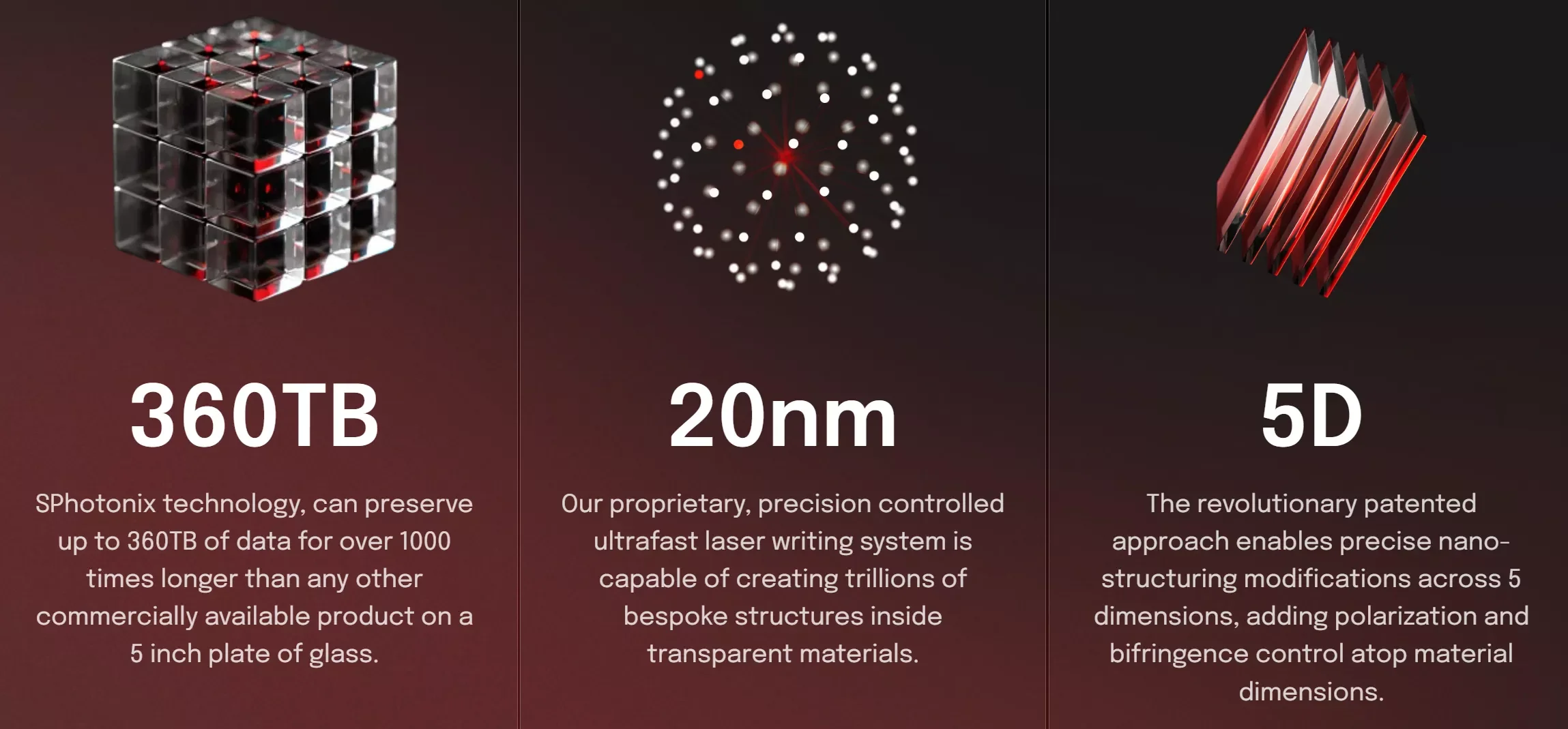
SPhotonics data storage system
SPhotonix: The Builder Nobody Knows
Private. Newark, Delaware, with a research lab in Neuchâtel, Switzerland. Founded 2024. $4.5 million pre-seed raised November 2025, led by Creator Fund and XTX Ventures [3][4].
SPhotonix is a family operation before it is anything else. Chief Scientific Officer Peter Kazansky spent roughly twenty years at the University of Southampton developing the underlying technology: a way to burn data into fused silica glass using ultrashort laser pulses, creating microscopic structures that encode information across five dimensions instead of the usual two or three [2]. His son, Ilya Kazansky, now runs the company as CEO [1][3].
The technology itself isn't new. What's new is the attempt to sell it. A single five-inch glass disc can hold up to 360 terabytes of data, and the company's claimed durability runs into the billions of years [1]. That is not a typo. It's a materials claim: fused silica does not degrade the way magnetic tape or a hard drive does, so the theoretical shelf life is enormous.
SPhotonix raised its first outside capital, a $4.5 million pre-seed round, in November 2025. Creator Fund and XTX Ventures led it, with the money earmarked for expanding the company's research lab in Neuchâtel, Switzerland [3][4]. Around the same time, CEO Ilya Kazansky said the round moves the company from Technology Readiness Level 5 to Technology Readiness Level 6. Technology Readiness Level, or TRL, is a nine-point scale engineers and government agencies use to describe how close a technology is to real-world deployment. Level 5 means the technology has been validated outside the lab; level 6 means a working prototype has been demonstrated in a realistic setting [1]. That is meaningfully further along than just a research paper, but it is still short of a shipped product.
Here's the honest gap. Kazansky told The Register the company is speaking to a lot of the hyperscalers about releasing some of its prototypes into their data centers over the course of the next couple of years [1]. That's a real signal of interest. It is not a contract. No hyperscaler has been named publicly as a pilot partner, and nothing in the public record confirms a signed deployment. The company's structural position is genuinely ahead of Microsoft's on paper. Whether that lead turns into an actual customer is still open.
The company's optics business is worth noting too, since it is the part of SPhotonix that already generates commercial interest. The same FemtoEtch laser-nanostructuring process used for data storage also produces specialty fused-silica optics for microscopy, high-power lasers, and semiconductor manufacturing, giving SPhotonix a second revenue path that does not depend on winning a hyperscaler pilot [3]. That matters structurally: a company with only one path to revenue is more fragile than one with two, even if the data-storage path is the more interesting story for this piece.
SPhotonix's key dependency is straightforward: it needs a named hyperscaler pilot to convert curiosity into commercial validation, and it needs continued capital to fund the jump from a TRL6 prototype to a manufacturable product. Right now it is a four-person team competing for attention against a company with Microsoft's name recognition and research budget.
What to watch: any named hyperscaler pilot agreement, or a second funding round sized to fund actual manufacturing rather than lab expansion.
Microsoft: The Name on the Byline, Not the Shipping Date
Public. NASDAQ: MSFT. Price $489.29, market cap approximately $3.63 trillion, as of August 25, 2026, 11:59 AM EDT [12]. This figure is current as of drafting, not the publish date; it must be reconfirmed the morning of August 31 before this issue goes out, per standard practice for any live price or market cap figure.
Project Silica is Microsoft Research's glass storage program, not a Microsoft product. In February 2026, the team published a paper in the scientific journal Nature describing a full write-store-read system using ordinary borosilicate glass, the same material used in kitchen cookware, instead of the far more expensive fused silica SPhotonix relies on [5]. That is a genuine technical achievement: it makes the medium itself cheaper.
It doesn't make the system commercial. Microsoft's own statement after the paper was blunt: the research phase is now complete, and the company is continuing to consider learnings from Project Silica while it explores the ongoing need for sustainable, long-term preservation of digital information [6]. That is not the language of a company about to ship a product. It's the language of a company closing out a research program and deciding what, if anything, comes next.
Independent trade coverage backs this up. A Microsoft Research presenter at the 2026 Library of Congress storage architecture meeting placed any commercial return in the 2027 to 2030 window at the earliest, and said the primary blocker is not Microsoft's engineering. It's the cost of the femtosecond lasers the whole approach depends on, and that cost is not something Microsoft controls [7].
So Microsoft has the brand recognition, the Nature publication, and the research budget. It doesn't have a shipping date, a named commercial partner, or control over the one input that would let it commercialize even if it wanted to. That's the contrast this whole piece turns on: the company most people would name is not the company closest to actually building the thing.
What to watch: any Microsoft announcement of a commercial pathway, a licensing deal, or an acquisition of outside glass-storage intellectual property, since that would signal the research-only posture has changed.
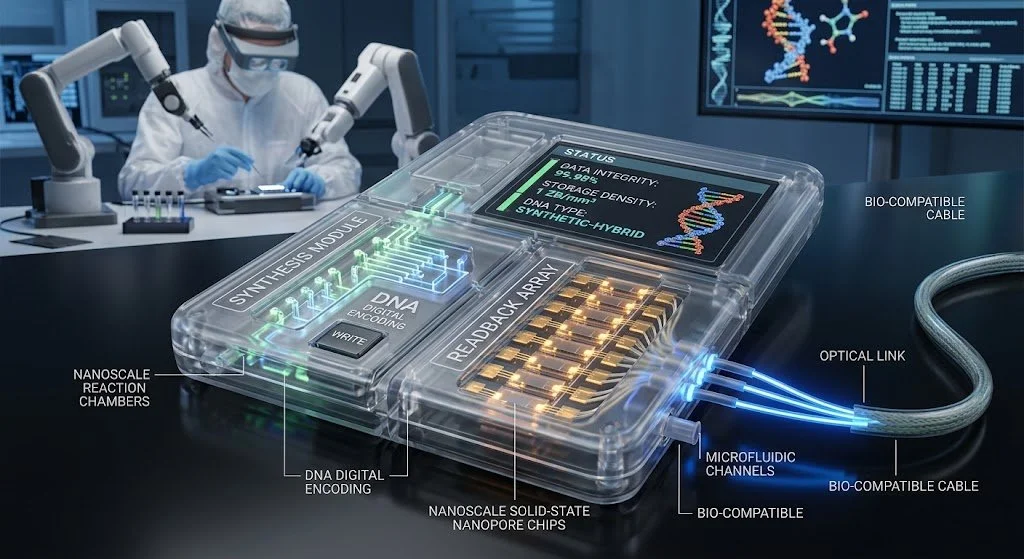
Future DNA storage system
Biomemory: The Competing Modality Actually Moving Faster
Private. Paris, France, with a Boston, Massachusetts hub. Founded 2021. $18 million Series A raised December 2024, led by Crédit Mutuel Innovation. Acquired the assets of Catalog Technologies in March 2026 [9][10].
Biomemory isn't playing the same game as SPhotonix or Microsoft. It stores data in synthetic DNA instead of glass, betting that the molecule already responsible for storing every instruction in every living cell can do the same job for digital archives [8]. In March 2026, the company acquired the assets of Catalog Technologies, a Boston-based rival that had spent years building industrial DNA-writing machines. The deal consolidated two companies' worth of intellectual property, hardware, and expertise into one, and gave Biomemory a North American production and research hub in Boston [9].
Biomemory says it plans to launch its first commercial data center deployment in the second half of 2026, positioning itself to be the first DNA storage company actually operating inside a data center rather than demonstrating in a lab [9]. That is a bolder near-term claim than either glass effort has made.
It's not an unsupported one. In June 2026, Biomemory announced a named partnership with Scality, a data infrastructure software company, to build DNA-based cold archive storage into existing enterprise storage systems. Scality's chief executive sits on Biomemory's board [11]. That is the most concrete signal in this entire piece: a named partner, in a specific product category, with a board seat attached. Neither SPhotonix nor Microsoft has anything comparable on the public record right now.
Biomemory's key dependency is scaling its DNA synthesis and writing process to data-center volumes without the cost per terabyte staying prohibitive, a problem that has dogged DNA storage broadly for years and one the company hasn't yet disclosed current figures for.
What to watch: the Scality-integrated deployment actually going live, since that would be the first confirmed commercial DNA storage installation in a data center from any company in this space.
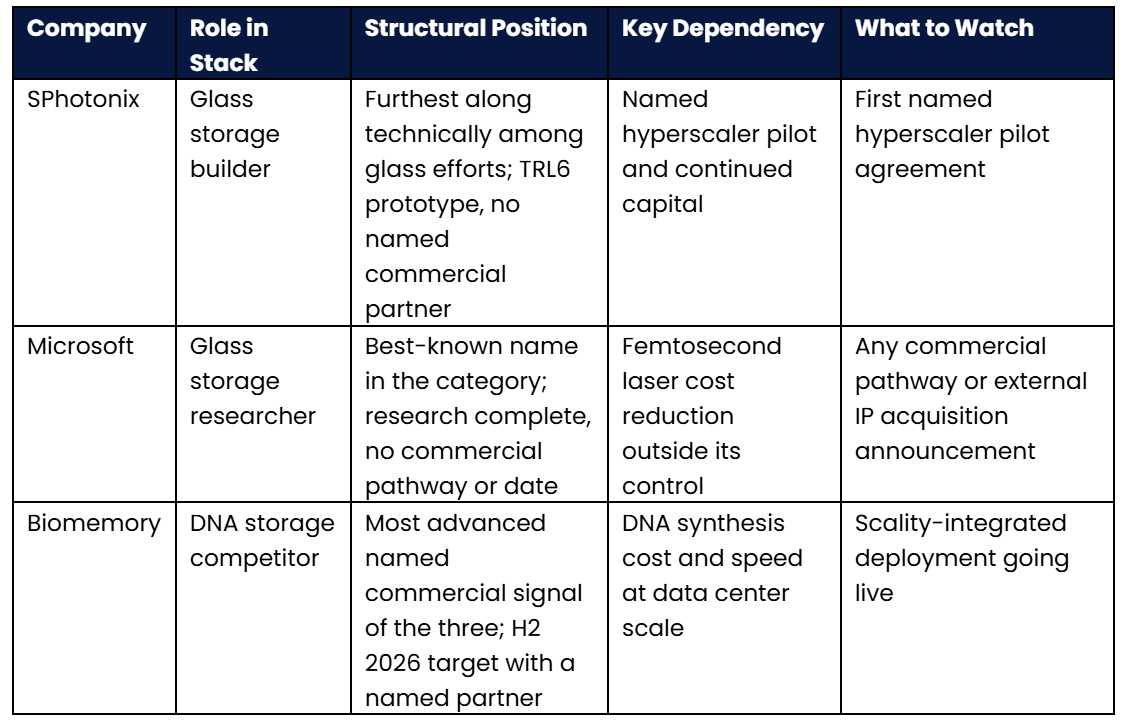
The Honest Tension
SPhotonix's strongest evidence is a CEO's account of conversations with hyperscalers, not a signed contract. No named pilot exists yet, and a four-person company still needs a lot to go right before a prototype becomes shipped hardware. Biomemory's H2 2026 target is the most concrete date in this piece, but DNA storage's cost and speed problems have missed deadlines industry-wide for a decade, and Biomemory hasn't disclosed the numbers that would prove this time is different. Microsoft's silence could also just be patience: a company with Microsoft's balance sheet can afford to wait out a bottleneck smaller players can't solve on their own.
This is editorial content. Rabbt is not a registered investment advisor and does not provide investment recommendations.
This issue reflects structural analysis and figures verified as of its publish date. The frontier economy moves quickly: funding rounds close, valuations shift, contracts get renegotiated, and timelines change. Details in this issue may no longer be current by the time you are reading it. Treat this as a structural snapshot, not a live feed, and verify anything time-sensitive independently before acting on it.
Sources
[1] The Register. "5D memory crystal storage moves closer to deployment." Dec 14, 2025.
[2] University of Southampton. "5D memory - the Superman memory crystal." phys.soton.ac.uk.
[3] SPhotonix. "SPhotonix Raises $4.5M to Scale 5D Optical Data Storage and Advanced Optics." Press release via PRNewswire, Nov 25, 2025.
[4] The Creator Fund. "SPhotonix" case study. thecreatorfund.com.
[5] Microsoft Research. "Project Silica's advances in glass storage technology." Feb 18, 2026.
[6] Redshark News. "Microsoft Updates Project Silica: 10,000 Year Memory Storage Inches Closer." Feb 19, 2026.
[7] Blocks and Files. "Project Silica's glass storage archive tech progress." Updated Aug 2026.
[8] Data Center Dynamics. "DNA data storage startup Biomemory acquires Catalog Technologies, plans data center deployment in H2 2026." Jun 8, 2026.
[9] Biomemory, via StorageNewsletter/PRNewswire. "Biomemory Acquires the Assets of Catalog, Boosting Its Ambitions in DNA Data Storage and Computing." Mar 5-10, 2026.
[10] Biomemory, via BusinessWire. "Biomemory Secures $18 Million in Series A Funding to Revolutionize Data Storage With Molecular Technology." Dec 10, 2024.
[11] Scality. "DNA Data Storage Partnership: Scality and Biomemory." Press release, Jun 2, 2026.
[12] MSN Money. MSFT stock quote. Accessed Aug 25, 2026, 11:59 AM EDT.