
Roche's AXELIOS Entered a Growing Market. It's Locked Out of the Growth.
Genomic sequencing is booming. The boom is concentrated in one segment, and most new entrants are locked out of it.
By Rabbt | August 10, 2026
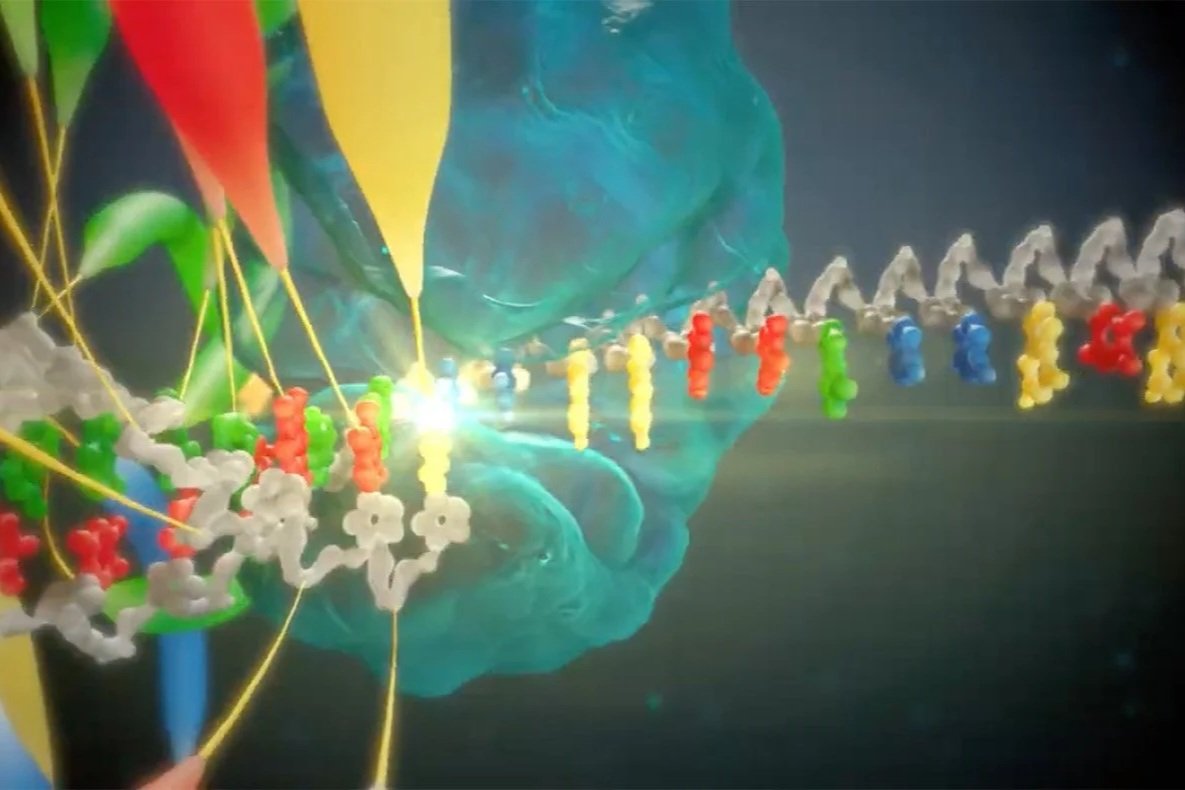
Stylized 3D illustration of a DNA double helix with colorful genetic markers, representing genomic sequencing technology.
On June 29, Roche launched AXELIOS 1, a new DNA sequencing machine built on technology the company calls sequencing by expansion, or SBX [1]. Most coverage read the launch as Roche stepping into a booming sequencing market, and the market is booming: global sequencing revenue is on track to grow by double digits a year through the early 2030s [2]. That's the story most people are telling. It is also the wrong one. AXELIOS is sold for research use only, and Roche says plainly it is not for diagnostic procedures [1]. It can't touch the fastest-growing part of that boom: hospitals and clinics. Roche entered a growing market and locked itself out of the growth.
Why the Research-Only Label Actually Matters
Research use only, or RUO, is a regulatory label. It means a device is sold for lab experiments, not for diagnosing patients. An RUO instrument can help scientists study biology, but it cannot legally tell a doctor what's wrong with someone.
That label matters because of where sequencing spending is actually growing. Global demand for sequencing technology is expanding somewhere between 13 and 19 percent a year, depending on which market research firm you ask [3]. That growth is not spread evenly. It concentrates in clinical use, where sequencing gets built into cancer testing, and in international markets. Academic research, the segment AXELIOS is actually allowed to sell into, is growing too, just more slowly, around 14 percent a year by one estimate [3].
In the United States specifically, the picture is tighter. The National Institutes of Health, or NIH, the federal agency that funds most American academic biomedical research, kept its overall 2026 budget roughly flat in dollars [5][6]. But a shift toward committing multiple years of grant money upfront, called forward funding, meant the number of new grants awarded fell 8.6 percent [7]. Instrument purchases follow funded projects. Fewer new grants doesn't mean less money exists somewhere. It means fewer new labs are getting equipped, right when Roche needs new customers to buy something.
None of this is unique to sequencing. Research instrument makers across genomics, proteomics, and cell biology have spent the past two years competing for the same limited pool of grant-funded capital equipment budgets. When a research budget holds steady while the number of funded projects shrinks, every company selling into that budget is fighting over relatively less, even if the total dollar figure looks unchanged. Roche picked a fight in exactly this pool, at exactly this moment.
Every Monday at 6 AM Eastern. Subscribe at rabbt.org/frontier-file
Roche
Public. Listed: SIX: RO, ROP; OTCQX: RHHBY. Headquartered in Basel, Switzerland. Founded 1896. AXELIOS 1 launched globally June 29, 2026 [1][8].
Roche is not a startup chasing a new market. It's one of the largest diagnostics and pharmaceutical companies in the world, and AXELIOS is its bid to become a serious player in DNA sequencing instruments, a business it has mostly supported from the sidelines until now.
AXELIOS 1 uses a chemistry Roche calls sequencing by expansion. It converts DNA or RNA into larger, easier-to-read molecules the company calls Xpandomers, then reads them using a reusable chip packed with millions of nanopores, tiny holes that measure one molecule at a time [1]. In its most accurate mode, it produces reads of roughly 230 to 260 base pairs, the stretch of DNA sequence read in a single pass, at a claimed accuracy scientists call Q38, a quality score where higher numbers mean fewer errors [9]. That's short-read territory, the same general range Illumina's machines work in, not the long-read range PacBio built its business on.
Roche launched with two marquee early customers already running the machine, Spain's CNAG genome center and the Netherlands' Hartwig Medical Foundation, plus Broad Clinical Labs in the United States [10]. CNAG bought a unit outright. The Broad is receiving its commercial units now, after running an early prototype for more than a year.
Roche has also touted a per-genome cost target near $150, a figure aimed squarely at the price-sensitive end of the research market where budget growth is flattest. The instrument itself is large, with Roche's own materials describing a footprint close to a twin bed and a weight of more than 1,200 pounds [10], a detail that matters for the smaller labs Roche says it also wants to reach.
The key dependency isn't the chemistry. It's what Roche does once the research-only version has sold as many units as it can. Roche has said, through its Foundation Medicine subsidiary, that it plans to build a decentralized test for minimal residual disease, or MRD, a way of checking whether tiny amounts of cancer remain in a patient's body after treatment, by combining AXELIOS with Roche's existing cobas platform, which relies on PCR, short for polymerase chain reaction, a common lab method for detecting small amounts of genetic material [10]. That's a real clinical ambition, not just a research pitch. But a Roche spokesperson told GenomeWeb the company is not sharing a timeline for it, and Broad Clinical Labs' own clinical strategy lead said the same thing: too early to say when.
That leaves Roche selling into the slower-growing side of its own market while its clinical plan sits with no date attached.
What to watch: whether Roche or Foundation Medicine attaches an actual timeline to the decentralized MRD plan. That single disclosure would be the moment AXELIOS's addressable market genuinely expands, instead of just growing at the pace of the flat research budgets it depends on today.
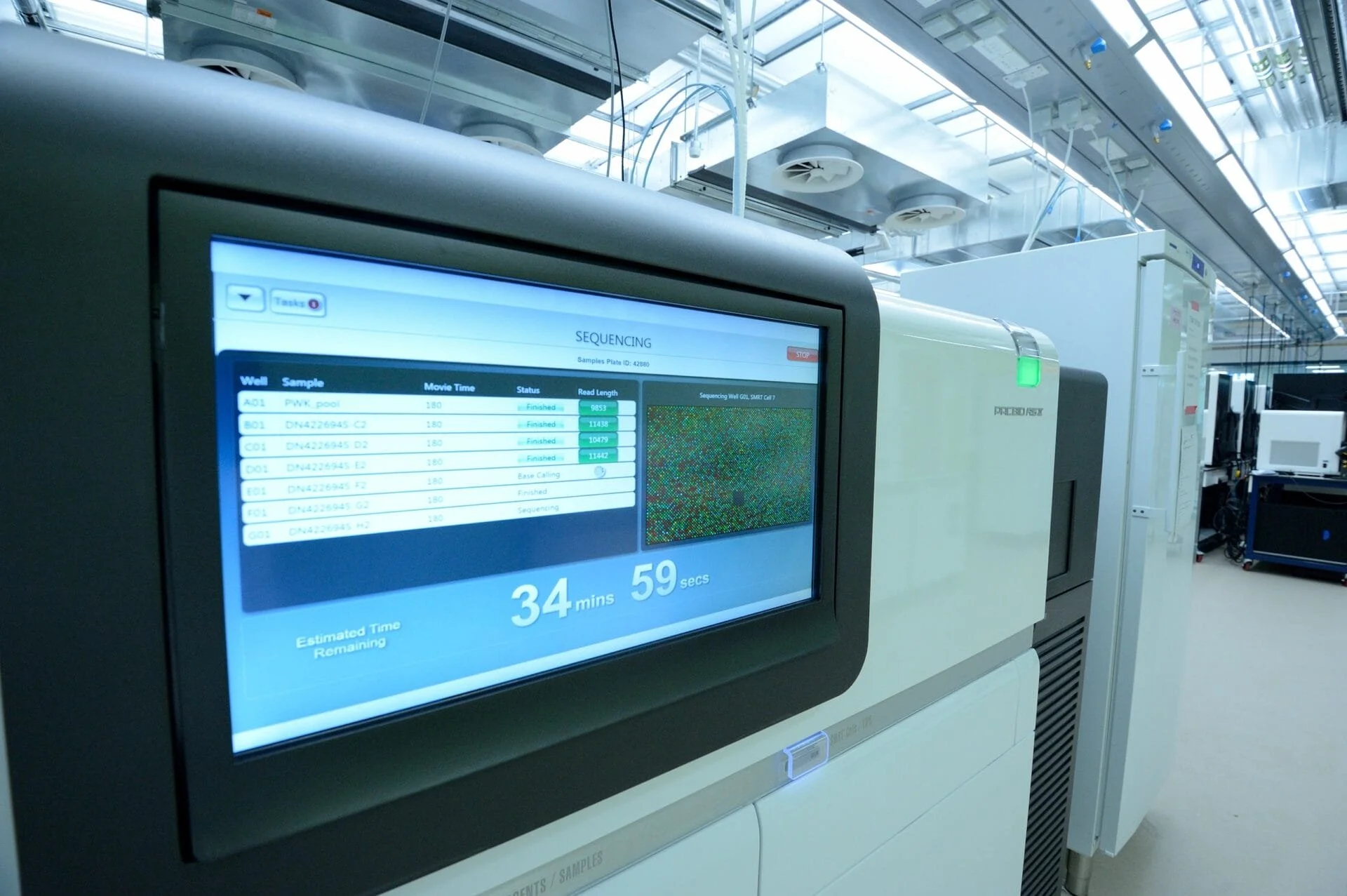
PacBio DNA sequencer with active run displayed on touchscreen.
PacBio
Public. Ticker: PACB (Nasdaq). Headquartered in Menlo Park, California. Q1 2026 revenue approximately $37.18 million, roughly 9 percent below consensus. FY2026 guidance $165 million to $175 million. Barclays cut its price target to $1 on July 28, 2026 [11]. [Unverified, pending PacBio's Q2 2026 report due August 5, 2026, five days before this issue publishes.]
PacBio builds long-read sequencers under its HiFi brand, capable of reads in the 15,000 to 20,000 base pair range, dozens of times longer than AXELIOS's short reads [11]. On chemistry, the two companies barely compete. On budget, they compete directly. Both are asking the same research labs, the ones whose grant dollars are not growing much right now, to spend money on a new instrument.
PacBio was already under pressure before AXELIOS shipped. First-quarter 2026 revenue landed around $37.18 million, about 9 percent below what analysts expected, and full-year guidance sits at $165 million to $175 million. Barclays cut its price target on the stock to $1 in late July.
The company has leaned on its long-read chemistry as a technical moat against short-read competitors for years, arguing that longer reads solve problems short reads structurally cannot. AXELIOS does not challenge that moat directly. What it challenges is PacBio's ability to win the next research contract before a tighter grant cycle forces a customer to pick just one new instrument instead of two.
What to watch: whether PacBio's Q2 2026 results, due August 5, show any sign AXELIOS is winning customers PacBio expected to keep, or whether PacBio's troubles have nothing to do with the new competition at all.
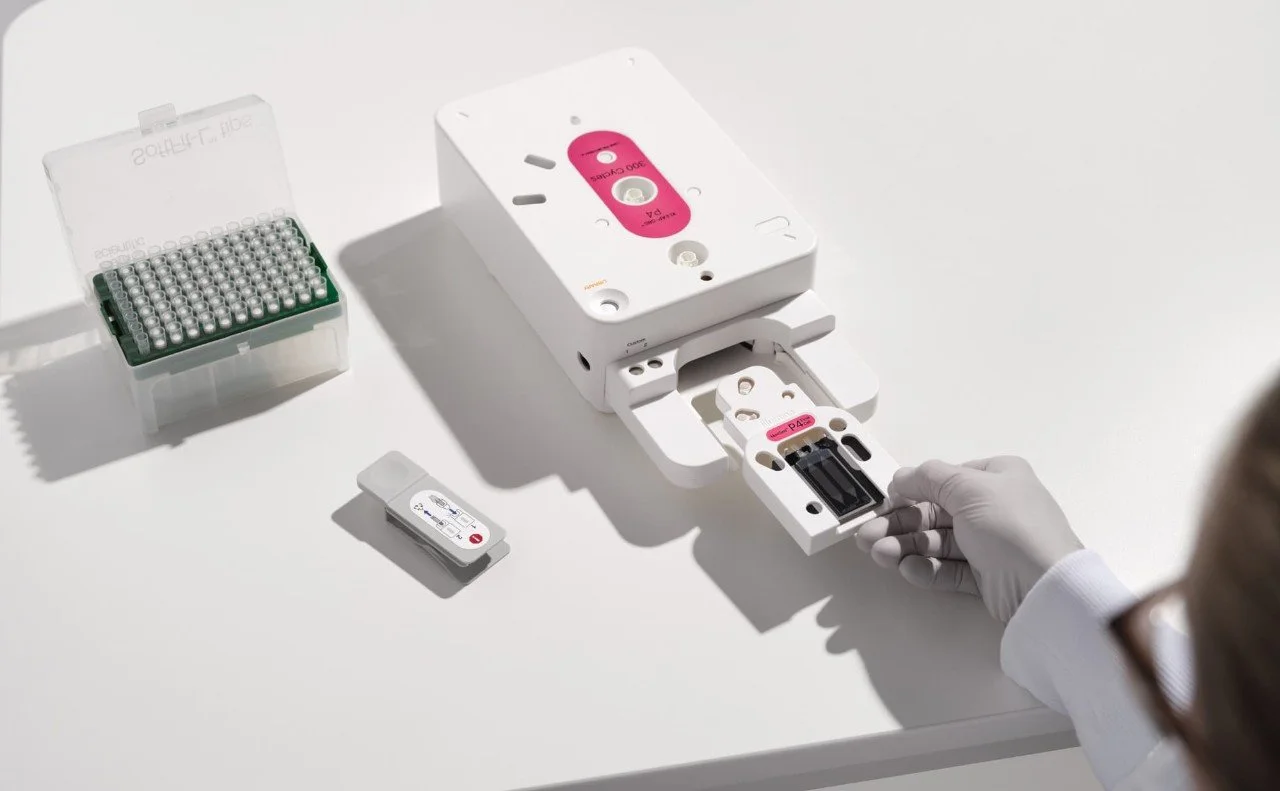
Lab technician loading a sample cartridge into a benchtop sequencing device, with a tray of pipette tips beside it.
Illumina
Public. Ticker: ILMN (Nasdaq). Headquartered in San Diego, California. Dominant short-read sequencing incumbent. Whole-genome-sequencing-based MRD detection kit slated for launch in 2027 [10].
Illumina is the company AXELIOS actually resembles on paper. Both run short-read chemistries in a similar length range, which makes Illumina, not PacBio, the closer technical comparison, even though most early coverage frames this as a PacBio story.
Illumina is also already building the exact clinical product Roche has only gestured at. The company has announced a whole-genome-sequencing-based MRD detection kit aimed at the same minimal residual disease testing market Foundation Medicine says it eventually wants to enter with AXELIOS. Illumina has a date. Roche doesn't.
Illumina isn't standing still while it waits for 2027. The company has spent the past two years expanding its own research-segment sequencing lineup, which means it's competing with Roche on two fronts at once: today's research budgets and tomorrow's clinical ones.
What to watch: whether Illumina's 2027 MRD kit ships on schedule, and whether Roche discloses a competing timeline before or after that happens. Whoever names a date first sets the clock the other has to run against.
| Company | Role in Stack | Structural Position | Key Dependency | What to Watch |
|---|---|---|---|---|
| Roche | Research-use-only sequencing entrant | Selling into the slower-growing, RUO-eligible slice of a growing market; clinical ambition disclosed, undated | Attaching a timeline to the Foundation Medicine decentralized MRD plan | Any disclosed date for the MRD roadmap |
| PacBio | Long-read incumbent, no chemistry overlap | Financially pressured; competes with Roche for the same flat research budgets rather than the same customer chemistry needs | Q2 2026 earnings, due August 5, showing whether pressure is related to AXELIOS or independent of it | Q2 2026 results and any guidance revision |
| Illumina | Short-read incumbent, closest technical peer to AXELIOS | Defending research share while building its own clinical MRD product on a disclosed 2027 timeline | Shipping the 2027 MRD kit on schedule | Whether the 2027 date holds and whether Roche names a competing date |
The Honest Tension
The clearest evidence against this entire framing comes from Roche's own customer. Ivo Gut, who runs Spain's CNAG genome center, told GenomeWeb he doesn't see AXELIOS as competition for the Illumina, PacBio, and Oxford Nanopore machines his center already runs. He called it a complement, a new tool added to an existing toolbox, not a replacement for anything [10]. That is a direct rebuttal to a research-budget mismatch story. The problem is the sample. CNAG and the Broad are both large, multi-instrument reference centers that can absorb a new machine without giving anything up. Neither is the harder test: a smaller lab actually forced to choose.
Rabbt Intelligence Note: A structured Research File on Roche would map the Foundation Medicine decentralized MRD plan against the absence of a disclosed timeline, and flag any dated announcement on that roadmap as the Change Trigger most likely to shift this picture. The Relationship Graph would show that Illumina, not PacBio, is AXELIOS's true structural peer: same read-length range, same clinical ambition, except Illumina already has a 2027 date attached to its version. The open question: when Roche finally names a date for its own MRD product, will it be racing Illumina's 2027 target, or trailing it?
This is editorial content. Rabbt is not a registered investment advisor and does not provide investment recommendations.
This issue reflects structural analysis and figures verified as of its publish date. The frontier economy moves quickly: funding rounds close, valuations shift, contracts get renegotiated, and timelines change. Details in this issue may no longer be current by the time you are reading it. Treat this as a structural snapshot, not a live feed, and verify anything time-sensitive independently before acting on it.
Sources
[1] Roche, "Roche announces the launch of AXELIOS 1, a transformative next-generation sequencing platform," press release, June 29, 2026.
[2] Grand View Research, "Next Generation Sequencing Market Size Report, 2026-2033."
[3] Mordor Intelligence, "Next Generation Sequencing (NGS) Market," industry report, updated January 2026.
[4] Medical Device Network, "Roche launches Axelios 1 sequencing platform," June 30, 2026.
[5] Association of American Medical Colleges, "Tracking NIH Awards in FY 2026," data brief, March 24, 2026.
[6] National Institutes of Health, Fiscal Year 2026 Congressional Justification Overview.
[7] C&EN (Chemical & Engineering News), "For more researchers, securing NIH funding becomes a 'pipe dream,'" March 20, 2026.
[8] Roche, "Roche's strong momentum continues in the first half of 2026," media release, July 23, 2026.
[9] Independent technical analysis of AXELIOS 1 specifications (sequencing industry newsletter), June 2026. [Tier note: independent analyst commentary, not a peer-reviewed or company primary source; used only for read-length and accuracy figures, corroborated against Roche's own stated specifications.]
[10] GenomeWeb, "Roche Sets Sights on Clinic Following Commercial Launch of Axelios 1 Sequencer," July 1, 2026.
[11] PacBio, Q1 2026 earnings release and investor materials, with a Barclays Research price-target note, July 28, 2026. [Unverified: carried forward from a prior verification pass; requires confirmation against PacBio's Q2 2026 report, due August 5, 2026, before publication.]
