
Three Companies Got Big July News. One Comes With a Deadline.
Radiant Nuclear's delayed test bed quietly held its schedule. Deployable Energy landed a headline-grabbing pipeline deal.
General Matter got a $100 billion neighbor. These aren't the same kind of good news.
By Rabbt | August 5, 2026

Micro nuclear microreactor installed in an A-Frame building. This is not a tiny-home. It’s a micro nuclear reactor.
Advanced nuclear had a loud July
Radiant Nuclear got fuel delivered to a test site whose schedule had already slipped once [1]. Deployable Energy signed a partnership with a very large dollar figure attached. General Matter got a $100 billion neighbor. Read side by side, it looks like the whole sector moved at once. It didn't. Two of those three describe something that might happen later. One describes something a federal agency has already put in writing, with a date on it. Dates slip constantly here, and a company can revise its own forecast without anyone's permission. The question that separates them: who outside these companies has agreed to be held to a date?
Why These Three Catalysts, and Why Now
The U.S. Department of Energy, or DOE, launched the Nuclear Energy Launch Pad in 2025. The point was speed: get privately built advanced reactors authorized and running without the years a traditional Nuclear Regulatory Commission, or NRC, license takes. The program named its first four picks on April 27, 2026: Radiant Nuclear, Deployable Energy, General Matter, and NuCube Energy, which is developing a research reactor at Idaho State University in partnership with the university [9].
Radiant and Deployable build microreactors, not the small modular reactors, or SMRs, they tend to get grouped with. The difference is not cosmetic; an SMR is still a power plant: assembled largely on site, sized to feed a regional grid, sold to a utility. A microreactor is closer to a product. Factory-built, shipped inside a standard container, sized to power one base or one campus. Different size, different buyer, different license path.
General Matter doesn't build reactors at all. They're building a plant to enrich the fuel those reactors run on, a form of uranium called HALEU (high-assay low-enriched uranium), and only Russia and China enrich HALEU at commercial scale today, making domestic supply a federal priority.
All three put out July news that reads, at a glance, as unambiguously good. They aren't equally solid, and the difference is who else is on the hook. Radiant's update sits on a published federal docket, with a decision date and a filing deadline outside parties can act on. Deployable's rests on a commercial partnership whose headline dollar figure describes a sales pipeline, not signed and paid contracts. Next door to General Matter, a $100 billion project just got announced, and they aren't a party to it. One of those three obligates somebody besides the company. The other two don't.
Every Monday at 6 AM Eastern. Subscribe at rabbt.org/frontier-file
Radiant Nuclear
Private. El Segundo, California. Founded 2020. Total funding of more than $525 million across Series B, Series C, and a 2025 extension round, including a strategic investment from Lockheed Martin Ventures. Holds the first fueled test slot at the DOME facility at Idaho National Laboratory. Selected by the U.S. Air Force to deliver its Kaleidos reactors to Buckley Space Force Base in Colorado. Building an R-50 production facility in Oak Ridge, Tennessee, targeting up to 50 reactors a year by the early 2030s.
Radiant's July news came in two parts, and the second one carries the date. Take the fuel first; on July 1, the company confirmed its first tranche of TRISO fuel had reached DOME, short for the Demonstration of Microreactor Experiments [1]. DOME is a DOE test bed at Idaho National Laboratory built for a single job: running a fueled microreactor at full power inside a contained structure. No other facility possesses this capability, meaning a microreactor developer can't demonstrate a working reactor without a slot here. That's why DOME's schedule matters. Installation was first set for summer 2026, then pushed to December. Radiant holds the first fueled slot, so their timeline moves whenever DOME's does.
The fuel is TRISO, short for tri-structural isotropic. Uranium kernels, each one sealed inside its own layers of carbon and ceramic, every particle carrying its own containment rather than relying on the building to provide it. Standard Nuclear fabricated this batch in Oak Ridge to Radiant's specifications. This is what Kaleidos, Radiant's 1-megawatt container-sized reactor, will run on for a full-power test this summer. The National Reactor Innovation Center, or NRIC, the DOE unit that runs DOME, now describes the facility on its own scheduling page as "currently hosting" Radiant's experiment [2].
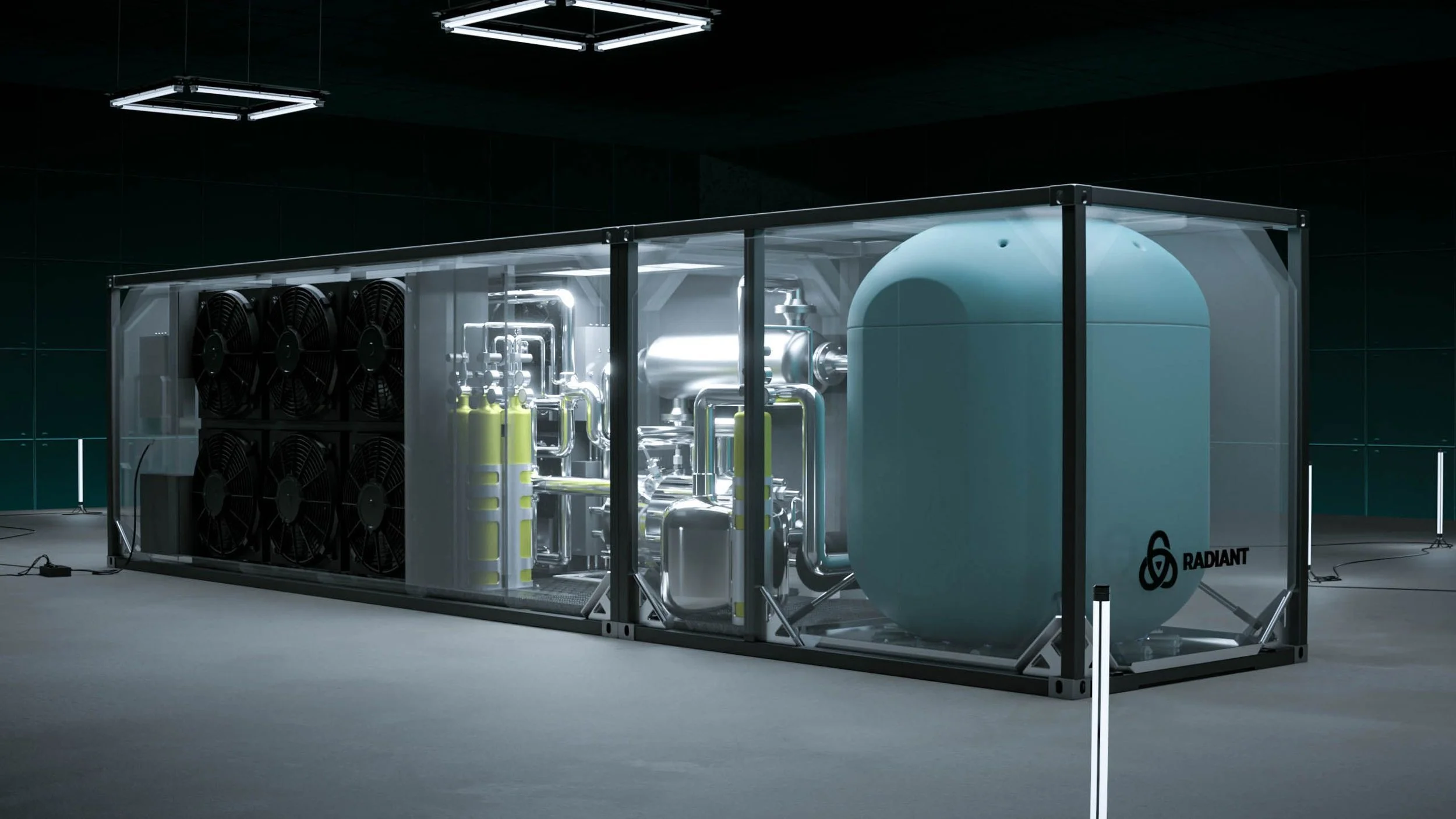
Radiants Advanced Reactor Core: The design is a High-Temperature Gas-cooled Reactor (HTGR) utilizing a prismatic graphite block core.
The second piece of July news is regulatory, and it's the one with an actual deadline attached. On July 27, the Federal Register published a formal notice opening the hearing and intervention window on Radiant's Part 70 special nuclear material license, the license Radiant's R-50 factory in Oak Ridge needs to handle and assemble fuel [3]. The notice states plainly that the NRC's decision is scheduled for completion by December 18, 2026, and that Radiant plans to begin operations in early 2027. Anyone who wants to formally contest the license has until September 25 to file a hearing petition. Federal dockets don't move on a company's own say-so. The NRC set that date, and the NRC's own review calendar, not Radiant's roadmap, is what the timeline now depends on.
Radiant also picked up a second DOE fuel allocation on July 23: a conditional award of HALEU specifically to fuel the Buckley Space Force Base reactor, due for delivery by 2028, with Radiant named the only private-sector recipient in that funding round alongside NASA [4]. Combined with Radiant's existing commercial supply agreement with Urenco, that gives the company two separate paths to fuel on top of what's already sitting inside DOME.
Key dependency: whether the summer full-power test sequence completes cleanly, and whether the December 18 Part 70 decision holds if a hearing petition is admitted before the September 25 deadline.
What to watch: the outcome of Kaleidos's full-power test this summer, and whether any hearing petition against the R-50 license is filed and accepted before the NRC's decision date.
Deployable Energy
Private. Houston, Texas. CEO and co-founder Bobby Gallagher. Selected for the DOE Nuclear Energy Launch Pad in April 2026. Its Unity Nuclear Battery achieved zero-power criticality at Idaho National Laboratory on June 30, 2026, roughly 150 days after project kickoff, the first reactor completed specifically under the Launch Pad framework.
Deployable's criticality milestone in late June was real and independently notable. What happened next is where the story needs a closer look. On July 7, Deployable announced a strategic partnership with GridMarket, a firm that connects data center developers with power sources, covering priority access to Deployable's reactors for hyperscale and data center customers [5]. GridMarket's own headline put the deal at $22.5 billion. Buried in the same release is a second, larger number: an estimated lifetime energy contract value near $145 billion over a 40-year horizon, built on more than 3 gigawatts of planned nuclear deployments through 2035, with Deployable targeting 500 megawatts of new capacity every year starting in 2030. Two numbers, one press release, describing the same deal at different time horizons. Neither is a signed contract.
Those are large, headline-ready numbers. Read them for what they are: a priority-access and pipeline arrangement. GridMarket is agreeing to route its customer funnel toward Deployable's reactors, not signing power purchase agreements on those customers' behalf. No individual data center customer has been named. No firm order has converted from Deployable's previously reported letter of intent, or LOI, pipeline, which the company has separately described as exceeding $10 billion. No specific customer has agreed to pay for a specific reactor on a specific date. Compare that to Radiant's Federal Register notice, which specifies a decision date on a specific license issued by a federal regulator.
Deployable's underlying design choice still looks sound next to Radiant's more exotic fuel chemistry. Unity runs on standard low-enriched uranium and commercially available materials rather than the HALEU-fueled, TRISO-fueled architecture Kaleidos uses, a bet that simpler fuel and materials mean faster licensing. That bet hasn't been tested at the NRC yet. Deployable remains in pre-application activity, working toward an initial utilization-facility license under Part 50 of NRC regulations.
Key dependency: converting the GridMarket pipeline, and its broader letter-of-intent base, into a signed, priced contract, and advancing from NRC pre-application into an actual filed license application.
What to watch: any named commercial customer or a filed NRC license application, either of which would move Deployable's position from promising to proven.
General Matter
Private. Founded 2024 by Scott Nolan, formerly of SpaceX and Founders Fund. Backed by Founders Fund. Awarded a $900 million DOE contract in January 2026 as part of a $2.7 billion federal enrichment investment split among three companies [8]. Building a $1.5 billion HALEU enrichment facility at the former Paducah Gaseous Diffusion Plant in Kentucky.
General Matter's own construction timeline hasn't produced a hard milestone since early summer. Site preparation, tree clearing, root extraction, geotechnical sampling, has continued at Paducah, but a discrete groundbreaking for the enrichment plant itself hadn't been announced as of this writing. The company's public target for actual enrichment operations remains 2034, essentially unchanged since January.
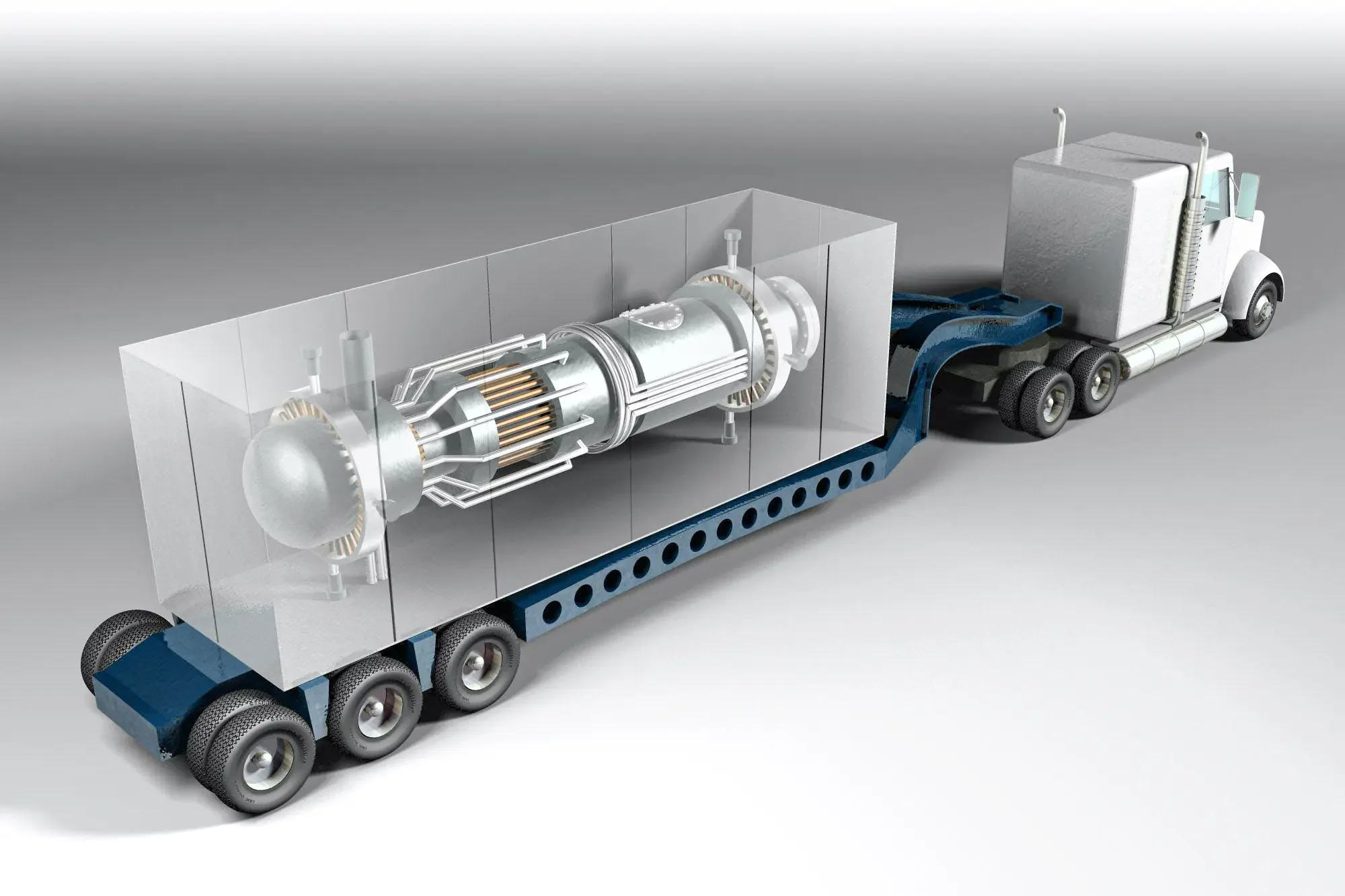
A 3D conceptual rendering of a transportable nuclear microreactor mounted on a heavy-duty semi-truck.
What did change is the neighborhood. On July 29, Brookfield and NextEra Energy, alongside two local utilities and the Paducah Power System, announced a $100 billion, privately funded AI data center campus on federally owned land surrounding the same Paducah site. The companies are targeting up to 1.8 gigawatts of utility capacity, with the Energy Department putting full construction completion at 2031 [6]. Brookfield's CEO called the Paducah site "the seed" of the firm's broader plan to invest $100 billion in AI infrastructure.
It's tempting to read that announcement as General Matter's news. It isn't. General Matter is a separate, existing DOE leaseholder on adjacent land, not a named party to the Brookfield and NextEra project. What the announcement actually signals is site-level momentum: a major private capital commitment on the same federal reservation General Matter already occupies, and a visible bet from two large infrastructure investors that the region has a future worth $100 billion. That's a favorable backdrop for a fuel-supply company trying to prove out a decade-long buildout, and nothing more. General Matter has no contract, no funding commitment, and no construction milestone to show for it.
Meanwhile, the near-term HALEU bridge that Launch Pad companies actually need is coming from elsewhere. Centrus Energy's subsidiary, American Centrifuge Operating, finalized its own separately awarded DOE HALEU task order on July 1, worth roughly $900 million with options extending toward $1.07 billion, aiming to deploy commercial HALEU capacity at Piketon, Ohio, by around 2029 [7]. That timeline still lands five years ahead of General Matter's own 2034 target.
Key dependency: an actual construction start at Paducah, and continued DOE milestone funding under the ten-year contract.
What to watch: the first disclosed construction milestone at the General Matter site itself, distinct from the Brookfield and NextEra data center news next door.
The Launch Pad Stack: How They Compare
| Company | Role in Stack | Structural Position | Key Dependency | What to Watch |
|---|---|---|---|---|
| Radiant Nuclear | DOME test-bed reactor demonstrator | Fuel delivered to DOME; full-power test targeted this summer; Dec 18, 2026 NRC decision date confirmed by Federal Register notice | Clean completion of the summer test sequence; no admitted hearing petition against the R-50 license before Sept 25, 2026 | Kaleidos full-power test results; outcome of the Part 70 hearing window |
| Deployable Energy | Independent-pathway microreactor demonstrator, first to criticality | GridMarket partnership signals large future demand; still pre-application with the NRC | Converting pipeline and letter-of-intent figures into a signed, priced contract; advancing to a filed NRC license | Any named commercial customer; a filed NRC license application |
| General Matter | Domestic HALEU fuel supply | $900M DOE-backed enrichment buildout at Paducah; site benefits from a new $100B neighboring data center project it isn't party to | Actual construction start at Paducah; continued DOE milestone funding | First disclosed Paducah construction milestone specific to General Matter's own plant |
The Honest Tension
None of these three catalysts is as settled as its headline suggests, and none should be read as interchangeable. Radiant's is the most concrete: a federal decision date sits on a public docket, though it isn't final until the hearing window closes without a successful challenge, and the summer test sequence still has to work. Deployable's GridMarket numbers describe demand the company hopes to capture. It hasn't booked the revenue yet, and a $145 billion figure spread across a 40-year horizon means little without a first paying customer. General Matter's biggest July headline belongs to its neighbors. Its own construction schedule sits exactly where it did in January. Three companies, three genuinely different kinds of good news, and only one comes with an enforceable deadline attached.
Rabbt Intelligence Note
A structured Research File on Radiant Nuclear would map the September 25, 2026 hearing-petition deadline against the December 18, 2026 Part 70 decision date, and flag an admitted hearing petition as the Change Trigger most likely to shift this picture. The Relationship Graph would show that Deployable Energy's GridMarket partnership and General Matter's Paducah neighbor share a structural feature Radiant's milestones don't: both describe future demand or future capital rather than a completed regulatory or physical step, a distinction most coverage of all three companies has blurred together. The open question: when the next Launch Pad cohort is named, expected around mid-August 2026, will the new entrants be judged by the same standard, or will pipeline announcements keep getting read as equivalent to hard delivery?
This is editorial content. Rabbt is not a registered investment advisor and does not provide investment recommendations.
This issue reflects structural analysis and figures verified as of its publish date. The frontier economy moves quickly: funding rounds close, valuations shift, contracts get renegotiated, and timelines change. Details in this issue may no longer be current by the time you are reading it. Treat this as a structural snapshot, not a live feed, and verify anything time-sensitive independently before acting on it.
Sources
1. Business Wire, "Radiant Receives First TRISO Fuel Shipment at INL's DOME Facility, Clearing Path to Full-Power, Full-Temperature Testing," July 1, 2026.
2. National Reactor Innovation Center, DOME Scheduling Application, Idaho National Laboratory, accessed July 2026.
3. Federal Register, "Radiant Nuclear, LLC; Radiant's Special Nuclear Material License; License Application," 91 FR 46971, July 27, 2026.
4. Radiant Nuclear press release via Yahoo Finance, "DOE Selects Radiant for Second HALEU Allocation to Support First Commercial Microreactor at a U.S. Military Installation," July 23, 2026.
5. GlobeNewswire, "GridMarket and Deployable Energy Partner on $22.5B Nuclear Pipeline to Power Data Center Customers Through 2035," July 7, 2026.
6. PR Newswire / Bloomberg, "DOE Site in Western Kentucky Revitalized with Data Center Campus and Dedicated Energy Project," July 29, 2026.
7. Centrus Energy Corp., announcement of American Centrifuge Operating DOE HALEU task order finalization, July 1, 2026.
8. U.S. Department of Energy / PR Newswire, "U.S. Department of Energy Awards $900 Million Contract to General Matter," January 7, 2026.
9. American Nuclear Society, "DOE selects first companies for nuclear launch pad," ANS Nuclear Newswire, April 2026.
