
The Motor War Nobody's Covering Is Happening Beneath Tesla's Press Release
Three small companies are betting that the dominant motor design won't survive electrification's next decade.
Tesla's new Cybercab motor swaps materials within a design the company has used since the Model 3. Three much smaller companies are betting the entire architecture changes instead, and one independent rival already failed while making a similar bet.
By Rabbt | October 5th, 2026
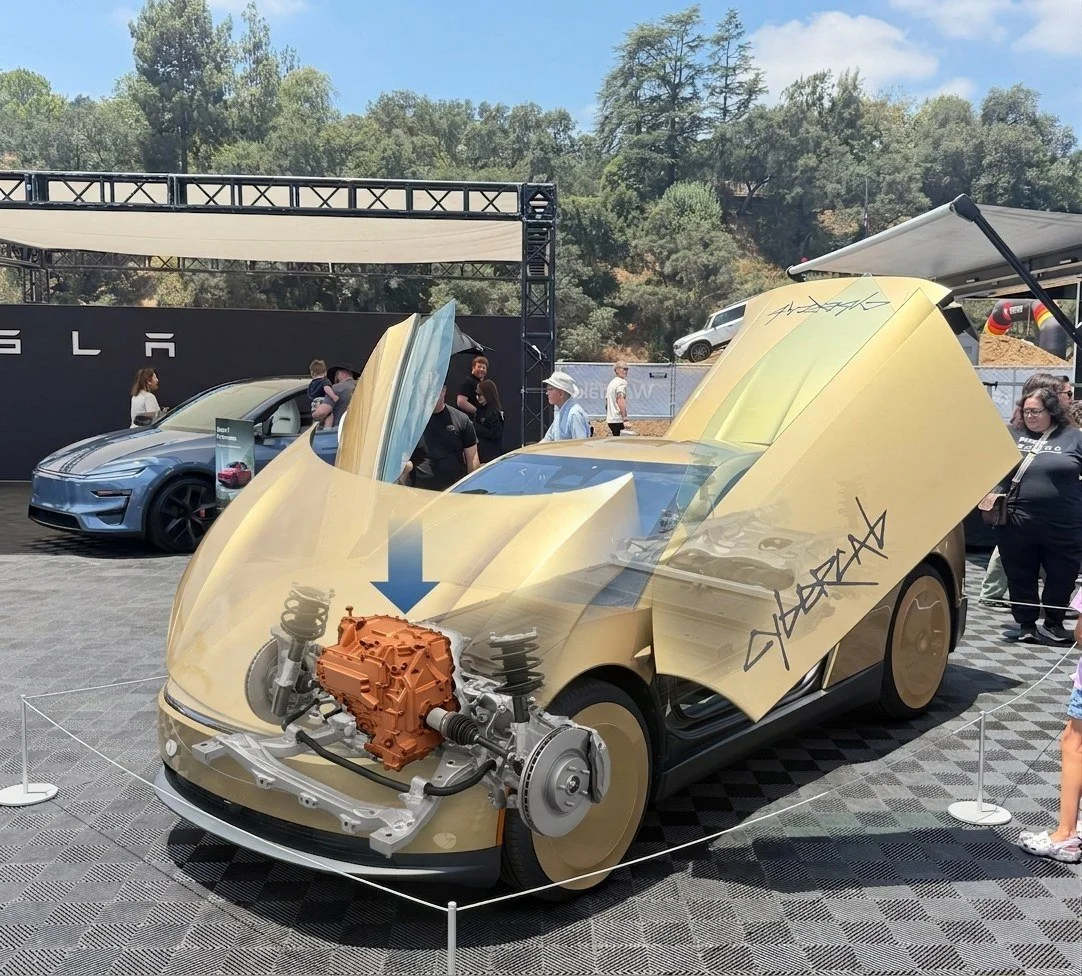
Tesla Cybercab drive unit motor Reveal, September, 2026
Tesla's new Cybercab motor uses no rare earth elements, and the company says it's smaller and lighter than its prior drive units [1]. On its own, that's not the interesting news. Even the least efficient EV motors already convert more than 90 percent of input energy into torque, so the efficiency gain is real but modest [1]. What matters more is how Tesla got there: with a materials swap inside the same radial motor design it has used since the Model 3, rather than a redesign of the motor itself. A handful of much smaller companies are taking a different approach. They aren't just swapping materials. They're betting the entire architecture changes instead, and that bet, not Tesla's, is where the real structural risk sits.
Why Motor Architecture, and Why Now
China's rare earth export controls this year turned a theoretical supply risk into a real one for automakers [2]. Most of the world's rare earth processing runs through China, and although a single car motor needs only a small amount of rare earth material by weight, that concentrated processing is exactly the chokepoint recent export controls have targeted [1]. Tesla chose to solve that problem with a materials swap while keeping the same radial permanent-magnet architecture it has used since the Model 3.
Elsewhere, a different design is gaining ground: the axial-flux motor. It turns the magnetic field sideways rather than straight through the motor, as a conventional radial design does, packing more power into a thinner, lighter housing for the same output. This year, the technology moved from prototype to commercial production. Mercedes-Benz's YASA subsidiary began large-scale production at its Berlin-Marienfelde plant in June 2026, and the new Mercedes-AMG GT 4-Door Coupe is the first car to use it [3]. But axial flux is not a sure bet. Saietta Group pursued the same approach without a large parent company behind it and entered administration in March 2024 after running out of cash before reaching commercial scale [4]. That failure is the baseline against which every independent architecture bet in this sector is measured.
Three much smaller companies are making that bet now, each in a different way.
Turntide Technologies
Private. More than $400 million in disclosed funding since 2021 [5]. Investors include Canada Pension Plan Investment Board, the Amazon Climate Pledge Fund, Bill Gates' Breakthrough Energy Ventures, Robert Downey Jr.'s FootPrint Coalition Ventures, and BMW i Ventures [5]. Headquartered in Sunnyvale, California, with its transport division based in Gateshead, UK.
Turntide is the only company here with neither a large parent nor a single-architecture bet. Its core technology is the switched reluctance motor, a design that has existed for more than a century and spins a simple toothed rotor using electromagnetic attraction, with no magnets at all. Historically, it has been too difficult to control precisely for broad commercial use. Turntide's solution is a cloud-connected control system designed to make switched reluctance motors commercially viable without rare earth magnets, a different path from both Tesla's materials swap and YASA's axial-flux geometry.
In 2021, Turntide bought two UK companies, Hyperdrive Innovation, a battery-pack maker, and BorgWarner's Gateshead power-electronics operations, and combined them into a new division called Turntide Transport [6]. The acquisitions gave Turntide manufacturing scale and an existing customer base in commercial and industrial vehicles. By September 2022, the company said its parts and batteries were powering more than 300,000 vehicles across that combined base [10]. Turntide's axial-flux motor line, a separate technology from switched reluctance, has developed on its own track since then, most recently with the AF300 and AF400 models announced in 2026 [7].
In August 2026, Turntide won a £17 million matched grant from the UK government. Project SUPREME, awarded through the Advanced Propulsion Centre's DRIVE35 program, is intended to automate axial-flux production, an area where manufacturing complexity has historically made the technology expensive to scale [8]. The project runs for 18 months, through January 2028.
Turntide names JCB, Hitachi Rail, and Volkswagen's MAN division among its transport customers [9]. The more unusual dependency sits inside its own cap table: BMW i Ventures is an early strategic investor. That makes BMW both a backer of Turntide's technology and a potential future rival, since BMW runs its own in-house electrification programs. It is a structural tension similar to NVIDIA's relationship with Figure AI in robotics.
What to watch: whether Project SUPREME's automation targets translate into consistent production yields by its January 2028 deadline, and whether Turntide's named customer relationships become disclosed volume orders rather than remaining at the pilot or early-production stage.
Every Monday at 6 AM Eastern. Subscribe at rabbt.org/frontier-file

axial flux electric motor cutaway disc rotor design
Equipmake Holdings plc
Public. AQSE: EQIP, listed on the Aquis Stock Exchange, a UK market for smaller public companies. FY26 revenue, for the year ended May 31, 2026, was approximately £8.2 million according to the company's unaudited trading update, more than double FY25's £3.5 million. Audited results are due in October 2026 [11, 12].
Equipmake is a UK small-cap company building spoke-wound electric motors, inverters, and e-axles for heavy commercial retrofits: buses, trucks, and off-highway vehicles. Its products carry ASIL-D functional safety certification, the strictest tier of the ISO 26262 automotive safety standard, reserved for systems whose failure could directly cause harm. Equipmake's structural position is narrower than Turntide's: it isn't betting on a new physical principle but refining a known one, spoke-wound motor architecture, for a heavy-duty niche the passenger EV conversation largely ignores.
Its H1 FY26 results, covering the six months through November 2025, showed just £1.44 million in revenue, but trading improved sharply in the second half of the year [11]. Orders from Brazilian bus maker Agrale reached roughly £8.8 million in total since September 2025, and Equipmake said it became Adjusted EBITDA-profitable in the second half of FY26 for the first time [12]. Existing supply relationships include Perkins, a Caterpillar subsidiary building a custom heavy-duty hybrid system around Equipmake's motor and inverter technology; Rimac, which uses Equipmake's silicon carbide inverters in its vehicles; and a 2023 licensing deal giving India's Sona Comstar rights to Equipmake's spoke-motor technology across South Asian markets [13].
What to watch: whether this improved trading holds once Equipmake's audited FY26 results arrive in October 2026. The figures here come from the company's unaudited update and have not yet been independently confirmed by an outside auditor.
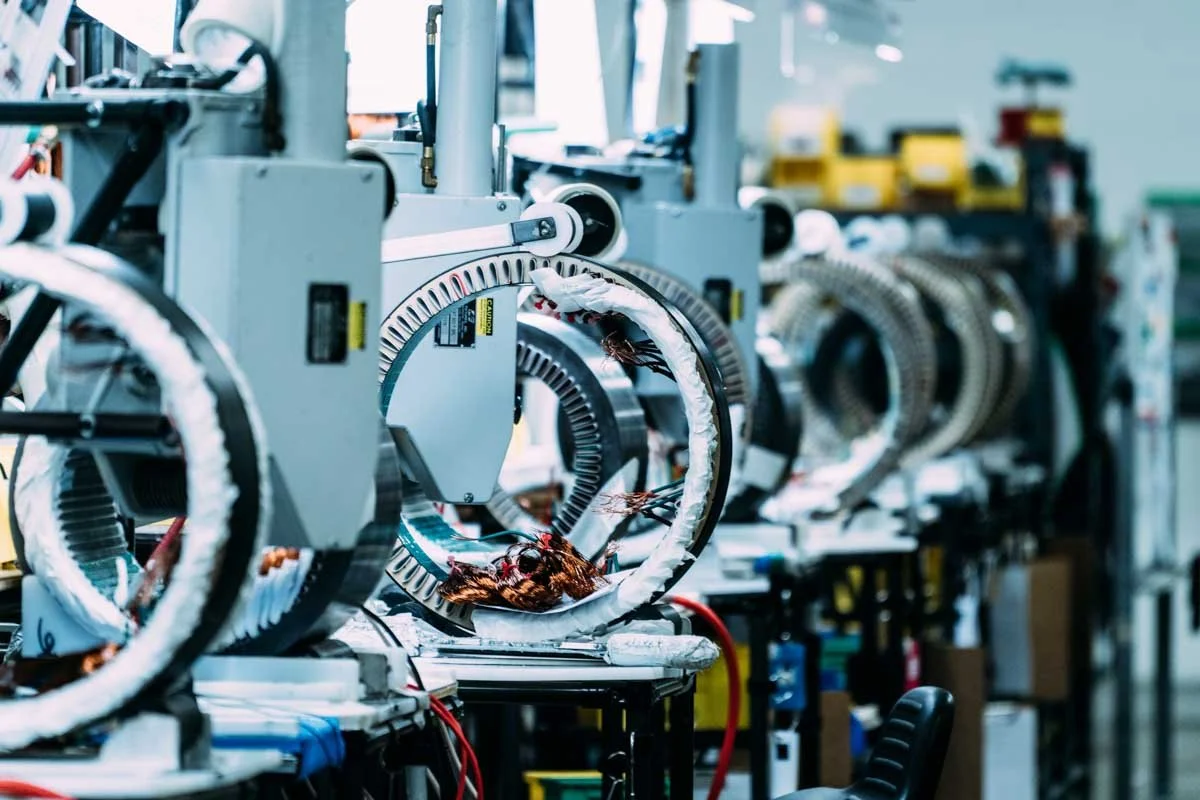
UK electric motor manufacturing production line reluctance motor
Advanced Electric Machines
Private. Spun out of Newcastle University in 2017 by CEO Dr. James Widmer and CTO Dr. Andy Steven [14]. Confirmed funding includes a £23 million Series A in November 2023 and a £16 million follow-on round in August 2026 [14, 15]. Earlier seed-stage funding is not confirmed by a primary source.
Turntide runs two architectures, while Equipmake refines one for a heavy-duty niche. AEM is the purest single-technology bet of the three: switched and segmental reluctance motors only, with no axial-flux line and no acquired businesses layered on top. Its motors also replace conventional copper windings with compressed aluminum coils, a second materials change built on the same logic driving Tesla's rare-earth move, because copper processing is concentrated in a small number of countries as well. AEM's HDRM commercial-vehicle motor is already in production in vehicles across the UK, Europe, North America, and Asia-Pacific [15]. Its passenger-car product, SSRD, remains in development, backed by two commercial relationships announced in the past year: a seven-figure contract with an undisclosed global tier-one automotive supplier signed in October 2025 and a development agreement with an undisclosed major Asian automaker signed in January 2026 [16]. Neither counterparty has been named publicly.
AEM also has an older, named partnership with Bentley Motors through a UK government co-funded research program that built a prototype SSRD e-axle between 2020 and 2023. That work established the technology's early credibility, but it predates AEM's current commercial pipeline and is not a current production dependency [15].
The dependency risk here already has a real example. AEM posted an £8.3 million loss in 2024 on just £2.9 million in revenue, driven partly by the insolvency that year of Tevva Electric Trucks, one of its main commercial-vehicle customers, which forced AEM to write off inventory [16]. It is a reminder that architecture-bet risk does not only come from the motor company failing; a customer failing underneath it can have the same effect.
What to watch: whether either of the new 2025-2026 development contracts turns into a named, disclosed production award, the same commercialization test Turntide faces with Project SUPREME.
| Company | Role in Stack | Structural Position | Key Dependency | What to Watch |
|---|---|---|---|---|
| Turntide Technologies (private) | Independent motor architecture developer running two non-rare-earth designs at once | Backed by $400M+ in institutional and strategic capital since 2021; pursuing switched reluctance and axial flux simultaneously across industrial, rail, and transport applications | UK government grant for axial-flux automation; named customers JCB, Hitachi Rail, and Volkswagen's MAN division; BMW i Ventures as an early strategic investor and potential future competitor | Project SUPREME production automation output through January 2028; whether named customer relationships convert to disclosed volume orders |
| Equipmake Holdings plc (AQSE: EQIP) | Spoke-architecture motor and e-axle supplier for heavy commercial retrofit | UK small-cap; unaudited FY26 revenue roughly doubled to about £8.2 million; turned Adjusted EBITDA-profitable in H2 for the first time | Confirmation of the unaudited FY26 trading update by external audit, due October 2026; licensing relationship with Sona Comstar in India | Whether the improved H2 trading holds once results are audited |
| Advanced Electric Machines (private) | Pure switched and segmental reluctance motor developer for commercial and passenger vehicles | HDRM already in production for commercial vehicles across four regions; SSRD for passenger cars still in development, backed by two new 2025-2026 OEM development contracts | Converting a development contract into a named production award; customer concentration risk already realized once, in the 2024 Tevva insolvency | Whether either new development contract converts to disclosed production volume |
The Honest Tension
Every company in this piece is betting on the same idea: that the dominant radial permanent-magnet motor, the design Tesla just improved rather than replaced, is not the final answer. History says that bet is not free, and the risk runs in two directions. Saietta made the same axial-flux bet Turntide is now scaling, without large-cap backing, and entered administration in March 2024 before reaching commercial volume [4]. AEM took an £8.3 million loss in 2024 when a customer, not AEM itself, collapsed underneath it [16]. None of the three companies here has yet proved its architecture at the kind of sustained, high-volume scale that would displace the dominant design. An architecture bet that runs out of cash, or loses the customer buying it, does not get remembered as a pioneer. It gets remembered as Saietta.
Rabbt Intelligence Note
A structured Research File on Turntide Technologies would map the Project SUPREME grant timeline against its named customer relationships with JCB, Hitachi Rail, and Volkswagen's MAN division, while flagging the pace of axial-flux production automation as the condition most likely to shift this picture. The Relationship Graph would surface something most coverage misses: through BMW's own electrification programs, BMW i Ventures is both an early strategic investor and a potential future competitor. The open question: does running two architectures under one roof provide a genuine hedge if one technology fails, or does it split capital and engineering focus across two bets when one disciplined approach might have scaled faster?
This is editorial content. Rabbt is not a registered investment advisor and does not provide investment recommendations.
This issue reflects structural analysis and figures verified as of its publish date. The frontier economy moves quickly: funding rounds close, valuations shift, contracts get renegotiated, and timelines change. Details in this issue may no longer be current by the time you are reading it. Treat this as a structural snapshot, not a live feed, and verify anything time-sensitive independently before acting on it.
Sources
1. Digital Today, "Tesla unveils rare earth-free Cybercab motor; doubts remain over supply chain shift," September 7, 2026.
2. BigGo Finance, "Tesla's Rare-Earth-Free Cybercab Motor Challenges China's Supply Chain Leverage," September 2026.
3. Mercedes-Benz Group, "Large-scale production of electric axial flux motor," June 9, 2026.
4. Drives & Controls, "UK motor-maker Saietta enters administration," March 8, 2024.
5. PR Newswire, "Turntide Technologies Completes $225 Million Financing," June 30, 2021.
6. electrive.com, "Hyperdrive & BorgWarner Gateshead acquired by Turntide," June 8, 2021.
7. OEM Off-Highway, "Turntide Technologies Expands Axial Flux Motor Portfolio with AF300, AF400 Models," April 22, 2026.
8. GlobeNewswire, "Turntide Selected for £17 Million UK Government Grant Project to Accelerate Volume Production of Axial Flux Motors," August 10, 2026.
9. PR Newswire, "Turntide Technologies Extends Its Smart Motor System To Transportation Sector With Acquisition Of Electric Vehicle Technology," June 8, 2021.
10. GlobeNewswire, "Turntide Technologies Electrifies 300,000 Commercial Vehicles, a New Company Milestone," September 14, 2022.
11. Aquis Stock Exchange (Equipmake Holdings plc company announcement), "Trading Update and Directorate Changes," June 22, 2026.
12. DirectorsTalk Interviews, "Equipmake FY26 Revenue More Than Doubles As Trading Improves," July 21, 2026.
13. EV Tech Insider, "Equipmake Unveils New Heavy-Duty Electric Motor With Double The Continuous Power," October 3, 2024.
14. UKTN, "Newcastle spinout Advanced Electric Machines secures £16m," August 5, 2026.
15. Legal & General Group, "Advanced Electric Machines addresses sustainability of EV motors with £23 million new investment," November 20, 2023.
16. electrive.com, "AEM gains additional development partner for rare-earth-free electric motors," January 28, 2026.