
The Virtual Cell Race Isn't About Better Models. It's About Who Controls the Data.
Recursion and NVIDIA show why, and NVIDIA turns out to have a stake in the outcome.
Insitro built its reputation on modeling human biology in software. The real contest beneath that pitch is over who owns the data and the machines that process it, and one of those machine owners has already picked a side.
By Rabbt | September 28, 2026

AI drug discovery computational biology lab automation
Insitro calls itself a company that models human biology in software. That description is accurate, but it is also the less interesting part of the story. The interesting part is that Insitro, like every serious competitor in this field, has discovered that a good model is no longer the hard part. The hard part is generating enough proprietary data to train it and securing enough computing power to do the training. Most coverage of AI-driven biology treats this as a modeling contest. It's actually a resource contest, and one of its most important resources, compute, isn't being supplied neutrally.
Why Virtual Cells and Why Now
Two studies published this month in the journal Cell gave scientists their first real look at a working “virtual cell.” Researchers at the University of California San Diego built two systems: an AI model that predicts a cell's health just from the shape of its mitochondria, the structures inside cells that convert nutrients into energy, and a separate physics-based simulation, sometimes called a digital twin, that reproduced how a real cancer cell's internal transport network responded to a drug without the researchers changing a single setting [1]. Neither system is a product. Both are academic demonstrations that cell-level simulation has crossed a real scientific threshold: software can now predict biological behavior accurately enough to be useful, not just illustrative.
That threshold matters because a handful of companies have spent years betting their entire business on reaching a version of it commercially. Insitro calls its platform “Virtual Human” [2]. Recursion Pharmaceuticals calls its dataset a map that lets it predict and navigate trillions of biological and chemical relationships [3]. Both are chasing a simulation of human biology accurate enough to test drugs virtually before anyone touches a real cell. Getting there depends on two things neither company can shortcut: proprietary data nobody else has, and enough computing power to make sense of it. That's where NVIDIA enters the picture, and where the story stops being simple.
Insitro
Private. Headquartered in South San Francisco, California. Founded in 2018 by Daphne Koller. Raised at least $643 million across three announced funding rounds since 2018 [4][5][6]. Key partnerships: Bristol Myers Squibb (NYSE: BMY) on amyotrophic lateral sclerosis, or ALS, a fatal disease that progressively destroys nerve cells; Gilead on liver disease [6]; Eli Lilly on metabolic disease [7].
Insitro's pitch is that it builds a “Virtual Human” platform: software models trained to predict how a real patient's biology will respond to a drug before that drug exists. The platform runs on two separate engines. One, called ClinML, mines large public datasets for genetic patterns linked to disease. Those datasets include the UK Biobank, which holds health and genetic records for roughly half a million people. The other, CellML, is Insitro's own wet-lab system, with robots running gene-editing experiments on human cells at scale to generate data nobody else has. Insitro's own leadership has said plainly that public data alone is not enough. It's limited in scope and hard to interpret without a company generating its own complementary data [8].
That second engine, the proprietary one, is the actual structural position. Anyone can download the UK Biobank. Nobody else can download Insitro's cell experiments, because Insitro is the company running them. The bet is that owning the data-generation pipeline, not just the modeling layer built on top of it, is what can compound over time.
The dependency that follows from this bet is straightforward. Insitro's value is tied directly to how fast and how cheaply it can keep generating proprietary experimental data. If the wet lab slows down relative to competitors, the model also stops improving relative to competitors, regardless of how clever its architecture is.
The clearest evidence that the strategy is working comes from Insitro's oldest partnership. Bristol Myers Squibb and Insitro signed a five-year collaboration in 2020 to find new targets for ALS, for which no treatment currently reverses the disease's course. In December 2024, Bristol Myers Squibb nominated its first target, ALS-1, based on biology the Virtual Human platform identified [2]. In March 2026, the companies expanded the deal: Bristol Myers Squibb nominated two more targets, ALS-2 and ALS-3, both aimed at correcting a protein abnormality present in nearly 97% of ALS cases, and paid Insitro a $10 million milestone for the selection [9]. That's a pharmaceutical partner putting real money behind targets identified by a virtual model three separate times over roughly fifteen months.
What to watch: whether ALS-2 and ALS-3 reach further milestones as the programs advance. That would be the strongest available evidence that Insitro's proprietary-data bet is translating into real drugs rather than just well-funded modeling. A slowdown in new target nominations from any of Insitro's partners would be an earlier, quieter signal that the data-generation engine is not keeping pace.
Every Monday at 6 AM Eastern. Subscribe at rabbt.org/frontier-file

Recursion Pharmaceuticals BioHive-2 NVIDIA supercomputer data center
Recursion Pharmaceuticals
Public. Ticker: NASDAQ: RXRX. Price approximately $3.60 and market capitalization approximately $1.6 billion, last confirmed in late July 2026 within the research-stage budget [10] [Unverified: this is not a live quote; price and market cap require a same-day pull before publish]. Headquartered in Salt Lake City, Utah. Founded in 2013. Key partnerships include Roche and Genentech, Sanofi, Bayer, and Merck KGaA [11].
If Insitro's bet is about the data-generation pipeline, Recursion Pharmaceuticals is the clearest example of what that bet looks like at an industrial scale. Recursion's own regulatory filings put its combined dataset, the Recursion OS, at more than 50 petabytes: over 300 million cell-imaging experiments, more than a million gene-expression readouts, and predicted interactions across roughly 36 billion chemical compounds [3]. Recursion's manufacturing arm has produced more than a trillion lab-grown neuronal cells since 2022 to feed those experiments [3]. In November 2024, Recursion completed its acquisition of Exscientia, a chemistry-focused AI drug design company, folding precision molecule design directly into its data pipeline [12].
None of that data is useful without the computing power to process it, and that is where the contrast with Insitro sharpens. In 2023, NVIDIA invested $50 million directly into Recursion and became a technical partner in the development of BioHive-2, a supercomputer using more than 500 of NVIDIA's high-end graphics processing units, or GPUs, the specialized chips that do the heavy computing work behind AI models [13]. BioHive-2 debuted at No. 35 on the TOP500, the industry's twice-yearly ranking of the world's fastest supercomputers, making it the most powerful supercomputer owned by any biopharmaceutical company [14]. As of a 2024 disclosure, Recursion was NVIDIA's second-largest publicly disclosed equity investment, trailing only chip designer Arm Holdings [15].
What to watch: whether NVIDIA forms a comparably direct financial and engineering relationship with any other virtual-cell competitor. If it doesn't, that's a real structural advantage for Recursion, not just a vendor relationship.
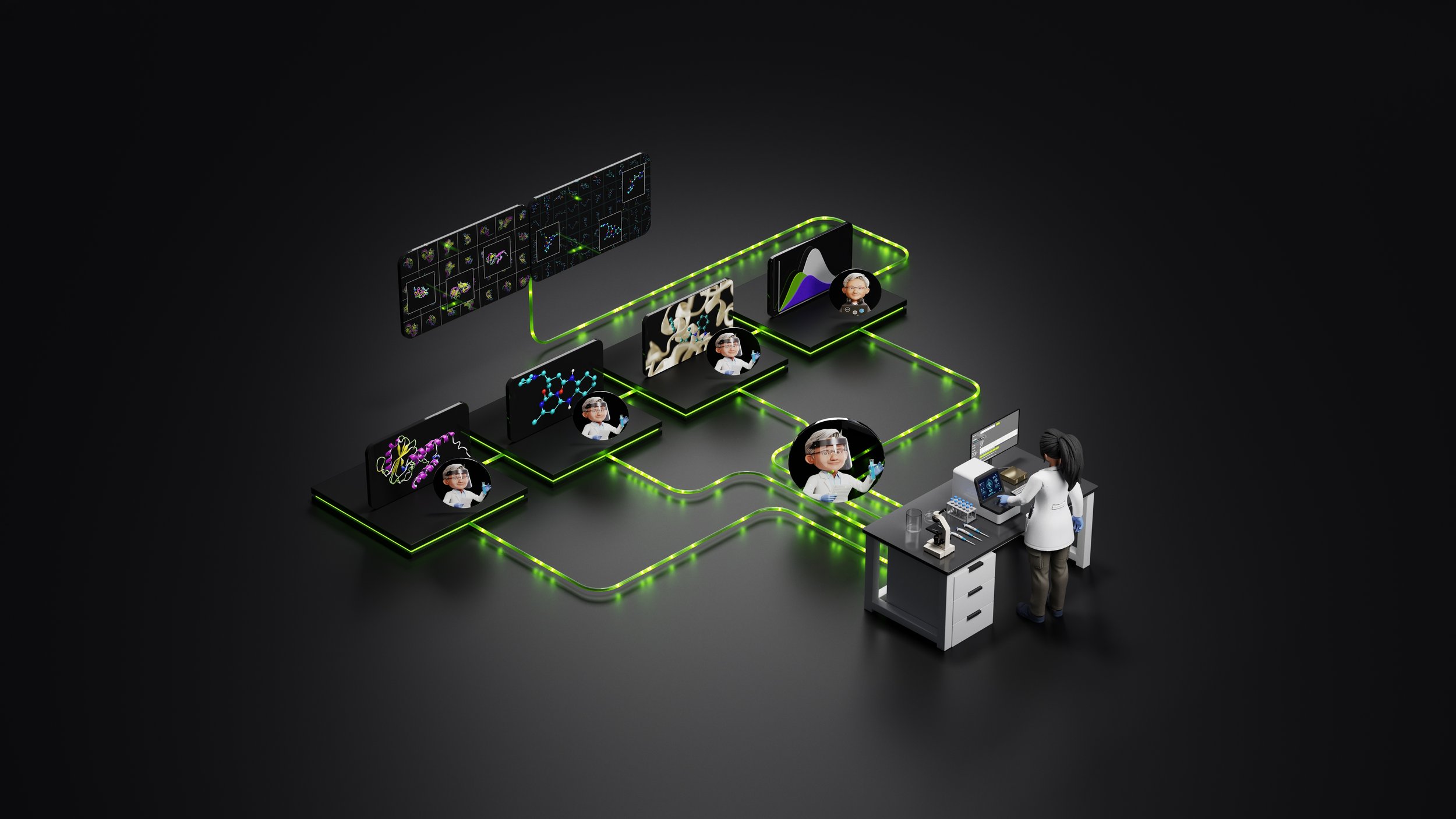
NVIDIA’s visualization of BioNeMo’s AI drug discovery toolkit
NVIDIA
Public. Ticker: NASDAQ: NVDA. Price approximately $219 and market capitalization approximately $5.3 trillion as of September 17, 2026 [16] [Unverified: live price and market cap require a same-day pull before publish]. Headquartered in Santa Clara, California.
NVIDIA's role in this story is usually framed as infrastructure: it sells the GPUs everyone needs, and everyone needs them equally. That framing is mostly true, but incomplete. NVIDIA's BioNeMo platform, a set of tools for training AI models on biological data, has been adopted by more than 200 biopharmaceutical and technology-biology companies as of a January 2026 expansion announcement, and cloud providers including Amazon Web Services, Deloitte, and Accenture now deploy BioNeMo-based solutions to their own enterprise customers [17]. On paper, that's exactly the neutral-utility position this comparison would assign it.
But NVIDIA is not participating in this race from the sidelines. Its direct equity stake in Recursion and its hands-on role building BioHive-2 mean it has a financial and engineering interest in one specific competitor's success, not just in selling compute to the field broadly. That's a materially different relationship than the one it has with the hundreds of other companies using BioNeMo off the shelf. Whether NVIDIA has comparable ownership stakes or engineering relationships with Insitro, or with any other virtual-cell company, is not publicly disclosed, which is itself worth noting: this is not a pattern NVIDIA is visibly repeating across the whole field.
What to watch: any future NVIDIA equity filing or joint-engineering announcement naming a second virtual-cell company. That would show whether NVIDIA is building a portfolio of strategic bets inside the field it also supplies, or whether Recursion was a one-off.
| Company | Role in Stack | Structural Position | Key Dependency | What to Watch |
|---|---|---|---|---|
| Insitro | Proprietary data generation for virtual human modeling | Combines public genetic data with its own wet-lab perturbation data via CellML | Pace and cost of proprietary data generation | Whether ALS-2 and ALS-3 reach further milestones |
| Recursion Pharmaceuticals | Data at scale plus dedicated compute | Proprietary dataset of more than 50 petabytes (Recursion OS), paired with an NVIDIA-built supercomputer | NVIDIA's direct equity and engineering involvement | Whether NVIDIA forms a similar alliance with a second company |
| NVIDIA | Compute supplier and equity stakeholder | BioNeMo platform serving more than 200 biopharma companies, plus a direct equity stake in Recursion | Whether its infrastructure role and its equity role stay separable | Any new NVIDIA equity or build announcement with another virtual-cell company |
The Honest Tension
The bifurcation this piece set out to describe, data companies against compute companies, doesn't survive contact with the facts. NVIDIA is both. It sells compute to more than 200 companies in this field and holds a direct equity stake in one of them. That's not a conflict that Recursion or NVIDIA has hidden; both disclosed it in required filings. It's a conflict most coverage of AI-driven drug discovery simply does not mention. Insitro's compute arrangement is not publicly disclosed, so this comparison can't say whether Insitro faces the same asymmetry or a different one. What the evidence supports is narrower than the original pitch: NVIDIA's infrastructure position is real, and it's not neutral.
Rabbt Intelligence Note
A structured Research File on Insitro would map its proprietary CellML data-generation pace against Bristol Myers Squibb's milestone cadence, and flag any slowdown in new target nominations as the Change Trigger most likely to shift this picture. The Relationship Graph would show that Insitro's compute arrangement is not publicly disclosed, unlike Recursion's direct equity alliance with NVIDIA. That is a genuine information gap rather than a settled fact. The open question: does Insitro's proprietary-data approach compound as reliably without a comparable strategic compute partner, or is Recursion's direct NVIDIA relationship the real structural edge in this race?
This is editorial content. Rabbt is not a registered investment advisor and does not provide investment recommendations.
This issue reflects structural analysis and figures verified as of its publish date. The frontier economy moves quickly: funding rounds close, valuations shift, contracts get renegotiated, and timelines change. Details in this issue may no longer be current by the time you are reading it. Treat this as a structural snapshot, not a live feed, and verify anything time-sensitive independently before acting on it.
Sources
[1] UC San Diego Today, “Virtual Cells Built from 4D AI Models and 'Digital Twins' Could Speed Up Drug Discovery,” Sept. 17, 2026, referencing Cell (2026), DOI: 10.1016/j.cell.2026.08.028. today.ucsd.edu/story/virtual-cells-built-from-4d-ai-models-and-digital-twins-could-speed-up-drug-discovery
[2] Business Wire (insitro), “insitro Receives $25 Million in Milestone Payments from Bristol Myers Squibb for the Achievement of Discovery Milestones and the Selection of First Novel Genetic Target for ALS,” Dec. 18, 2024. businesswire.com/news/home/20241218771566/en
[3] Recursion Pharmaceuticals, Inc., Form 10-Q, period ended Sept. 30, 2024, U.S. Securities and Exchange Commission. sec.gov/Archives/edgar/data/1601830/000160183024000196/rxrx-20240930.htm
[4] Daphne Koller, “insitro: rethinking drug discovery using machine learning,” Medium. medium.com/@daphne_38275/insitro-rethinking-drug-discovery-using-machine-learning-dcb0371870ee
[5] Business Wire (insitro), “insitro Announces $143 Million Raised in Series B Financing,” May 26, 2020. businesswire.com/news/home/20200526005212/en
[6] Business Wire (insitro), “insitro Raises $400 Million in Series C Financing,” March 15, 2021. businesswire.com/news/home/20210315005214/en
[7] BioWorld, “Insitro and Lilly take aim at metabolic diseases through new agreements,” Oct. 10, 2024. bioworld.com/articles/topic/214
[8] American Medical Association Ed Hub, interview with Ajamete Kaykas (insitro). edhub.ama-assn.org/jn-learning/audio-player/19015752
[9] Business Wire (insitro), “insitro and Bristol Myers Squibb collaboration expanded with nomination of new targets,” March 23, 2026, as carried by SWOK News (AP). swoknews.com/ap/business/insitro-and-bristol-myers-squibb-collaboration-expanded-with-nomination-of-new-targets
[10] StockEvents, Recursion Pharmaceuticals (RXRX) snapshot [not a confirmed live quote; see note in body]. stockevents.app/en/stock/RXRX
[11] Recursion Pharmaceuticals, “Recursion Provides Business Updates and Reports Fourth Quarter and Fiscal Year 2024 Financial Results,” Feb. 28, 2025. ir.recursion.com/node/11341/pdf
[12] Recursion Pharmaceuticals, Inc., Form 424B5, U.S. Securities and Exchange Commission. sec.gov/Archives/edgar/data/1601830/000160183026000041/rxrx-2026atm.htm
[13] Recursion Pharmaceuticals, Inc., Form 8-K, Exhibit 99.1, July 12, 2023, U.S. Securities and Exchange Commission. sec.gov/Archives/edgar/data/1601830/000160183023000050/ex991-rxrxxnvidiapr.htm
[14] Recursion, “Drug Discovery, STAT! NVIDIA, Recursion Speed Pharma R&D With AI Supercomputer.” recursion.com/news/drug-discovery-stat-nvidia-recursion-speed-pharma-r-d-with-ai-supercomputer
[15] Benzinga, “Nvidia-Backed Recursion Pharmaceuticals Stock Is Up On Q1 Earnings: Everything You Need To Know,” May 2024. benzinga.com/news/earnings/24/05/38747694
[16] Analytics Insight, “NVIDIA Stock Price, Performance & Key Factors to Watch,” data as of Sept. 17, 2026. analyticsinsight.net/stocks/nvidia-stock-price-performance-key-factors-to-watch
[17] NVIDIA, “NVIDIA BioNeMo Platform Adopted by Life Sciences Leaders to Accelerate AI-Driven Drug Discovery,” Jan. 12, 2026. investor.nvidia.com/news/press-release-details/2026/NVIDIA-BioNeMo-Platform-Adopted-by-Life-Sciences-Leaders-to-Accelerate-AI-Driven-Drug-Discovery/default.aspx