
QCi, IonQ and IBM are making different bets on one of the hardest parts of quantum hardware: building it reliably, repeatedly, and at a cost customers can support.
October 26, 2026
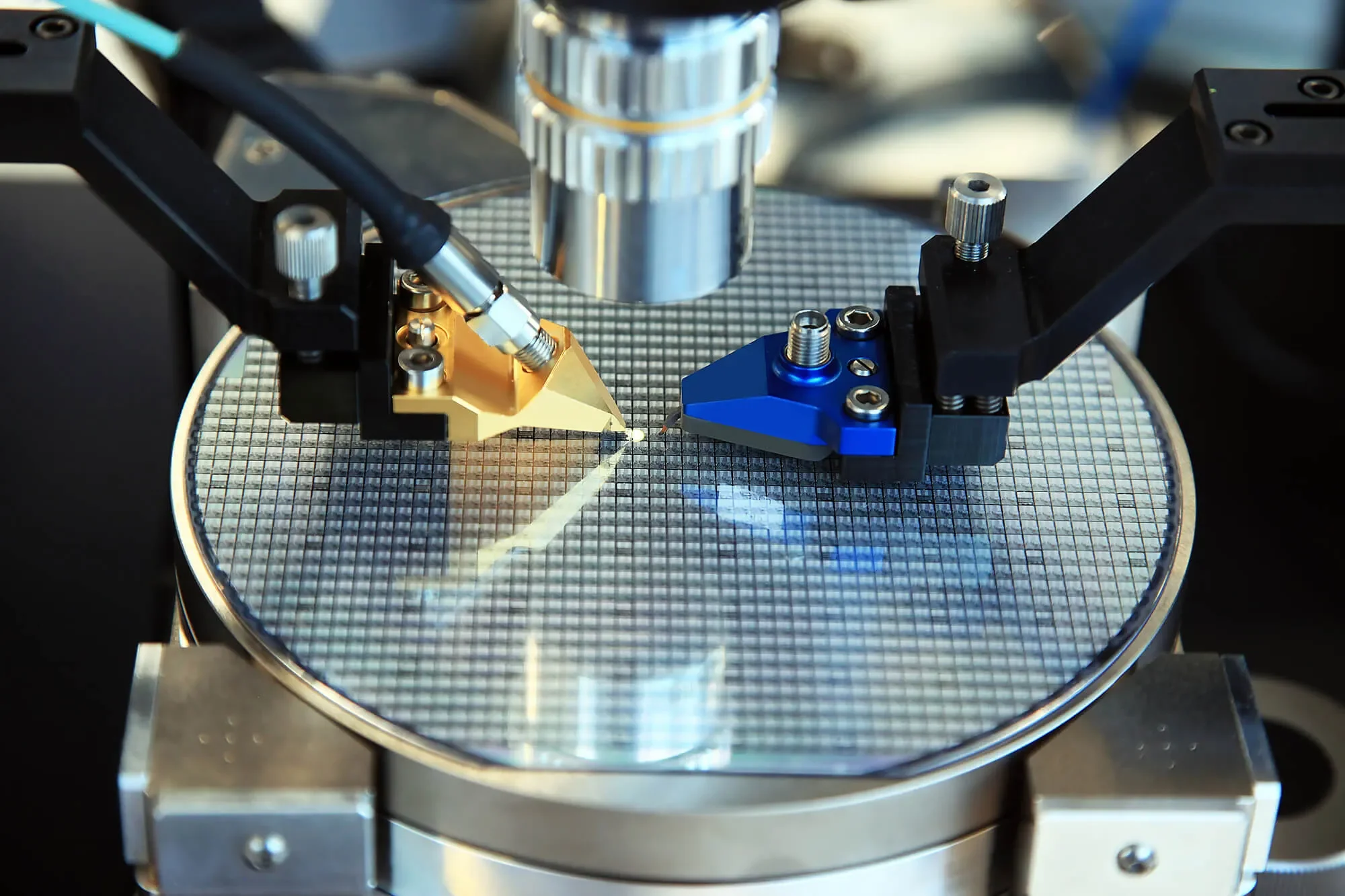
Image of robotics in quantum wafer-production
A quantum computer can look impressive in a laboratory. There may be a maze of cables, a gleaming metal enclosure, and a research team that has spent years coaxing a fragile physical system into producing a result. What you cannot see in that photograph is how easily the same result can be reproduced. Could a second system be built on schedule? Could the necessary components be made in volume? And would anyone be willing to pay what that process costs?
Those questions are becoming harder to postpone. In 2026, three very different companies made significant moves in the manufacturing behind quantum technology. Quantum Computing Inc., better known as QCi, expanded its photonics and packaging operations. IonQ acquired an established semiconductor foundry business. IBM, meanwhile, backed Anderon, a company dedicated to quantum wafer production. The headline sounds simple: quantum companies are moving into factories. The details tell a more useful story.
A factory is not proof of a superior quantum computer. It is an attempt to control part of the path from experiment to commercial product. What matters now is what each company can actually make, who might buy it, and whether the economics still work after the initial announcements fade.
Why Manufacturing, and Why Now
Quantum computing is not a single machine built to a single standard. Some systems use superconducting electrical circuits chilled to extremely low temperatures. Some hold individual ions in electromagnetic fields. Photonic systems use light, while silicon-spin approaches encode information in the properties of electrons. The machines and the components around them pose different engineering problems. Many rely on specialist chips, lasers, optical parts, packaging, control electronics, or a combination of these.
A wafer is a thin piece of material on which circuits or other structures can be fabricated. A foundry provides manufacturing capability, often for companies that do not own the equipment. Packaging comes after core structures are fabricated: connecting, protecting, and integrating them so they work in usable systems. These activities are connected, but they are not interchangeable. Owning packaging equipment is not the same as owning a leading-edge wafer process. Having a large wafer plant does not mean a company has solved quantum error correction.
In established semiconductors, the practical questions are familiar. How many usable devices come off each wafer? How much variation is there from one production run to another? What does it cost to manage defects, package parts, and test them? Manufacturers call the share of acceptable units the yield. A research result that works only occasionally is difficult to commercialize. The same basic discipline is reaching quantum hardware, although the measurement problems can be substantially different.
There is also a strategic reason to care. A company that controls scarce manufacturing processes may be able to iterate designs more quickly, keep specialized knowledge close, and sell services to other firms. It may also inherit substantial fixed costs, expensive equipment, and customers whose interests do not always match its own. That trade-off, rather than a race to own the most factories, is what links the three companies.
Every Monday at 6 AM Eastern. Subscribe at rabbt.org/frontier-file
QCi
Public company: Nasdaq QUBT | Headquarters: Hoboken, New Jersey
QCi is the smallest and most specialized of the three companies here. Its photonics strategy uses thin-film lithium niobate, often shortened to TFLN. The material responds strongly to an applied electric field, which allows engineers to change properties of light traveling through an optical device. That makes it useful for modulators and other components used in optical communications, sensing, and some quantum-related systems. It does not mean that every TFLN chip is itself a quantum computer.
QCi's manufacturing footprint has expanded through a series of moves. Its corporate predecessor dates to 2001, but QCi adopted its quantum-computing direction in 2018 and expanded its photonic expertise through the 2022 QPhoton merger [1]. In 2025 it opened Fab 1 in Tempe, Arizona. In 2026, it added capabilities through the acquisition of Luminar Semiconductor and, in June, NHanced Semiconductors [2]. Those steps expanded the fabrication, laser, detector, and advanced-packaging work available within its group. They do not establish complete independence from external suppliers.
NHanced matters because this is not simply a story about QCi manufacturing for itself. NHanced had its own customers before the acquisition. In a June letter, the business told customers their existing programs and orders would continue and said customer-specific information would be protected [3]. Those are management commitments, not independent evidence that every relationship will remain unchanged. Still, the starting point matters: QCi did not have to create an outside-customer base from nothing.
QCi completed the NHanced acquisition in June. Its closing announcement described consideration of about $73.1 million in cash and stock, plus up to $72 million of additional contingent consideration. The June-quarter filing reported a preliminary accounting allocation of about $73.8 million [2, 4]. The acquisition had already closed; only the accounting allocation remained preliminary. The filing also distinguishes a $20 million escrow arrangement from the contingent earn-out. Specific future revenue and EBITDA milestones affect these arrangements in 2027 and 2028 [4]. They measure financial performance under the deal terms, not the percentage of factory machines being used.
The gap between QCi's ambitions and current operations is visible in its financials. QCi reported roughly $5.55 million of revenue in the second quarter of 2026 and about $21.85 million in operating expenses. Its reported cost of revenue exceeded quarterly revenue, implying a gross loss of about $1.17 million. The company also reported around $42.5 million in backlog and about $1.3 billion in cash, cash equivalents, and investments at June 30 [4, 5]. Backlog is not booked revenue, expenses are not interchangeable with cash burn, and a large investment balance does not prove that a new manufacturing operation will become profitable.
The other side of that picture is that QCi has resources to experiment, acquire assets, and endure a slower commercial ramp than its current revenue might suggest. Its challenge is not simply whether the next financing round appears. It is whether those assets turn into repeatable production, recognizable customer demand, and attractive unit economics before operating costs erode the advantage that capital provides.
QCi also acquired NuCrypt in 2026, adding a quantum-communications business. That matters because the commercial uses of photonic components extend beyond quantum processors. In its second-quarter announcement, QCi described an order from an unnamed university for a secure quantum-communications system [5]. The company did not disclose the contract value. The order is evidence of customer interest, but it is not proof of shipment, payment, or demand at scale. Quantum-secure communications also should not be conflated with post-quantum cryptography, which uses different security methods.
What to watch: organic and acquired revenue separately, NHanced’s contractual financial milestones, evidence of recurring outside-customer orders, reported gross margins, and any concrete disclosure on manufacturing yield or utilization. Those measures will tell us more than the number painted on a building.
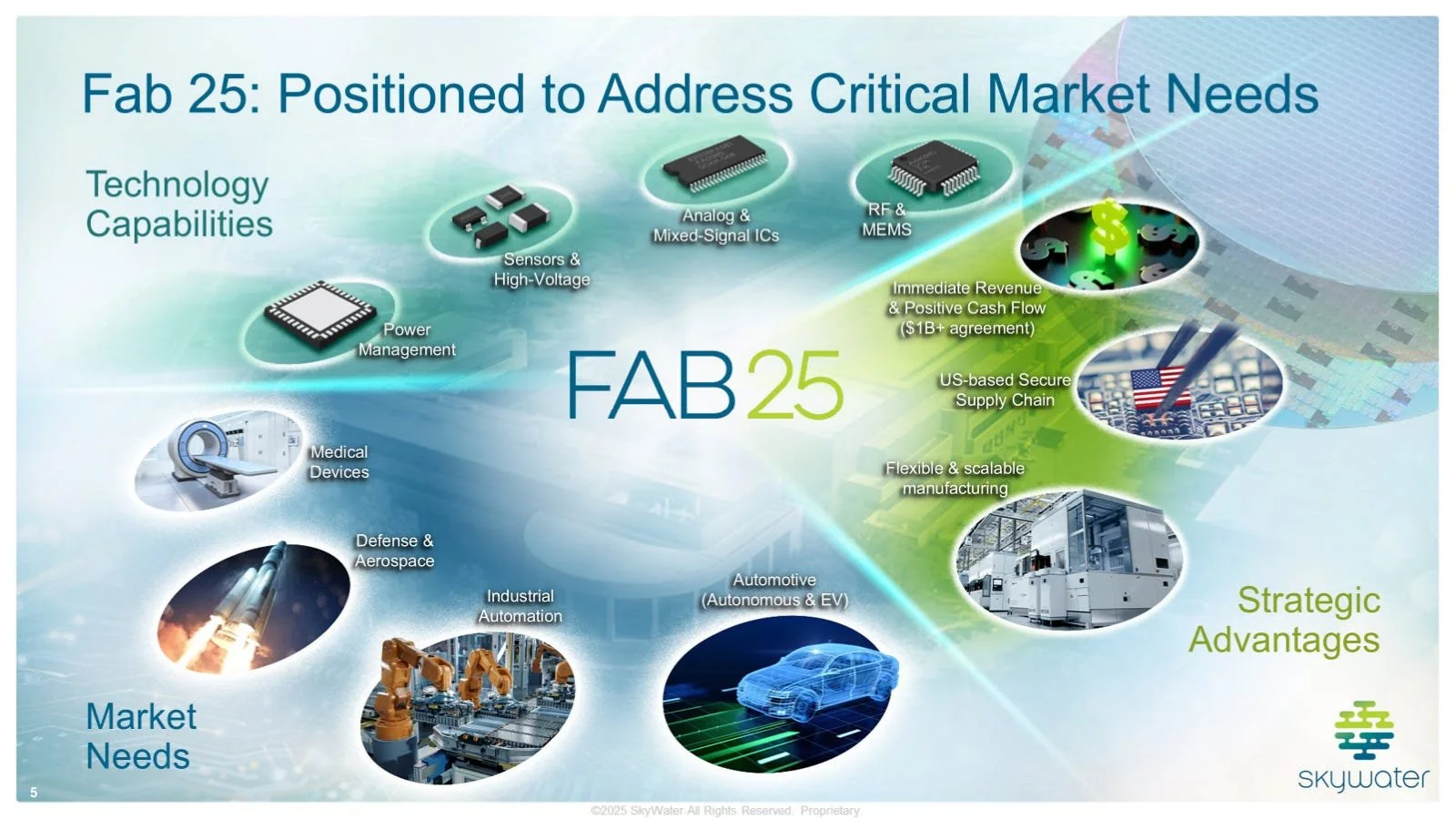
Image of various critical market uses for Skywater chips
IonQ
Public company: NYSE IONQ | Headquarters: College Park, Maryland
IonQ approached the manufacturing question by buying an operating business rather than assembling specialized capabilities one piece at a time. On July 31, 2026, it completed its acquisition of SkyWater Technology, valued at approximately $1.8 billion in the company's disclosures [6, 7]. SkyWater already manufactured chips and related technologies for outside customers in several industries. IonQ therefore acquired not only facilities and technical capabilities but also a business with established customer relationships and its own economics.
That difference cuts both ways. An existing customer base gives SkyWater a reason to operate beyond IonQ's internal roadmap. At the same time, customers, including companies that may compete with parts of IonQ's business, need confidence that their confidential designs and priorities remain protected. IonQ has said SkyWater will continue serving its customers. The detailed contractual arrangements are not publicly available in the sources reviewed here. There is no basis to claim a breach or customer departure, nor is there a basis to declare every potential conflict permanently resolved.
SkyWater offers a broad collection of semiconductor services, including manufacturing and packaging capabilities. Its website specifies that DMEA Category 1A Trusted Foundry services are available through select facilities, not at every location [8]. That detail matters in a market where national security, supplier qualification, and domestic manufacturing are central concerns. A designation is meaningful, but its actual scope matters too.
IonQ's financial scale also matters. It reported $80.1 million in second-quarter 2026 revenue, before the July 31 SkyWater closing, and about $3.0 billion in cash, cash equivalents, and investments at June 30. The company presented a pro forma figure of approximately $2.0 billion after the cash component of the SkyWater acquisition [9]. This should not be mistaken for an independently audited October cash balance. On September 8, IonQ raised its full-year 2026 revenue outlook to $450 million to $460 million, expressly including SkyWater contributions from the acquisition date and eliminating estimated intercompany revenue [10]. That was management guidance, not revenue already earned.
The distinction is essential. Buying a revenue-producing foundry changes the size and mix of consolidated revenue. It does not tell us how much demand for IonQ's quantum computers grew organically. Readers should track the core quantum platform and the manufacturing business separately rather than treat all post-deal growth as a single technical breakthrough.
IonQ has continued to expand on other fronts. In October, it announced an agreement to acquire cybersecurity company Elisity in a transaction valued at up to $1.3 billion, including contingent consideration [11]. On October 14, IonQ priced a $2.0 billion financing that closed October 16. The transaction involved common stock, pre-funded warrants, and separate seven-year warrants covering up to 100 million additional shares at a $69.46 exercise price [12]. Potential dilution depends on the terms and future exercise; those additional shares should not be counted as already issued. These are material capital-allocation decisions, although the Elisity deal is not itself about fabrication.
What to watch: separate performance reporting for SkyWater, retention of existing outside customers and acquisition of new ones, manufacturing profitability, and evidence that its capabilities shorten IonQ's own development cycle. If those data remain blended into a larger consolidated story, outsiders will have a harder time judging the acquisition on its own merits.
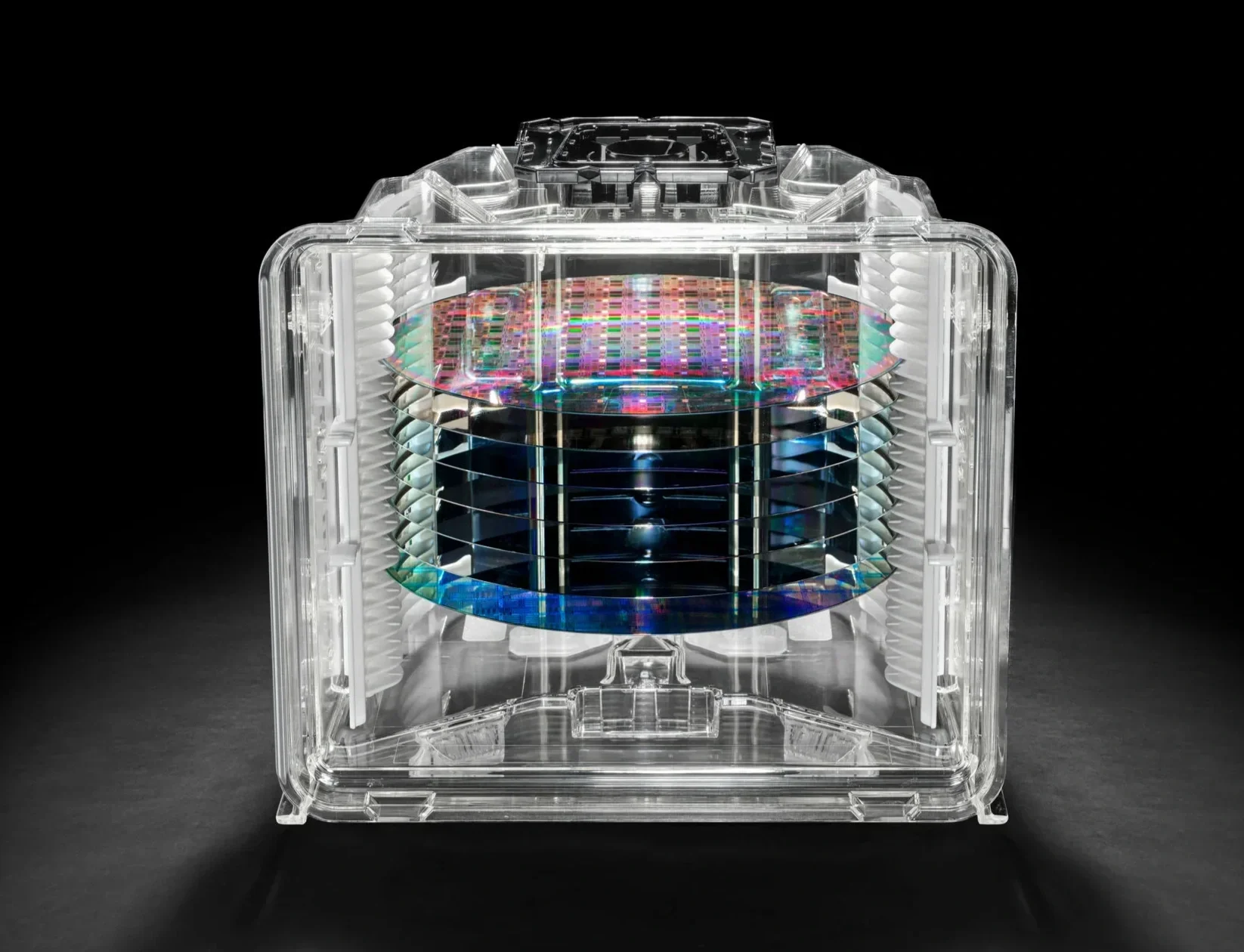
Image of a stack of IBM’s Anderon Quantum Wafers
IBM
Public company: NYSE IBM | Headquarters: Armonk, New York | Q3 2026 revenue: approximately $17.1 billion [13].
IBM offers a third model. In May 2026, IBM and the U.S. Department of Commerce announced plans for Anderon, a dedicated quantum wafer foundry in Albany, New York. A September announcement said Anderon had finalized a $1 billion CHIPS award focused on research and development, alongside an additional $1 billion investment from IBM [14, 15]. The distinction matters: neither the IBM commitment nor the federal award should be treated as cash already spent or fully disbursed.
Anderon describes a 300-millimeter production platform designed for quantum wafers, including devices supporting superconducting qubits and associated input, output, and readout components. IBM says initial quantum wafers were running through the facility by September [15]. That is a tangible manufacturing milestone. It is not, by itself, evidence of sustained commercial shipment volumes, customer revenue, high yields, or cost-effective mass production. Anderon's stated ability to serve outside customers is also distinct from a publicly documented list of paying customers.
IBM added another capability through its August acquisition of HRL Laboratories, previously owned by Boeing and General Motors. HRL contributes experience in silicon-based quantum technologies, sensing, and materials research. IBM specifically said HRL's expertise creates opportunities for future collaboration with Anderon [16]. This is a strategic connection identified by the company, not proof that HRL processes are already on Anderon's production line. Research and manufacturing can reinforce each other without being the same activity.
There is another important contrast. IBM's large, established business can pursue quantum manufacturing alongside software, infrastructure, and consulting activities. That scale gives IBM more room to sustain the initiative without requiring Anderon to become a major revenue contributor quickly. It can provide financial resilience, but it also makes it harder for outside researchers to isolate the returns from an individual quantum-manufacturing investment. The question is not whether IBM mentions the program in every earnings release. It is whether Anderon eventually reports meaningful production, external commercial engagement, and improvements that connect manufacturing to IBM's technical roadmap.
What to watch: evidence of external customers, manufacturing yields and capacity utilization, and specific examples of HRL research moving into processes or products. The present record supports operational progress and strategic intent. It does not yet answer the harder commercial questions.
Structural Comparison
| Company | Role in Stack | Structural Position | Key Dependency | What to Watch |
|---|---|---|---|---|
| QCi | Photonics and advanced packaging | Fab 1 plus acquired NHanced manufacturing and customer base | Integrating assets while establishing commercially repeatable margins | Organic/acquired revenue; deal milestones; yield and utilization if disclosed |
| IonQ | Quantum platform and merchant-foundry owner | Acquired established SkyWater serving multiple industries | Retaining customers and capturing manufacturing benefit without distorting priorities | SkyWater customer mix, profitability and value to quantum roadmap |
| IBM | Quantum R&D and purpose-built wafer-foundry sponsor | Anderon, plus complementary HRL research expertise | Turning early wafer processing into repeatable commercial capacity | External customers, yields and verified research-to-manufacturing transfer |
The Honest Tension
There is a temptation to treat a plant, an acquisition price, or a government award as evidence that the hard part is over. Manufacturing is often where the hard part becomes visible. A device may work once in a lab and prove expensive to reproduce. A foundry may have substantial demand in conventional semiconductors and still face unanswered questions about specialized quantum processes. A purpose-built facility may begin running wafers before it has a public record of repeatable commercial output.
QCi, IonQ and IBM are also not pursuing the same technological destination. A photonic component business, a trapped-ion system company with a diverse foundry subsidiary, and a superconducting-quantum program supported by a dedicated wafer facility cannot fairly be ranked by the square footage of their fabs. The useful comparisons are narrower: Are manufacturing outcomes getting more consistent? Are outside customers staying and returning? Are the businesses earning acceptable margins? Are technical milestones improving in ways the manufacturing investment plausibly helps explain?
The numbers also require perspective. QCi's investment balance is large relative to its current operating revenue, which creates room to build but increases the importance of eventual commercial adoption. IonQ has substantial revenue and capital, though its acquisitions make organic and acquired growth harder to disentangle. IBM has a far broader corporate base, but the economics of Anderon are not disclosed in enough detail to treat it as a proven stand-alone manufacturing success. These are open questions, not verdicts.
Rabbt Intelligence Note
A QCi Research File would separate three kinds of evidence that often get mixed together: manufacturing capability, operating performance, and commercial demand. It would track NHanced's future revenue and EBITDA milestones as financial indicators while asking separately whether production volumes, yields, and repeat orders are improving. A relationship view would connect Fab 1, NHanced, SkyWater, and Anderon with the customers, suppliers, and technical processes they disclose, rather than assuming ownership means full independence. The question to revisit in twelve months is not who announced the largest facility. It is who has shown that greater manufacturing control changed a measurable business or technical result.
Closing
Quantum hardware still has difficult scientific problems to solve. Better factories will not make those problems disappear. But when companies start committing substantial capital to the ability to reproduce their work, it suggests an industry thinking beyond the single successful experiment. The next revealing announcements may be less photogenic than a new quantum machine: a customer renewal, a higher yield, a lower defect rate, or a production schedule met twice in a row. That is where an ambitious roadmap begins to look like a durable business.
This is editorial content. Rabbt is not a registered investment advisor and does not provide investment recommendations.
This issue reflects structural analysis and figures verified as of its publish date. The frontier economy moves quickly: funding rounds close, valuations shift, contracts get renegotiated, and timelines change. Details in this issue may no longer be current by the time you are reading it. Treat this as a structural snapshot, not a live feed, and verify anything time-sensitive independently before acting on it.
Sources
[1] QCi company history, SEC annual filing. https://www.sec.gov/Archives/edgar/data/1758009/000121390024028799/
[2] QCi completes NHanced acquisition, June 23, 2026. https://www.prnewswire.com/news-releases/quantum-computing-inc-completes-acquisition-of-nhanced-semiconductors-inc-302806991.html
[3] NHanced, letter to customers, June 23, 2026. https://nhanced-semi.com/2026/06/23/a-letter-to-our-customers/
[4] QCi second-quarter 2026 Form 10-Q. https://www.sec.gov/Archives/edgar/data/1758009/000162828026055218/qubt-20260630.htm
[5] QCi Q2 2026 results, SEC-filed press release. https://www.sec.gov/Archives/edgar/data/1758009/000121390026087267/ea030143301ex99-1.htm
[6] IonQ completes SkyWater acquisition, July 31, 2026. https://investors.ionq.com/news/news-details/2026/IonQ-Completes-Acquisition-of-SkyWater-Technology/default.aspx
[7] IonQ second-quarter 2026 Form 10-Q. https://www.sec.gov/Archives/edgar/data/1824920/000119312526341001/ionq-20260630.htm
[8] SkyWater, Wafer Services. https://www.skywatertechnology.com/services/wafer-services/
[9] IonQ Q2 2026 results, August 5, 2026. https://www.sec.gov/Archives/edgar/data/1824920/000119312526335040/ionq-ex99_1.htm
[10] IonQ raises 2026 outlook, September 8, 2026. https://www.sec.gov/Archives/edgar/data/1824920/000119312526384388/ionq-ex99_1.htm
[11] IonQ Elisity agreement, October 2026. https://www.sec.gov/Archives/edgar/data/1824920/000119312526419609/ionq-ex99_1.htm
[12] IonQ October offering terms and closing, SEC filing. https://www.sec.gov/Archives/edgar/data/1824920/000119312526424230/ionq-20261014.htm
[13] IBM Q3 2026 results, October 21, 2026. https://www.sec.gov/Archives/edgar/data/51143/000005114326000093/ibm-20261021xex991.htm
[14] IBM/Commerce announcement of Anderon, May 21, 2026. https://newsroom.ibm.com/ibm-and-u-s-department-of-commerce-announce-americas-first-purpose-built-quantum-foundry
[15] Anderon finalizes CHIPS award, September 16, 2026. https://newsroom.ibm.com/2026-09-16-anderon,-an-ibm-company,-finalizes-agreement-with-the-u-s-department-of-commerce-for-a-1-billion-chips-award-to-accelerate-r-d-for-u-s-based-pure-play-quantum-foundry
[16] IBM completes HRL acquisition, August 26, 2026. https://newsroom.ibm.com/2026-08-26-ibm-completes-acquisition-of-hrl-laboratories-to-accelerate-the-future-of-quantum