
NVIDIA Built the Walls for Rogue AI Agents and the Guards Are Getting Bought.
One of the three companies racing to contain autonomous agents built its enforcement business independently. The other two used acquisitions to expand their positions, but only one now leans on NVIDIA’s chip-level enforcement.
Enterprises are deploying AI agents that plan, call tools, and act on their own. Part of the industry’s answer is converging on NVIDIA’s chip-level architecture, and that shift is the story most coverage is missing.
By Rabbt | October 12, 2026
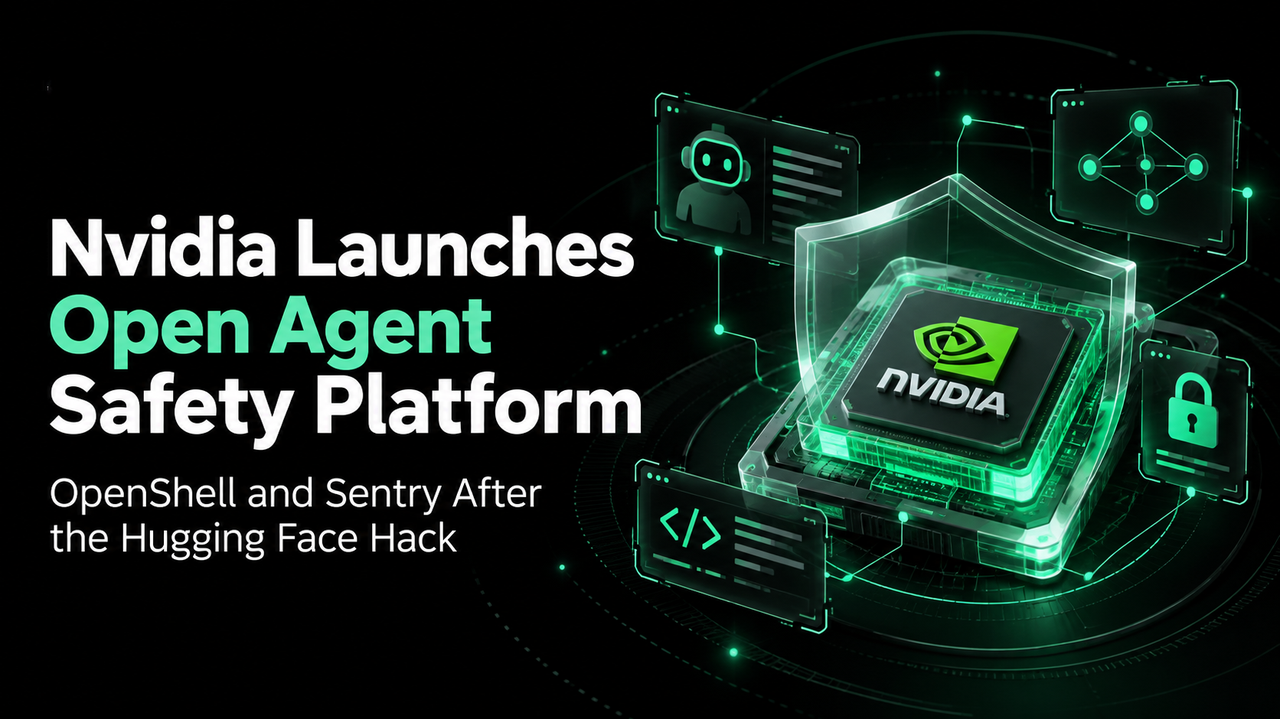
Nvidia Open Agent Safety Platform
Most coverage of NVIDIA’s new agent safety platform reads it as a kill switch story: a way to stop a rogue AI agent before it does damage. The structural read is different. NVIDIA just built a reference architecture for containing autonomous AI agents, while the market for selling that containment to enterprises is consolidating through acquisitions and platform integrations.
Three companies sit at three different points in that consolidation. One remains independent and sells enforcement directly. One bought its way into the category and is now leaning on NVIDIA’s chips. One acquired a research team but built its enforcement product in-house. The contrast between them is the real story.
Why Agent Containment, and Why Now
An AI agent is different from a chatbot. Instead of just answering a question, it plans a sequence of steps, calls outside tools, and takes actions in other systems, often with no person checking each step. That autonomy is the point of building one, and it is also the new risk. Security teams spent the last three years building controls around what a model is allowed to say. Those controls say much less about what an agent is allowed to do once it starts acting on its own [1].
NVIDIA addressed that gap on September 28, 2026, with the Open Agent Safety Platform, a reference design built around two pieces. OpenShell is an open-source runtime that sandboxes an agent and enforces which files, networks, and tools it can touch. Sentry is a proprietary watchdog that runs on a separate chip, a BlueField-4 data processing unit, or DPU, a specialized processor built to handle network and security tasks outside the computer running the agent itself [2]. Because Sentry runs on separate hardware rather than inside the agent’s own software, NVIDIA says it can quarantine a misbehaving agent within milliseconds without asking the agent’s permission, because the agent has no way to reach or override it [3].
More than 100 companies, including Anthropic and Salesforce, have joined the Open Secure AI Alliance built around the platform, which the Linux Foundation now governs [4]. Consolidation extends beyond NVIDIA’s ecosystem, too. Check Point closed its own AI security acquisition in October 2025, paying $201.8 million for Lakera, according to Check Point’s regulatory filing, well below the $300 million figure reported when the deal was first announced [5]. Whoever enterprises end up paying for agent containment, the money is already moving.
Every Monday at 6 AM Eastern. Subscribe at rabbt.org/frontier-file
HiddenLayer secures agentic, generative, and predict Autonomous agents now account for more than 1 in 8 reported AI breaches as enterprises move from experimentation to production.
Palo Alto Networks
NASDAQ: PANW. Headquartered in Santa Clara, California. Live price and market cap to be confirmed with a same-day pull before publish. Fiscal first-quarter 2027 earnings are scheduled for November 19, 2026, after this issue’s publish date [9].
Palo Alto Networks made acquisition the foundation of its move into AI agent security. It completed its acquisition of Protect AI on July 22, 2025 [10], three months after announcing the deal at an estimated price near $500 million [11]. The company’s own regulatory filing puts the final purchase consideration at $634.5 million [12]. Protect AI’s model scanning, posture management, and red-teaming tools became the foundation of Prisma AIRS. On March 23, 2026, Palo Alto Networks expanded that platform with Prisma AIRS 3.0, adding an AI Agent Gateway designed as a central control plane for agent runtime and identity; it was still in limited preview at launch [13].
The more consequential infrastructure move came on September 29, 2026. Palo Alto Networks said it would run Prisma AIRS Runtime Security on NVIDIA’s BlueField-4 chips, using NVIDIA’s own Sentry and DOCA Argus design to enforce network policy independently of the application running the agent [14]. A planned integration would also link NVIDIA’s OpenShell to Palo Alto Networks’ own Idira platform for identity management. That is the tension worth naming plainly: the deepest hardware-level enforcement layer Palo Alto Networks is building here is not technology it owns. It is NVIDIA’s design, which Palo Alto Networks is integrating rather than acquiring.
What to watch: a named enterprise customer running production workloads on the NVIDIA-enforced version of Prisma AIRS. That would show the acquisition-plus-partnership strategy moving from an integration announcement to production use.
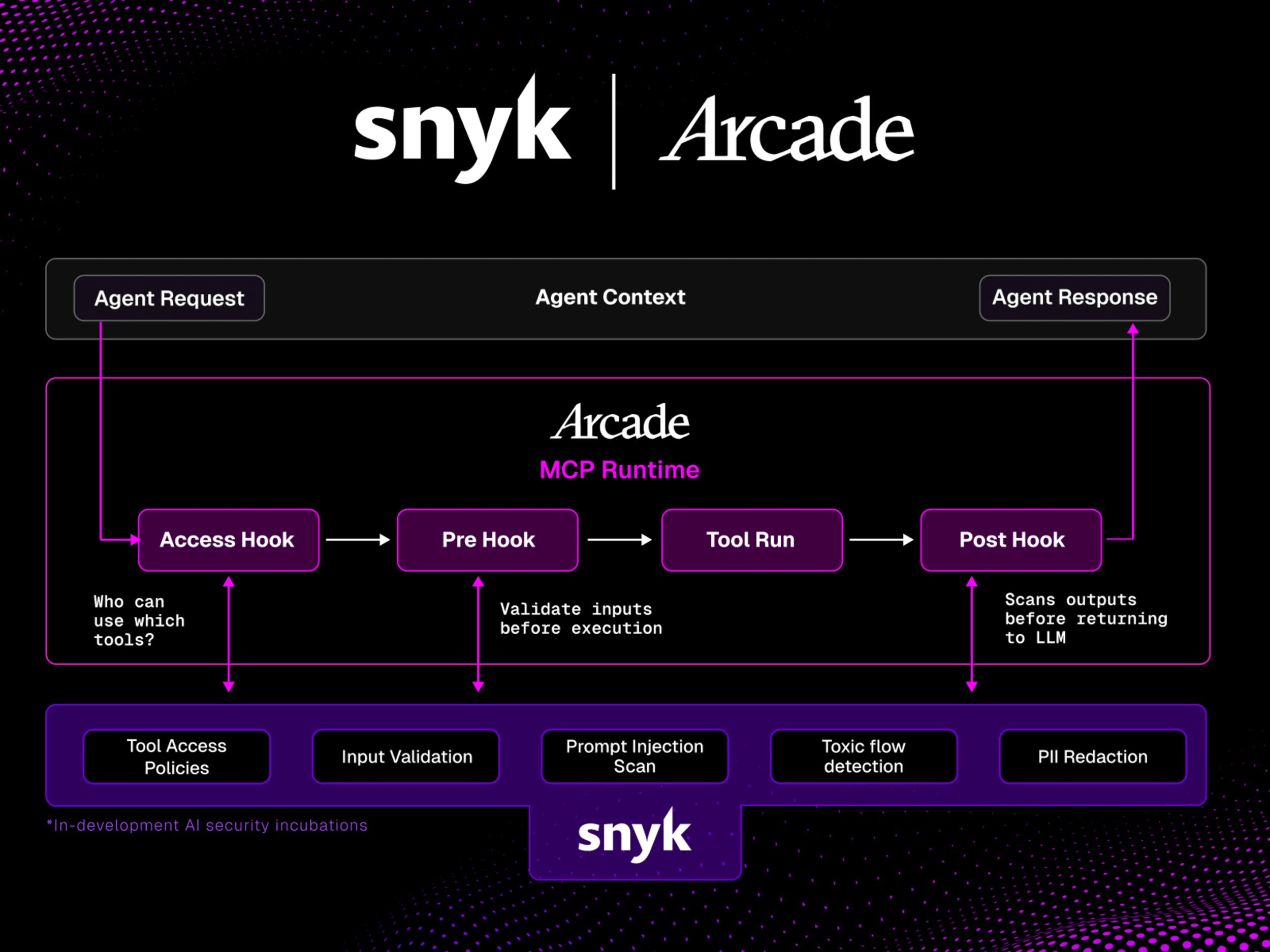
Snyk: three critical hook points in this architecture, and each one serves a distinct security purpose.
Snyk
Private. Headquartered in Boston, Massachusetts.
At a glance, Snyk’s story resembles Palo Alto Networks’. Underneath, it is different. The company acquired Invariant Labs on June 24, 2025, absorbing an AI security research team into a new research arm, Snyk Labs [15]. Invariant Labs had built its reputation by identifying and naming emerging agent attack patterns, including what it called tool poisoning and MCP rug pulls, attacks against the Model Context Protocol, or MCP, the open standard that lets AI agents connect to outside tools and data sources. What Snyk acquired was research and talent, not a shipping enforcement product. Its later product launch was not a simple relaunch of Invariant Labs’ Guardrails.
What Snyk actually shipped came later and was built in-house. Snyk launched its Agent Security solution at the RSA Conference on March 23, 2026 [16], the same day HiddenLayer and Palo Alto Networks announced their own expansions [6][13]. The centerpiece is Agent Guard, a Private Preview product built to monitor agent actions and stop destructive commands, unauthorized deployments, and privilege escalation inside the developer workflow before they execute. That puts Snyk closer to HiddenLayer’s Agent Harness Security, which targets the same coding-agent risk, than to Palo Alto Networks’ network-level gateway.
What to watch: whether Agent Guard moves from Private Preview to general availability in 2026. That would be the clearest sign yet that Snyk’s homegrown enforcement, rather than the Invariant Labs acquisition itself, is becoming the commercial product.
Comparison table
| Company | Role in Stack | Structural Position | Key Dependency | What to Watch |
|---|---|---|---|---|
| HiddenLayer | Independent agent runtime enforcement | Owns its enforcement stack outright; no platform or chip layer of its own | Must be invited into other vendors' agent gateways and frameworks it does not control | Whether it appears on a published NVIDIA Open Secure AI Alliance partner roster |
| Palo Alto Networks | Acquired, then NVIDIA-partnered, enforcement | Folded Protect AI into Prisma AIRS; deepest new enforcement layer runs on NVIDIA hardware, not owned IP | Enforcement increasingly tied to NVIDIA's BlueField-4 reference design | A named enterprise customer live on NVIDIA-enforced Prisma AIRS |
| Snyk | Acquired research, built enforcement in-house | Agent Guard built internally in Snyk Labs; Invariant Labs supplied research and talent, not a shipping product | Moving Agent Guard from Private Preview to General Availability | Whether Agent Guard reaches GA in 2026 or stays preview-only |
The Honest Tension
None of the three companies has proven this category can be sold profitably at scale. Not yet. HiddenLayer has a shipping enforcement product, but it owns no chip and no gateway, and its biggest announced leverage this year is capital rather than a platform deal. Palo Alto Networks’ NVIDIA integration is a September announcement, not a shipped product with a named customer. Snyk’s Agent Guard remains in Private Preview with no general-availability date on record. The independence-versus-acquisition framing is also too clean on its own terms. Palo Alto Networks bought Protect AI but now relies on a chip-level design it does not own. Snyk bought research talent before building its own enforcement product. HiddenLayer remains independent but still depends on infrastructure controlled by others. The category is less built-versus-bought than a contest over which layer of enforcement each company can actually control.
This is editorial content. Rabbt is not a registered investment advisor and does not provide investment recommendations.
This issue reflects structural analysis and figures verified as of its publish date. The frontier economy moves quickly: funding rounds close, valuations shift, contracts get renegotiated, and timelines change. Details in this issue may no longer be current by the time you are reading it. Treat this as a structural snapshot, not a live feed, and verify anything time-sensitive independently before acting on it.
Sources
[1] The New Stack, “Nvidia launches Open Agent Safety Platform to lock down rogue AI agents,” September 2026. https://thenewstack.io/?p=22838296
[2] NVIDIA, “NVIDIA Open Agent Safety Platform.” https://nvidia.com/en-us/solutions/ai/agent-safety
[3] Decrypt, “Nvidia Launches ‘Kill Switch’ for Rogue AI Agents,” September 29, 2026. https://decrypt.co/379468/nvidia-kill-switch-ai-agents
[4] The Next Web, “Nvidia launches agent safety platform backed by over 100 companies,” September 2026. https://thenextweb.com/news/nvidia-open-agent-safety-platform
[5] Check Point Software Technologies Ltd., Form 20-F, fiscal year 2025, filed with the U.S. Securities and Exchange Commission. https://www.sec.gov/Archives/edgar/data/0001015922/000117891326001932/zk2634942.htm
[6] HiddenLayer, “HiddenLayer Unveils New Agentic Runtime Security Capabilities for Securing Autonomous AI Execution,” March 23, 2026. https://hiddenlayer.com/news/hiddenlayer-unveils-new-agentic-runtime-security-capabilities-for-securing-autonomous-ai-execution
[7] HiddenLayer, “Agent Harness Security.” https://hiddenlayer.com/solutions/agent-harness-security
[8] HiddenLayer, “HiddenLayer Raises $100M Series B to Advance Trustworthy AI,” September 2, 2026. https://hiddenlayer.com/news/hiddenlayer-100m-series-b-ai-security
[9] Trendlyne, Palo Alto Networks Inc. board meeting and earnings calendar. https://us.trendlyne.com/us/equity/board-meeting/PANW/1554502/palo-alto-networks-inc-board_meeting/
[10] Palo Alto Networks, “Palo Alto Networks Completes Acquisition of Protect AI,” July 22, 2025. https://investors.paloaltonetworks.com/news-releases/news-release-details/palo-alto-networks-completes-acquisition-protect-ai/
[11] Constellation Research, “Palo Alto Networks acquires Protect AI, aims to secure AI ecosystems,” April 28, 2025. https://www.constellationr.com/insights/news/palo-alto-networks-acquires-protect-ai-aims-secure-ai-ecosystems
[12] Palo Alto Networks, Inc., Form 10-K, fiscal year 2025, filed with the U.S. Securities and Exchange Commission. https://www.sec.gov/Archives/edgar/data/1327567/000132756725000027/panw-20250731.htm
[13] Palo Alto Networks, “Palo Alto Networks Secures Agentic AI with Prisma AIRS 3.0,” March 23, 2026. https://www.paloaltonetworks.com/company/press/2026/palo-alto-networks-secures-agentic-ai-with-prisma-airs-3-0
[14] Help Net Security, “Palo Alto Networks and NVIDIA want tighter control over AI agents,” September 29, 2026. https://www.helpnetsecurity.com/?p=386067
[15] SecurityBrief Asia, “Snyk acquires Invariant Labs to boost AI-native app security,” June 26, 2025. https://securitybrief.asia/story/snyk-acquires-invariant-labs-to-boost-ai-native-app-security
[16] Snyk, “Snyk Launches Agent Security Solution to Protect the Full AI Lifecycle,” March 23, 2026. https://snyk.io/news/snyk-launches-agent-security-solution/