
While everyone’s chasing cloud stocks and AI tokens, DePIN is quietly building the rails of the next trillion-dollar infrastructure shift.
By Steve Hubbard | Rabbt.org | November 2025
DePIN stands for Decentralized Physical Infrastructure Networks, a model that uses blockchain technology and cryptocurrency incentives to crowdsource and manage real-world physical infrastructure, such as wireless networks, energy grids, and data storage.
Google ai overview
Artificial intelligence is growing so fast that even people building it can barely keep up, with new models dropping every month, the tools changing weekly, and the world suddenly needing GPU power like it is the new crude oil.
But here is the reality most will never hear.
The big cloud providers, the hyperscalers, don’t have space to spare. AWS, Google Cloud, and Azure can’t scale fast enough for growing demand; where they can, the prices are brutal. GPU rentals spike, queues get long, and smaller teams get boxed out of AI innovation entirely.
This is where everything will change in the story.
A new layer of infrastructure, catalyzed and sustained by regular people with spare GPUs, independent data centers, and thousands of small hardware providers, is forming beneath the tech world. The term is DePIN, short for Decentralized Physical Infrastructure Networks, and it may mean a shift in the power balance of AI from a handful of trillion-dollar giants to a global, community-owned grid.
Below, the blog breaks it down in everyday language, explains why it matters, and spotlights the small to mid-cap companies building the future of decentralized compute.
What DePIN Actually Is, in Human Terms
Think of DePIN as similar to Airbnb, but instead of booking rooms, you book GPU compute.
Instead of having one giant company in control of all the hardware, a blockchain-powered system coordinates thousands of individual providers.
Anyone can plug in:
- free GPUs
- small data centers
- mining rigs
- edge devices
- old gaming hardware
- new enterprise-grade servers
It connects users to the hardware they need, automates payments, makes usage transparent, and performance is verified on-chain. Further, because it’s distributed across thousands of nodes, it scales without giant central buildings, massive overhead, or corporate pricing games.
In short, DePIN turns global hardware into a shared compute cloud that anyone can use or contribute to.
Why Traditional Cloud Is Struggling
Let’s be real: this AI boom is stressing the cloud industry harder than anything we have seen before.
The GPU drought is real.
GPUs are sold out for months; NVIDIA can’t produce chips fast enough. Big corporations buy in bulk and hoard inventory, leaving the scraps to smaller companies and startups.
Hyperscaler pricing hurts.
If you have tried renting compute from AWS or Google Cloud, you already know:
- hourly GPU rates can be 3-4 times higher than decentralized alternatives.
- data transfer fees add up
- accumulation of storage charges
- long-term contracts trap users
It is a cost structure for Fortune 500 companies, not creators, indie devs, students, or small labs.
Innovation slows when compute is inaccessible
This is the part nobody wants to admit.
- People have ideas.
- People have the skills.
- But they do not have the compute power.
That means good ideas stay on the shelves, and the pace of innovation is slowed.
DePIN flips that dynamic. It breaks open access and makes compute abundant.
How DePIN Makes AI Compute Cheaper and More Fair
The advantage is simple.
Hyperscalers have huge overhead: cooling, power management, real estate, talent, compliance. Billions of dollars in cost structures.
DePIN does not.
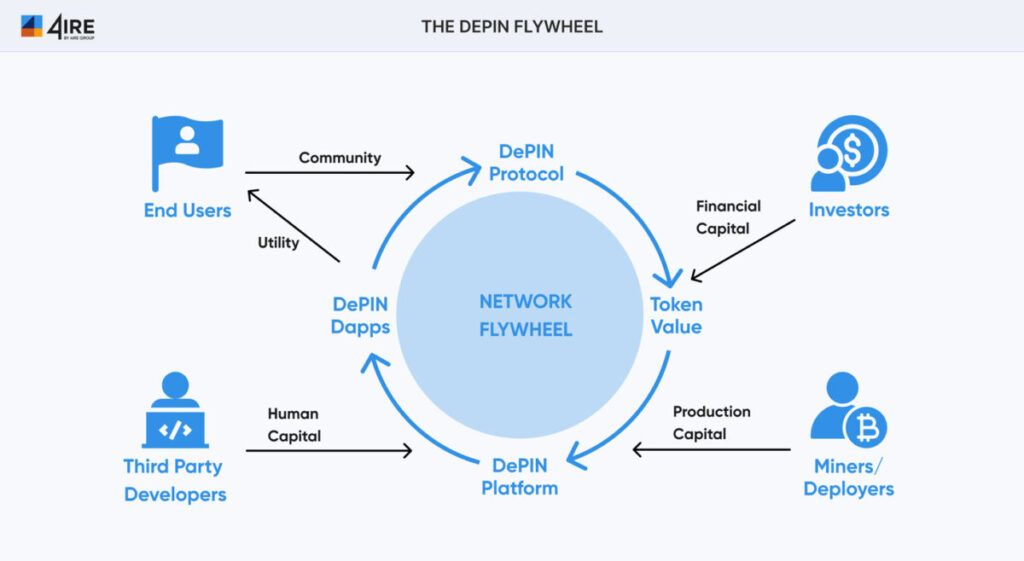
People from around the world provide the hardware while the network does all the coordination. This slashes total costs and often reduces pricing for a GPU by 50 to 70 percent.
Here is why it works:
- No giant buildings to maintain
- Hardware comes from everywhere
- The network grows organically as more people join it
- Token incentives reward providers for uptime and performance
It’s the closest thing that has ever existed within the compute world to an open, permissionless marketplace.
And for the first time in history, compute is not controlled by a few technology giants: it is something that anyone can participate in, or use, or profit from.
Where DePIN Fits in the AI Economy
This matters because compute is now the power source for everything being built in AI.
DePIN already powers:
- training small and mid-sized machine learning models
- running inference at global scale
- powering distributed AI agents
- feed GPU-thirsty generative tools
- running edge compute tasks closer to users
- monetizing idle hardware that normally sits unused
This is not speculative. These use cases are happening now.
The Investment Angle: Why This Sector Is Heating Up Fast
Investors are flocking to DePIN for several reasons.
- Compute is the most valuable resource in tech right now
If AI continues to scale at a rate this fast, demand for GPUs could triple or quadruple by 2030. DePIN is one of the few models that can scale alongside that demand. - DePIN generates real-world revenue
This is not a meme token phenomenon.
This is real hardware, providing real compute, to real users. - Early networks provide early mover advantages
Token value and node rewards can go higher as the network grows. Early contributors usually reap more benefits. - The hyperscalers cannot solve this problem alone.
Even doubling or tripling that capacity would not do the trick. The world needs another layer of infrastructure.
This is where DePIN steps in.
The Big Risks to Understand Before Investing
It’s not all sunshine. DePIN has real challenges.
- Hardware nodes vary in quality
- Uptime is inconsistent across providers
- Poorly maintained devices carry security risks
- Tokenomics differ wildly between projects
- Energy regulation varies by region
- Cloud giants could try to compete on price
DePIN is early.
Early means opportunity, but it means volatility, too.
5 Companies Building the Future of Decentralized Compute
Below are companies in the small to mid-cap range leading the DePIN movement. These align perfectly with the focus of Rabbt.org on frontier tech with asymmetric upside.
1. Render Network (RNDR)
Render started out as a decentralized GPU rendering marketplace for artists and VFX teams. And now it’s expanding into the realms of AI compute and distributed model training.
Why it matters:
- large existing base of GPU providers
- strong brand awareness
- real usage by creative professionals
- expanding into AI workloads
- mid-cap and growing
Render proves DePIN can operate at scale.
2. Akash Network (AKT)
Akash is a decentralized cloud marketplace where users can rent compute, store data, and deploy workloads at a fraction of the cost of AWS.
Why it matters:
- focused on general compute, not only GPUs
- strong developer community
- flexible marketplace model
- high real-world utility
It represents one of the most mature DePIN projects out there.
3. io.net (IO)
io.net builds large decentralized GPU clusters optimized for machine learning tasks.
Why it matters:
- targets AI developers directly
- supports large scale, parallel compute
- focuses on inference and training
- strong traction in the AI builder community
This is one of the fastest rising networks in the DePIN space.
4. Grass (GRASS)
Grass enables users to share underutilized computing and get rewards.
Why it matters:
- extremely low barrier to entry
- consumer friendly
- scalable through massive node counts
- early mover advantage
It is interesting because it democratizes participation even more.
5. Flux (FLUX)
Flux is a decentralized cloud infrastructure built for Web3 apps, AI apps, and compute-heavy workloads.
Why it matters:
- strong network of independent nodes
- multi-cloud strategy
- real user consumption
- already supports complex workloads
Flux targets the intersection of Web3 infrastructure and AI compute.
What Makes DePIN a Moonshot-Level Trend
DePIN does not replace cloud providers.
But it could run in tandem with them, for a different purpose altogether.
Here is what makes it powerful:
- It gives power back to users
- It saves money in a cost-crazy industry
- It scales without massive capital expense
- It draws more people into AI development
- It decentralizes one of the most centralized industries on earth
It is early, but early is where the opportunity always is.
Where This Goes by 2026 and Beyond
If current trends continue:
- DePIN networks can compete with AWS on price and availability
- Billions of dollars in unused hardware could join these networks
- Investors may treat DePIN as a core AI infrastructure asset class
- AI startups might choose DePIN first, cloud second
- Whole regions could build DePIN compute hubs as centers for employment and economic growth
If that happens, DePIN becomes part of the backbone of global AI systems.
Final Thoughts
Decentralized Physical Infrastructure Networks are not a fad in blockchain. They are a direct response to the biggest challenge in the AI industry: the shortage of compute.
DePIN opens the AI revolution to everyone, not just tech giants, through hardware redistribution, cost reduction, and building a community-owned compute layer.
This is one of today’s most promising frontier sectors for investors and innovators alike.This is where small to mid-cap companies can outmaneuver giants.
This is where asymmetric returns can arise.
And it is precisely that kind of trend Rabbt.org was created to find.
0 Comments