
Nanoform Built Its Identity on Supercritical Nanoparticles.
The Real Story Is a Stalled Launch and a Quiet Pivot to Biologics.
Most coverage of Nanoform's new manufacturing license reads as validation. The company's own disclosures three months later tell a different story.
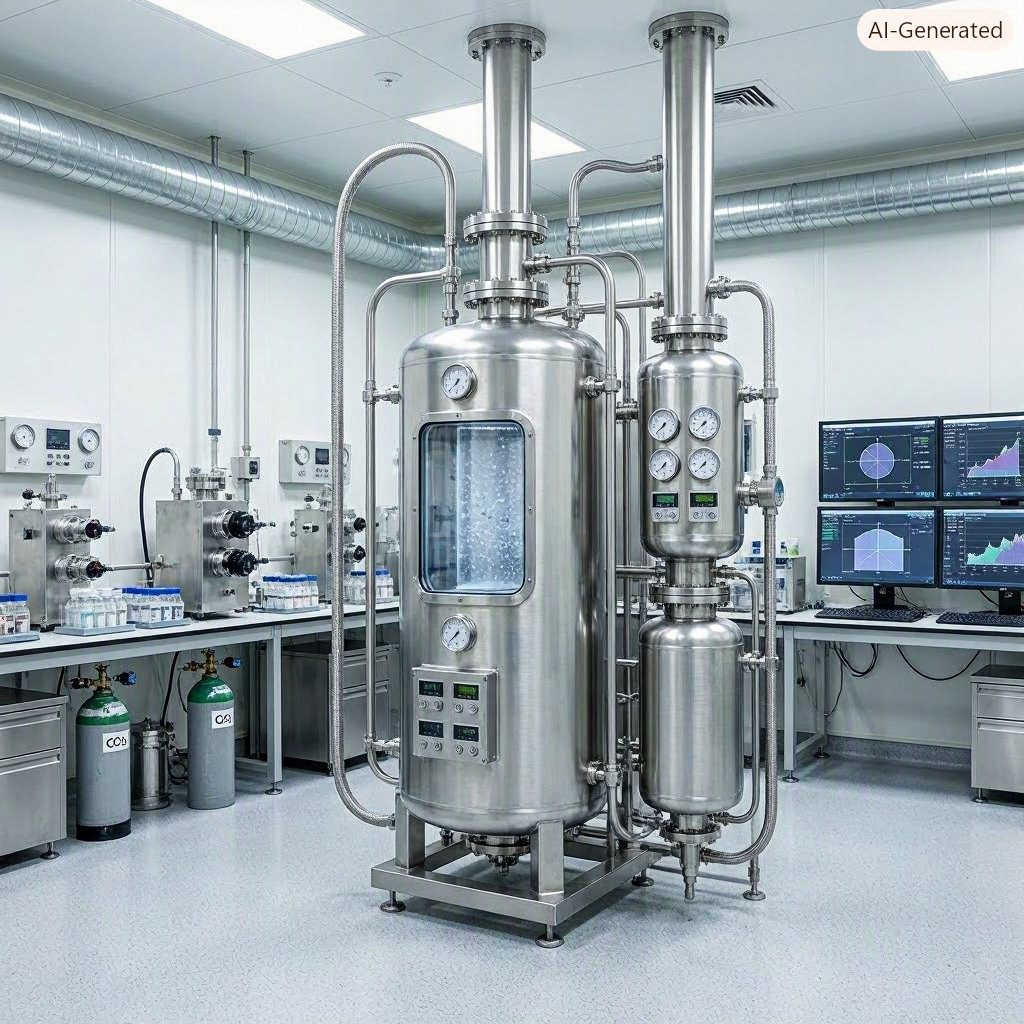
Supercritical CO2 nanoparticle pharmaceutical processing lab
What happens when a company gets the regulatory win it spent six years chasing, and then discovers the win doesn't get its actual product to market? In November 2025, Nanoform Finland found out. The company received a commercial cGMP license, current Good Manufacturing Practice, from Finland's medicines regulator, FIMEA, for nanoformed small-molecule active ingredients. Coverage treated it as vindication for the six-year bet behind it. Three months later, Nanoform's first-quarter 2026 report answered a different question: whether its flagship product could actually reach patients on schedule. It couldn't, not through the fast regulatory pathway the company had been counting on. The manufacturing win and the regulatory setback happened within the same two quarters, to the same company. Most coverage has only reported on the former.
Why Bioavailability Enhancement and Why Now
Roughly forty percent of new drug candidates entering development are poorly soluble in water, a classification pharma calls BCS Class II. A drug that will not dissolve will not reach the bloodstream in a useful concentration, no matter how well it works on a molecular target. This has been true since long before Nanoform existed, and is why particle-size reduction is an entire commercial category rather than a niche. So what’s been done to address this issue?
The category has an incumbent and a set of challengers, and the difference between them comes down to a simple question: which approach has actually gotten an approved drug into a patient's hands, and which is still trying to prove it can?
Spray drying is the incumbent. It works by dissolving a drug and a carrier material together, then rapidly evaporating the solution into a fine powder. The result is a version of the drug that dissolves faster in the body than its normal crystal form does. It's not new science, and that's the point: it's been used to get real, approved drugs to market at scale for the last two decades. Hovione, profiled below, is a major commercial supplier of exactly this.
Spray drying isn't the only technology that has broken through, either. Nanomilling and hot-melt extrusion are two older, established alternatives that have also been used commercially for years, each carving out a smaller share of drugs where its particular chemistry works best. No major company built around either technique is profiled here, but both are proof that the solubility problem has already produced more than one commercially successful answer, not just the one that happens to dominate.
That track record is exactly what Nanoform is trying to join. Supercritical fluid processing, the company's core technology, is one of the challengers trying to unseat the incumbent and take a seat at that table. Instead of dissolving a drug in a liquid solvent, it uses carbon dioxide held at a pressure and temperature where it behaves like both a gas and a liquid at once, which lets it break a drug down into extremely fine particles without leaving solvent residue behind. The pitch is finer control over particle size and a cleaner process to achieve the same results as techniques like spray drying. The problem is that the pitch is still mostly a pitch: there's real academic research behind it, but no marketed drug has yet reached patients faster or cheaper because a company used this method instead of spray drying.
So the competitive picture is this: spray drying is the proven, dominant technology. Nanomilling and hot-melt extrusion are proven but narrower, and already show the market rewards more than one approach. Nanoform’s supercritical processing is neither proven nor narrow, it simply hasn't produced a marketed drug yet, on any drug, at any scale. That's the six-year bet Nanoform has built its entire public-market story on.
Nanoform Finland: The Supercritical Bet That Hasn't Paid Off Yet
Listed: Nasdaq First North Helsinki (NANOFH) / Stockholm (NANOFS). Market capitalization approximately EUR 86 to 88 million as of mid-2026, down from an IPO market capitalization of approximately EUR 230 million in June 2020. Cash position EUR 24.0 million at year-end 2025, down from EUR 41.5 million a year earlier. FY2025 revenue EUR 3.5 million, up 28 percent year over year, against an operating loss of approximately EUR 18.5 million.Nanoform's patented CESS process, Controlled Expansion of Supercritical Solutions, uses supercritical carbon dioxide to produce drug particles as small as 10 nanometers, small enough to change how a poorly soluble molecule dissolves in the body. That is the pitch the company has made since its 2020 IPO, when it priced at a market capitalization near EUR 230 million on the promise that it would fix bioavailability for the pharmaceutical industry at large.
Six years on, the structural position is narrower than the pitch. Nanoform does not sell a marketed drug, it sells access to its process to pharmaceutical partners, collecting fees, milestones, and royalties on drugs those partners eventually bring to market. Fifty-three customer projects generated EUR 3.5 million in FY2025 revenue [Unverified: Nanoform reports this figure separately from other operating income, and some third-party aggregators report a combined figure closer to EUR 5 million]. Cash fell to EUR 24.0 million by year-end, and the company began layoffs in January 2026 targeting EUR 5 to 6 million in annual cost reductions, alongside a 2026 cash-burn target below EUR 10 million.
The dependency that matters most is nanoenzalutamide, a nanocrystalline reformulation of Astellas and Pfizer's Xtandi, a drug with global sales of roughly USD 5.9 to 6.2 billion in 2024 [estimate, figures vary by source]. Nanoform has called it the first nanoformed medicine to reach the market, announcing a 2027 US and 2028 EU launch through the hybrid generic pathway, a route that would let it reference Xtandi's existing safety and efficacy data rather than run its own full trials. In its Q1 2026 report, Nanoform disclosed that a European authority told the company its current regulatory and legal framework does not allow a hybrid generic application for nanoenzalutamide in its present form, because the drug's altered food-effect profile deviates from the bioequivalence criteria that pathway requires. Management says it is now assessing a non-generic pathway and still expects a launch before 2030. Meanwhile, standard generic enzalutamide has advanced independently: Lupin has received tentative FDA approval for generic enzalutamide tablets, and Astellas' key US patents begin expiring in 2026, narrowing the first-mover window nanoenzalutamide's original thesis depended on.
Against that setback, Nanoform's real near-term progress is elsewhere. The November 2025 FIMEA commercial cGMP license is a genuine and rare milestone for a company at this stage, and management has set a five-year target to grow GMP-related revenue from roughly 5 percent of its mix to 25 percent. The company also signed its first exclusivity deal around biologics and high-concentration subcutaneous delivery in Q1 2026, a category outside Nanoform's original small-molecule pitch. What to watch: whether nanoenzalutamide secures any viable filing pathway with a firm date, whether the biologics deal converts into milestone cash, and whether cash reserves reach a raise before either happens.
Astrazeneca nanoform
Hovione: The Incumbent Already Banking the Bioavailability Dollars
Private. Founded 1959, based in Portugal with sites in Ireland, the United States, and Macau. Revenue reported at approximately USD 500 million [Unverified, private company], roughly 2,500 employees. Completed an initial USD 100 million capital investment cycle at its East Windsor, New Jersey site in October 2025, adding two large-scale spray dryers for amorphous solid dispersion production, with GMP operations targeted for the second quarter of 2026.Hovione solves the same solubility problem Nanoform does, for the same category of drugs, using a different and older technology. Spray drying converts a drug into an amorphous solid dispersion, a physical state that dissolves faster and more completely than the drug's normal crystal form. As compared to Nanoform’s tech, this is not new science. It’s been proven, approved, and currently attracting fresh capital at a scale Nanoform's balance sheet cannot match. "Hovione's own materials describe the technology as capable of benefiting the development of up to 70 percent of drugs in the pipeline, and according to Ole Wiborg, CEO of Zerion Pharma, a Hovione partner company, Hovione has been the main commercial manufacturer of novel FDA-approved amorphous solid dispersion drugs over the last five years."
The structural contrast with Nanoform is direct. Hovione is profitable and privately held, so it does not need to demonstrate its technology to public markets, instead it needs to keep filling capacity its clients already trust. Its recent expansion is not a bet on unproven science, it’s a scale-up of a technology already carrying approved drugs to patients. Key dependency: continued demand from large pharmaceutical clients for spray-dried ASD capacity, which depends in turn on the industry's overall pipeline of poorly soluble candidates. What to watch: whether the East Windsor GMP operations start on schedule in Q2 2026, and whether additional capacity announcements follow in Cork or Portugal.
Thar Process: The Equipment Behind the Same Chemistry, Still Looking for Its Pharma Customer
Private. Based in Pittsburgh, Pennsylvania, founded by Dr. Lalit Chordia. Estimated revenue near USD 22 million, with headcount estimates ranging from 20 to 130 depending on source [Unverified, no audited financials are public]. Launched its SuperDry 9000 platform in January 2024, built specifically around supercritical and gas antisolvent processing for large-molecule biopharmaceuticals.Thar Process sits one level removed from Nanoform and Hovione. It does not sell a drug-delivery technology to pharma directly, rather it sells the equipment that makes gas antisolvent and supercritical antisolvent processing possible at all, the same underlying chemistry used in published academic work on drug nanoparticle production including gas antisolvent studies on poorly soluble small molecules. The SuperDry 9000 is Thar's explicit attempt to move that equipment business from the natural products and hemp extraction work that still makes up the bulk of its revenue into pharmaceutical particle engineering.
The gap between ambition and evidence is the structural story here. No named pharmaceutical customer or commercial contract for the SuperDry 9000 platform could be independently verified as of mid-2026, more than two years after launch. The underlying science is not in question, academic literature confirms Thar equipment has been used in published supercritical antisolvent micronization research. What is unproven is whether that translates into paying pharmaceutical customers rather than technology evaluations. Key dependency: a named commercial pharma contract that would validate the SuperDry 9000 platform beyond its extraction-industry base. What to watch: any disclosed GMP particle-engineering customer, which would be the first hard evidence that supercritical equipment vendors, not just formulation companies like Nanoform, have a real pharma revenue line.
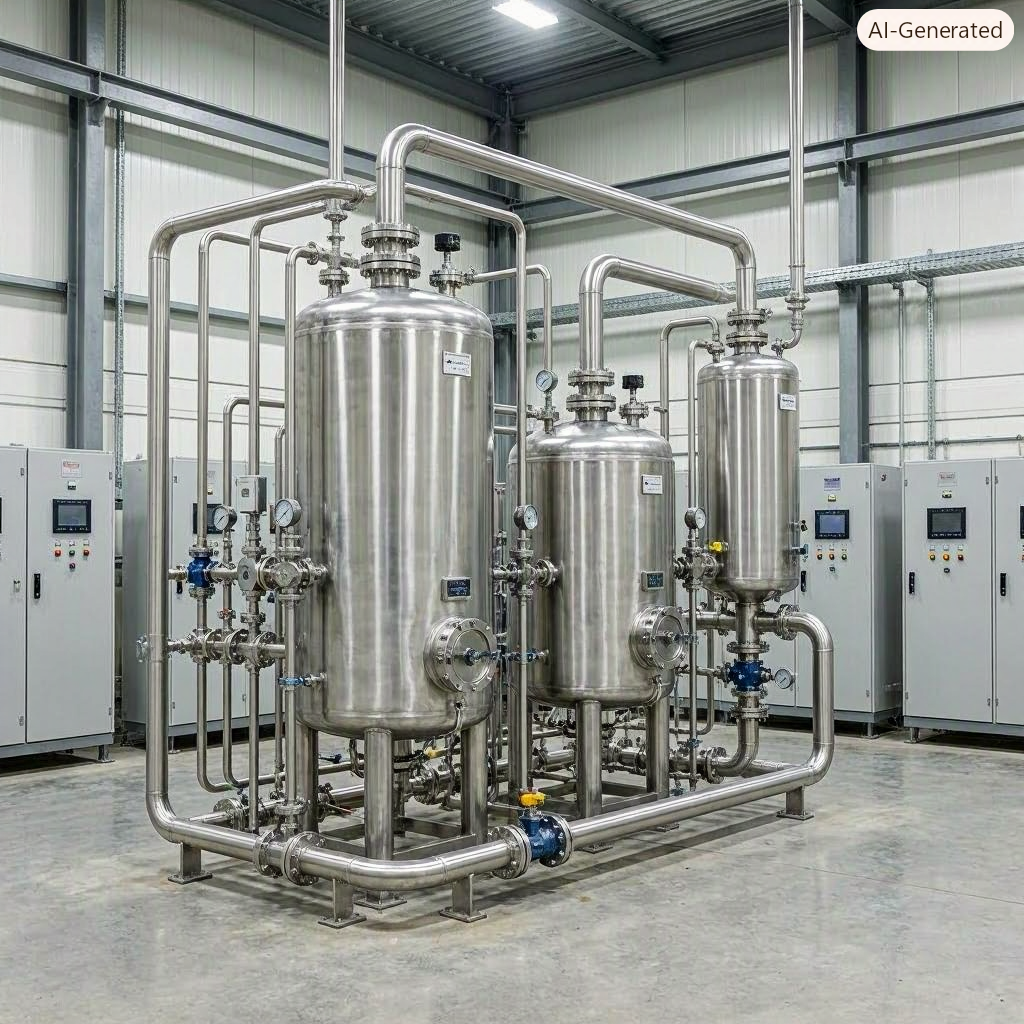
CO2 extraction pharmaceutical particle engineering equipment
The Post-Solubility Stack: How They Compare
| Company | Role in Stack | Structural Position | Key Dependency | What to Watch |
|---|---|---|---|---|
| Nanoform Finland | Supercritical CO₂ nanoparticle formulation | Patented CESS process, first commercial cGMP license (Nov 2025), no marketed drug yet | Nanoenzalutamide finding a viable non-generic regulatory pathway before cash runway tightens | Filing pathway update, biologics deal conversion to milestone cash, 2026 burn vs EUR 24M reserve |
| Hovione | Spray-dried ASD, incumbent bioavailability enhancement | Profitable private CDMO, established approved-drug track record, fresh $100M US capacity | Continued large-pharma demand for spray-dried ASD capacity | East Windsor GMP start Q2 2026, further capacity announcements |
| Thar Process | Supercritical / gas antisolvent equipment supplier | Private equipment maker, extraction-industry revenue base, SuperDry 9000 unproven in pharma | A named commercial pharma contract to validate the platform | Any disclosed GMP particle-engineering customer win |
The Honest Tension
The bifurcation implied by this comparison is real but uneven. Hovione's dominance is not new information, it’s the established baseline the other two companies are trying to disrupt or supply into, which means the contrast is less a horse race than a reminder of how far the challengers still have to go. Thar Process's pharma ambitions rest on a platform with no verified pharma customer two years after launch, and its own financial reporting is thin enough that basic figures like headcount cannot be confirmed. Nanoform's cGMP license is genuine progress, but a license to manufacture is not the same as a drug cleared to be sold, and its cash runway is the clock the rest of this story runs against.
Rabbt Intelligence Note
A structured Research File on Nanoform would map its EUR 24 million cash position against its stated sub‑EUR 10 million 2026 burn target and flag any dilutive capital raise before a nanoenzalutamide filing decision as the Change Trigger most likely to shift this picture. The Relationship Graph would show that Hovione and Thar Process, despite sitting in the same bioavailability‑enhancement category as Nanoform, depend on entirely different customer relationships, one on established pharma manufacturing contracts and the other on unproven pharma sales into an extraction‑industry‑first business, making them structurally distinct risks rather than a single competitive threat. The open question: does Nanoform’s biologics pivot represent a genuine second product line, or a signal that the original small‑molecule nanoparticle thesis needs more time than the company’s cash position allows?
Sources
Nanoform Finland Plc, "Nanoform Q1 2026 Report: Record first quarter revenue, income and gross margin, first exclusivity deal signed around our Biologics technology," Company Release, May 19, 2026.
Nanoform Finland Plc, "Nanoform Q3 Report: Momentum in kernels continues, commercial cGMP manufacturing license received, first near-term target for 2026 set," Company Release, November 12, 2025.
Nanoform Finland Plc, "Inside Information Made Public: Nanoform Granted European Commercial cGMP Manufacturing License," November 11, 2025.
FIMEA (Finnish Medicines Agency), commercial cGMP manufacturing license grant to Nanoform Finland Plc, as reported in Nanoform company release, November 11, 2025.
Zerion Pharma A/S, "Zerion Pharma and Hovione Form Strategic Partnership to Market and Commercialise the Proprietary Dispersome Technology Platform," press release quoting Ole Wiborg, CEO of Zerion Pharma, February 22, 2022.
Hovione, "Amorphous Solid Dispersions: Increasing Solubility From API to Tablets," corporate knowledge center article.
Thar Process, Inc., "New Sustainable Lyophilization Technology Uses Supercritical CO2," press release quoting Todd Palcic, CEO of Thar Process, January 28, 2024.
Astellas Pharma and third-party financial reporting on Xtandi (enzalutamide) global sales figures, marked [Unverified] where figures vary by source.
Nanoform Finland Plc, "Nanoform Commenced Relative Bioavailability Study of Nanotechnology-Enhanced Enzalutamide," press release, January 2024, and "Inside Information Made Public: Nanoform Announces Important Milestone with Promising Clinical Results for Patient-Centric Nanotechnology-Enhanced Enzalutamide," January 26, 2024.
Van Nijlen, T., et al., "Supercritical fluids for pharmaceutical particle engineering: Methods, basic fundamentals and modelling," ScienceDirect, 2012, cited as representative of the academic literature on gas antisolvent and supercritical antisolvent pharmaceutical particle production.
