
Its flagship battery project went to a separate company instead.
Google paid $4.75 billion for Intersect Power's data-center-focused business. The company's biggest grid-scale battery project did not go with it.
By Rabbt | November 9, 2026
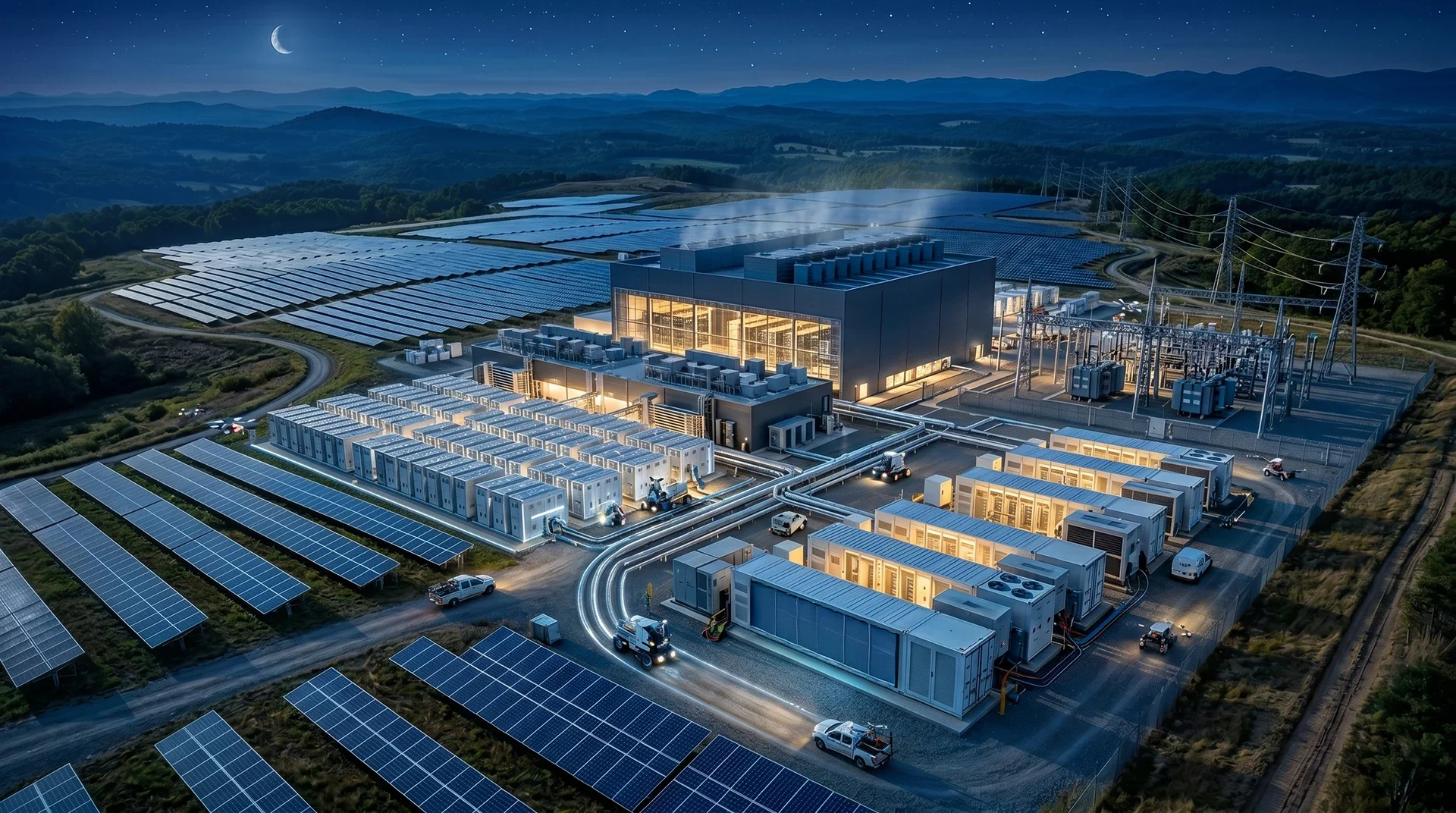
New Solar, Storage and Power System
When Google agreed in December 2025 to pay $4.75 billion for Intersect Power [1], much of the coverage framed the deal as Google building its own way past America's grid bottleneck. By the end of 2025, more than 2,060 gigawatts of generation and storage capacity, more than the entire existing U.S. grid, were sitting in interconnection queues nationwide waiting for permission to connect [2]. The obvious story was that Google would simply own its way past that wait. The deal itself says something narrower. Google took full ownership of the part of Intersect built to power its data centers directly. The grid-tied portfolio, including the company's largest battery project, was spun into a separate company in which Google retained only a minority stake.
Why Grid-Scale Storage and Why Now
A battery project cannot simply plug into the grid once it is built. It first has to wait in line. New power plants and battery systems seeking to connect to the public grid must complete an interconnection study before they are allowed to connect: a review by the local grid operator confirming that the surrounding wires and substations can handle the project safely. In California, that grid operator is the California Independent System Operator, or CAISO. It manages the flow of electricity across the state's high-voltage transmission lines.
That wait helps explain why Google and other large technology companies have moved toward a different model. Instead of connecting to the public grid, they can build solar and battery storage directly alongside a data center, behind the meter, so the power does not have to enter the same interconnection queue. Intersect Power built much of its original business on that approach, developing projects specifically co-located with data centers [3]. The same company also built conventional, grid-scale projects meant to sell power into the open market, the kind still subject to the queue.
Private. Google agreed to acquire Intersect's data-center-focused business for $4.75 billion, a deal announced December 22, 2025 and completed in March 2026. The same transaction spun Intersect's grid-tied assets into a new, independent company, IPX Power, with TPG Rise Climate holding majority backing and Google retaining a minority stake [1].
Intersect Power spent years building two different kinds of projects under one roof. One kind sat behind the meter: solar and battery systems built to power a single customer's data center directly, without ever touching the public grid. The other was conventional: grid-scale solar and battery projects meant to sell electricity into the open market, subject to the same interconnection queue as everyone else. Google's acquisition split the company along exactly that line.
When the deal closed, Google took full ownership of the first category, the co-located, behind-the-meter projects, folded into its own infrastructure under the Intersect brand and still led by founder and CEO Sheldon Kimber [4]. The grid-tied portfolio was spun off into a new, independent company called IPX Power. Google is one of several existing Intersect investors that hold a stake in IPX Power, alongside Climate Adaptive Infrastructure and Greenbelt Capital Partners. TPG Rise Climate, the private investment firm that had backed Intersect for years, holds majority control [1]. Coverage of the split was explicit that Intersect's operating and in-development projects in Texas and California, including its largest battery project, were excluded from the assets Google consolidated onto its own books [4].
That largest project is the Darden Clean Energy Project: a 1,150-megawatt solar farm paired with 4,600 megawatt-hours of battery storage on former farmland in Fresno County, California, enough storage to power roughly 850,000 homes for four hours [3]. Darden sells into the open CAISO grid through a Pacific Gas & Electric transmission line rather than feeding a single customer's data center, a grid-tied structure that helps explain why it stayed with IPX Power rather than Google. Filed through its project subsidiary, IP Darden I, LLC, the project moved through California's accelerated environmental review process under Queue Cluster 14 [6]. As of a March 2025 filing, Intersect's application targeted 2027 to 2028 for Darden's commercial operation. CAISO's interconnection queue at the time showed 2031, a gap of roughly four years between the company's target and the grid operator's estimate [5]. That queue estimate was not reconfirmed in the sources reviewed for this issue. What has changed is the financing: in May 2026, IPX Power secured $4.95 billion specifically to build Darden, separate from Google's balance sheet, with a revised target of 2028 [7].
Darden's other defining dependency is a single supplier. The project runs entirely on Tesla's Megapack batteries, part of a broader deal in which Intersect contracted for 15.3 gigawatt-hours of Megapack capacity through 2030 before the IPX split [5]. A delay in Tesla's production schedule could therefore become a delay for Darden as well.
What to watch: whether Darden's publicly documented interconnection timeline moves closer to IPX Power's 2028 target after the $4.95 billion financing, and whether other large technology companies structure future deals the way Google did here, taking control of the behind-the-meter assets while retaining only a minority stake in the grid-tied portfolio.
Public (NYSE: STEM). Closed at $2.58 on October 29, 2026, down from a 52-week high of $24.84, after the company completed a 1-for-20 reverse stock split earlier in the year [8].
Stem took the opposite bet from Intersect. Rather than own sites, Stem sells software intended to extract more value from batteries and solar systems that other companies own. Its platform, PowerTrack, monitors, controls, and trades power on behalf of customers who own the physical equipment. Stem's edge devices are designed to work across hardware brands, so the company does not need to own the generation or storage assets itself [9].
That model is showing up in the numbers, but not yet through total revenue growth. Stem's revenue fell 11 percent year over year in the first quarter of 2026, to $29.0 million, as the company deliberately reduced lower-margin battery hardware resale [10]. PowerTrack software revenue, by contrast, grew 16 percent year over year, while non-GAAP gross margin reached a record 52 percent, up from 46 percent a year earlier. Adjusted EBITDA was positive for a fourth consecutive quarter [10]. Commercial deployments are beginning to test whether the model works with larger counterparties. Stem's PowerBidder Pro trading software was deployed with Mercuria Energy Trading in the Texas power market, putting it in direct competition with Tesla's Autobidder. It is also the kind of software layer that larger rivals such as Fluence are building [11].
Shares have fallen more than 89 percent from their 52-week high. That decline sits alongside improving software revenue and non-GAAP margins, a sharp contrast between recent operating progress and market performance.
What to watch: whether PowerTrack's software revenue growth can offset the shrinking hardware resale business enough to return total revenue to growth, not just improve margin, and whether additional utility-scale counterparties adopt Stem's software as Mercuria did.
Fluence Energy
Public (NASDAQ: FLNC). Closed at $5.21 on November 2, 2026, down from a 52-week high of $33.51 [12].
Fluence sits between the other two models, selling physical storage systems and a software layer on top of them. That exposes it to hardware execution and manufacturing costs while also requiring its software business to compete with asset-light providers. The company is the largest pure-play battery storage integrator in the world, delivering and operating storage systems across nearly 50 markets [13].
Its most recent quarter shows the cost of that exposure. Gross profit margin fell to approximately 5.1 percent for the quarter ended June 30, 2026, from 14.8 percent a year earlier [14]. The company attributed the decline to delays in revenue recognition, startup costs at new manufacturing facilities, and an upfront charge tied to a long-term battery cell supply deal. It also cut full-year fiscal guidance from a range of $3.2 billion to $3.6 billion to a range of $2.9 billion to $3.1 billion after roughly $400 million in deliveries slipped into fiscal 2027 because of production issues at new manufacturing facilities in the U.S. and abroad [14]. (Q4 FY2026 results are due November 23, 2026)
The same quarter still showed strong demand signals. Order intake was more than $1.44 billion, nearly triple the year-earlier figure. Backlog reached a company record of approximately $6.4 billion, including Fluence's first large behind-the-meter order and roughly $550 million in awards from a large technology customer in July 2026 alone [14]. Fluence is pursuing the same data-center demand driving Intersect and the same software opportunity that Stem is targeting. It is aiming for approximately $180 million in software annual recurring revenue by the end of fiscal 2026 [13], a small fraction of a business expected to post billions of dollars in hardware revenue that year.
What to watch: whether Fluence's new manufacturing facilities resolve the production delays behind this quarter's margin decline without turning the record backlog into a larger execution risk, and whether its software business grows enough, relative to hardware, to materially change the company's margin profile.
| Company | Role in Stack | Structural Position | Key Dependency | What to Watch |
|---|---|---|---|---|
| Intersect Power | Co-located power developer (Google-owned) / grid-tied developer (IPX Power, TPG-majority) | Split in two by Google's 2026 acquisition; the behind-the-meter half consolidated onto Google's books, the grid-tied half, including the Darden project, became IPX Power, with Google as a minority investor | Tesla's Megapack production schedule for Darden's 15.3 GWh of contracted battery capacity | Whether Darden's documented interconnection timeline moves closer to IPX Power's 2028 target |
| Stem, Inc. | Asset-light software layer for storage and solar owned by others | Public micro-cap; shrinking hardware resale revenue offset by growing, higher-margin PowerTrack software revenue | Third-party hardware manufacturers and large counterparties like Mercuria Energy Trading adopting its trading software | Whether software growth can turn total revenue growth positive again, not just margin |
| Fluence Energy | Hardware-and-software integrator | Largest pure-play storage integrator; record backlog and order intake alongside sharply lower gross margin | Its own new contract manufacturing facilities delivering on schedule | Whether new manufacturing capacity resolves delays without turning record backlog into a larger execution risk |
The Honest Tension
The CAISO queue estimate anchoring this piece, which placed Darden's commercial operation in 2031, dates to March 2025 and has not been publicly reconfirmed. IPX Power's 2028 target may reflect a faster timeline than the old queue estimate supported, or the queue may have moved without a public update. Either way, the structural read does not depend on which date is current: Google did not take majority ownership or operating control of the grid-tied half of Intersect's business, retaining only a minority stake alongside TPG, Climate Adaptive Infrastructure, and Greenbelt. The tension cuts the other way for Stem. Its non-GAAP margin improvement is real, but total revenue is still shrinking. An asset-light software provider has limited leverage if the hardware owners it depends on build competing software themselves, as Fluence and Tesla are already doing.
This is editorial content. Rabbt is not a registered investment advisor and does not provide investment recommendations.
This issue reflects structural analysis and figures verified as of its publish date. The frontier economy moves quickly: funding rounds close, valuations shift, contracts get renegotiated, and timelines change. Details in this issue may no longer be current by the time you are reading it. Treat this as a structural snapshot, not a live feed, and verify anything time-sensitive independently before acting on it.
Sources
[1] TPG. "TPG Announces Completion of $4.75 Billion Sale of Intersect to Google; Launches IPX Power as Independent Power Producer." Press release, March 2026. https://www.tpg.com/news-and-insights/tpg-announces-completion-of-4-75-billion-sale-of-intersect-to-google-launches-ipx-power-as-independent-power-producer
[2] Rand, Joseph, et al. "Queued Up: 2026 Edition, Characteristics of Power Plants Seeking Transmission Interconnection As of the End of 2025." Lawrence Berkeley National Laboratory, June 2026. https://eta-publications.lbl.gov/sites/default/files/2026-06/queued_up_2026_edition.pdf
[3] "Google's $4.75B Intersect Power Acquisition Marks New Era of Hyperscaler Energy Ownership." Introl, January 20, 2026. https://introl.com/blog/google-intersect-power-acquisition-energy-vertical-integration-january-2026
[4] "Google closes $4.75bn Intersect acquisition as TPG, partners spin off clean energy assets into IPX Power." Alternatives Watch, March 12, 2026. https://www.alternativeswatch.com/2026/03/12/google-intersect-tpg-greenbelt-cai-ipx-power/
[5] "Intersect Power's 4.6GWh co-located BESS in California first to reach CEC milestone as hydrogen portion dropped." Energy-Storage.news, March 5, 2025. https://www.energy-storage.news/intersect-powers-4-6gwh-co-located-bess-in-california-first-to-reach-cec-milestone-as-hydrogen-portion-dropped
[6] California Energy Commission. "Application for Confidential Designation: Darden Clean Energy Project." Docket No. 23-OPT-02, May 24, 2024. https://efiling.energy.ca.gov/GetDocument.aspx?tn=256531&DocumentContentId=92355
[7] "Intersect Spinoff IPX Power Secures $4.95 Billion to Build Massive California Solar & Storage Project." ESG Today, May 26, 2026. https://www.esgtoday.com/intersect-spinoff-ipx-power-secures-4-95-billion-to-build-massive-california-solar-storage-project/
[8] Upstox. "Stem, Inc. Share Price." Price as of October 29, 2026. https://upstox.com/us-stocks/stem-share-price/
[9] Stem, Inc. Form 10-Q. U.S. Securities and Exchange Commission. https://www.sec.gov/Archives/edgar/data/0001758766/000175876626000081/stem-20260630.htm
[10] Stem, Inc. "Stem Announces First Quarter 2026 Results." Press release, May 6, 2026. https://www.sec.gov/Archives/edgar/data/0001758766/000175876626000043/exhibit99-8xkx20260506xq12.htm
[11] "Stem, Inc. (STEM) Stock Price & How to Invest." Walnut, last updated July 2026. https://walnutinvest.com/stocks/stem
[12] MarketChameleon. "Fluence Energy, Inc. (FLNC) Stock Summary." Price as of November 2, 2026. https://marketchameleon.com/Overview/FLNC/Summary/
[13] Fluence Energy, Inc. "Fluence Energy, Inc. Reports 2025 Financial Results and Initiates 2026 Guidance." Press release, November 24, 2025. https://ir.fluenceenergy.com/static-files/5f0006b6-7714-4c46-9228-94744e02d89c
[14] Fluence Energy, Inc. "Fluence Energy, Inc. Reports Third Fiscal Quarter 2026 Results." Press release, August 5, 2026. https://www.sec.gov/Archives/edgar/data/0001868941/000186894126000028/flncq3fy26earningspressrel.htm